
IBS
Reading File
The query "IBS" is broad. Let me clarify what would be most useful before diving deep.
Asking for Preferences
What aspect of IBS are you interested in?
Quick answer: IBS is diagnosed clinically using the Rome IV criteria - recurrent abdominal pain at least 1 day/week for the last 3 months, associated with ≥2 of: related to defecation, change in stool frequency, or change in stool form. Investigations are mainly aimed at ruling out organic disease (red flag symptoms trigger further workup). No single test confirms IBS.
Searching sources...
Finding Sources
Searching PubMed
"irritable bowel syndrome"[MeSH Terms] AND "diagnosis"[MeSH Terms]
Finding Sources
Reading File
Reading File
Good, I have the Goldman-Cecil content. Now let me read the diagnosis section specifically.
Reading File
I got a solid chunk. The output was truncated - let me read the next section which should contain the diagnosis criteria and investigations.
Reading File
Reading File
Excellent - I have the diagnostic criteria and investigations table. Let me also fetch the diagnostic algorithm flowchart image.
Loading Image
Reading File
I now have all the information needed for a thorough answer on IBS diagnosis. Let me compile the complete response.
IBS: Diagnosis & Investigations
Source: Goldman-Cecil Medicine, Chapter 123
Definition
IBS is a functional bowel disorder characterized by chronic or recurrent abdominal pain associated with alterations in stool form and/or frequency (diarrhea and/or constipation). It is attributable to the middle or lower GI tract, and functional bowel disorders form a spectrum that can transition from one subtype to another over time.
Rome IV Diagnostic Criteria
Criterion A (required): Recurrent abdominal pain, on average at least 1 day per week in the last 3 months, with symptom onset at least 6 months prior, associated with two or more of the following:
- Related to defecation
- Associated with a change in frequency of stool
- Associated with a change in form (appearance) of stool
Criterion B - supportive symptoms (not required but strengthen the diagnosis):
| Symptom |
|---|
| Abnormal stool frequency: ≤3 BM/week or >3 BM/day |
| Abnormal stool form: lumpy/hard or loose/watery |
| Defecation straining |
| Urgency |
| Feeling of incomplete bowel movement |
| Passing mucus |
| Bloating or abdominal distention |
IBS Subtypes (via Bristol Stool Form Scale)
- IBS-C - predominant constipation (~25%)
- IBS-D - predominant diarrhea (~35-40%)
- IBS-M - mixed bowel habits (~35-40%)
- IBS-U - unclassified (<5%)
Subtypes can transition in the same patient over time.
Alarm Features (require further investigation if present)
The following features shift the approach away from a positive IBS diagnosis toward targeted workup:
- New-onset symptoms at age ≥50 years
- Unintentional weight loss
- Hematochezia or melena (not related to hemorrhoids)
- Nocturnal diarrhea
- Anemia
- Palpable abdominal mass or lymphadenopathy
- Family history of colorectal cancer, IBD, or celiac disease
Diagnostic Algorithm
The approach is a positive diagnostic strategy - IBS should be diagnosed on its own merits rather than purely by exclusion:
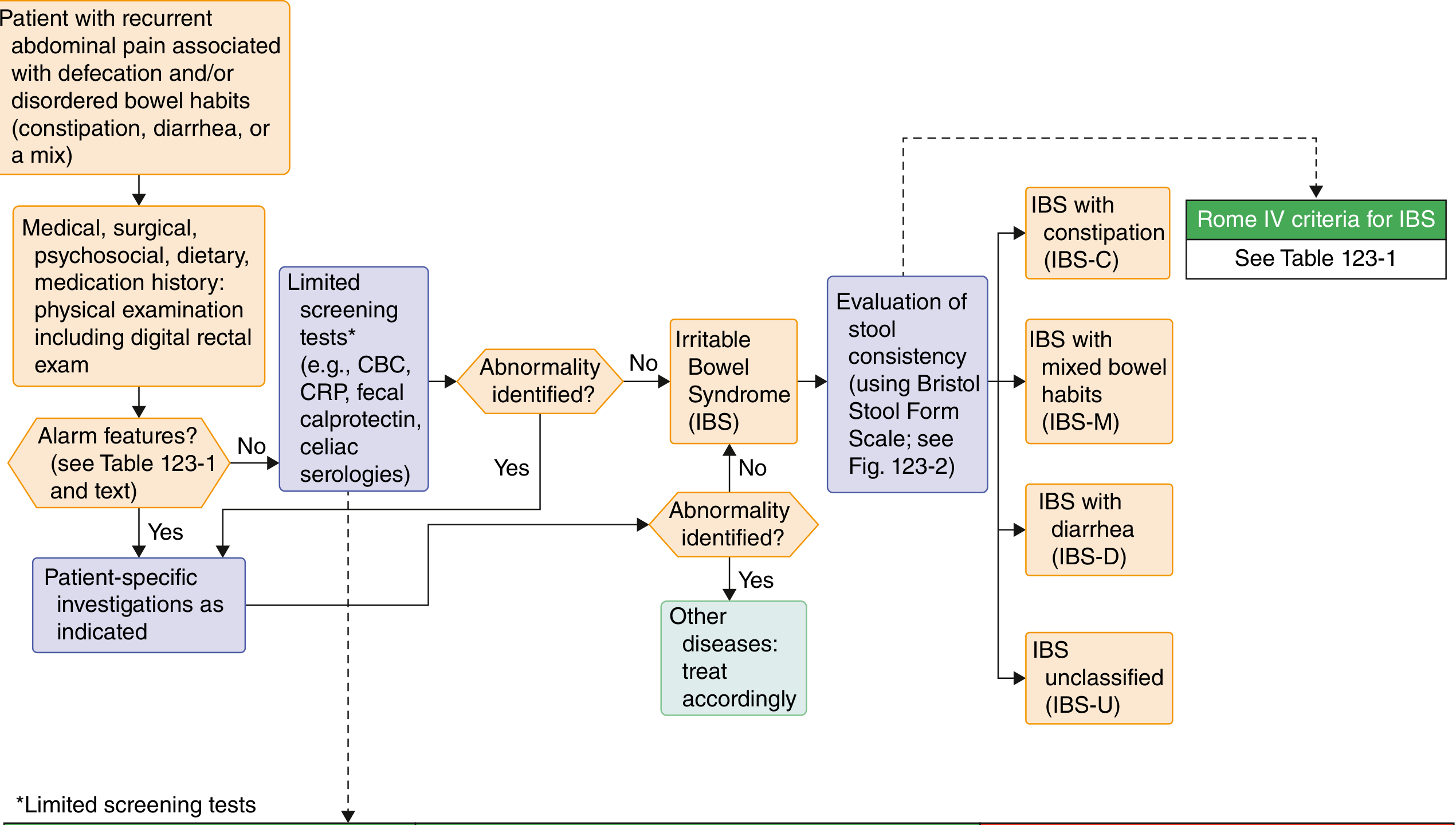
Flow: History + physical exam → check for alarm features → limited screening tests → if no abnormality found and Rome IV criteria met → diagnose IBS → classify subtype by Bristol Stool Form Scale.
Investigations
Generally Recommended
| Test | Population |
|---|---|
| Complete blood count (CBC) | All |
| C-reactive protein (CRP) | All (especially IBS-D) |
| Fecal calprotectin or lactoferrin | All (especially IBS-D) to exclude IBD |
| Celiac serologies (IgA anti-tTG + total IgA) | IBS-D |
| Bile acid diarrhea testing | IBS-D where BAD is suspected |
| Stool Giardia antigen or PCR | IBS-D in endemic areas |
| Stool culture/parasites | Relevant travel history |
| Colonoscopy | New-onset symptoms at age ≥50 years |
| Anorectal physiology testing | Suspected pelvic floor dysfunction or refractory constipation |
Note: In IgA-deficient patients, use serum IgG anti-tTG and/or IgG deaminated gliadin peptide to screen for celiac disease.
NOT Routinely Recommended
| Test | Reason |
|---|---|
| Colonoscopy in age <50 without alarm features | Low yield |
| Routine stool cultures without travel history | Low yield |
| Food allergy or intolerance testing | Not validated |
| Lactose or glucose hydrogen breath testing | Not recommended routinely |
If colonoscopy is performed in diarrheal-predominant IBS, random colon biopsies should be taken to examine for microscopic or collagenous colitis.
Key Diagnostic Principle
IBS is not diagnosed by exclusion alone. A positive diagnostic approach - applying Rome IV criteria combined with targeted limited tests to rule out structural/organic disease - is preferred by current guidelines. Over-investigation with colonoscopy, food allergy panels, and breath tests is neither necessary nor recommended in the absence of alarm features.
- Goldman-Cecil Medicine, Chapter 123 (Lin Chang)
Treatment
IBS treatment is stepwise: dietary changes (low-FODMAP diet), symptom-targeted medications (antispasmodics, laxatives, antidiarrheals), and psychosocial therapies for refractory cases. Specific drugs depend on the subtype (IBS-C vs IBS-D).
Searching sources...
Reading File
Searching PubMed
"irritable bowel syndrome"[MeSH Terms] AND "therapeutics"[MeSH Terms]
Good. The textbook content was truncated - it contains the medications table. Let me get the rest.
Reading File
Reading File
I went past the IBS treatment section. Let me go back and read the section I missed (psychological therapies, neuromodulators, probiotics, etc.).
Reading File
I need to capture the medications table and the IBS-C pharmacotherapy section that was truncated earlier. Let me read that section.
Reading File
I have enough comprehensive content now. Let me also fetch the IBS-C treatment algorithm image for completeness.
Loading Image
Loading Image
I now have all the content needed for a comprehensive treatment answer. Here it is:
IBS: Treatment
Source: Goldman-Cecil Medicine, Chapter 123 (Lin Chang)
Overall Approach
Treatment is stratified by symptom severity:
- Mild - education, reassurance, dietary advice, OTC medications
- Moderate - add pharmacotherapy targeted to predominant symptoms
- Severe / refractory - integrated approach combining pharmacotherapy + behavioral/psychological treatment
Treatment choices are guided by the most bothersome symptom, subtype (IBS-C vs IBS-D), comorbidities, and patient preference.
1. Dietary Therapy (First-Line for All Subtypes)
| Intervention | Evidence/Notes |
|---|---|
| Low-FODMAP diet | First-line; improves global IBS symptoms, especially in IBS-D. Reduces abdominal pain, bloating, and abnormal bowel habits. Best supervised by a trained dietitian. |
| Soluble fiber (psyllium) | 25-35 g/day; most useful in IBS-C. Start low, increase gradually. Soluble (psyllium) recommended; insoluble (wheat bran) is NOT. |
| Gluten-free diet | Less clear benefit; may be tried if gluten consistently triggers symptoms. |
| Food/symptom diary | 1-2 weeks to identify personal trigger foods. |
2. Medications - Active for All Subtypes
Antispasmodics & Peppermint Oil (Pain/Spasm)
| Drug | Dose | Key Side Effects |
|---|---|---|
| Peppermint oil | 1-2 capsules TID or PRN | Heartburn, nausea |
| Hyoscyamine | 0.125 mg TID-QID or PRN | Dry mouth, blurred vision, dizziness, constipation |
| Dicyclomine | 10 mg TID-QID or PRN | Dry mouth, blurred vision, dizziness |
Central Brain-Gut Neuromodulators (Pain)
Used at low doses for their visceral analgesic effects - not necessarily for treating anxiety or depression:
| Drug | Dose | Notes |
|---|---|---|
| Amitriptyline (TCA) | 10-25 mg QHS → up to 100 mg | Sedation, dry mouth; useful in IBS-D (slows transit) |
| Desipramine (TCA) | 10-25 mg QHS → up to 100 mg | Less anticholinergic |
| Nortriptyline (TCA) | 10-25 mg QHS → up to 100 mg | |
| Citalopram (SSRI) | 5-20 mg daily | SSRIs useful in IBS-C (may accelerate transit) |
| Fluoxetine (SSRI) | 20-40 mg daily | Sexual dysfunction, headache, nausea |
| Duloxetine / Venlafaxine (SNRI) | Standard doses | Useful for pain with comorbid anxiety/depression |
Probiotics
Combination probiotic products reduce global IBS symptoms by ~20%. Data from RCTs are mixed. Most useful for patients with persistent bloating. (Recent 2024 network meta-analysis, PMID 38999862 in Nutrients confirms benefit but notes heterogeneity across strains.)
3. IBS-C Specific Pharmacotherapy
Treatment algorithm:
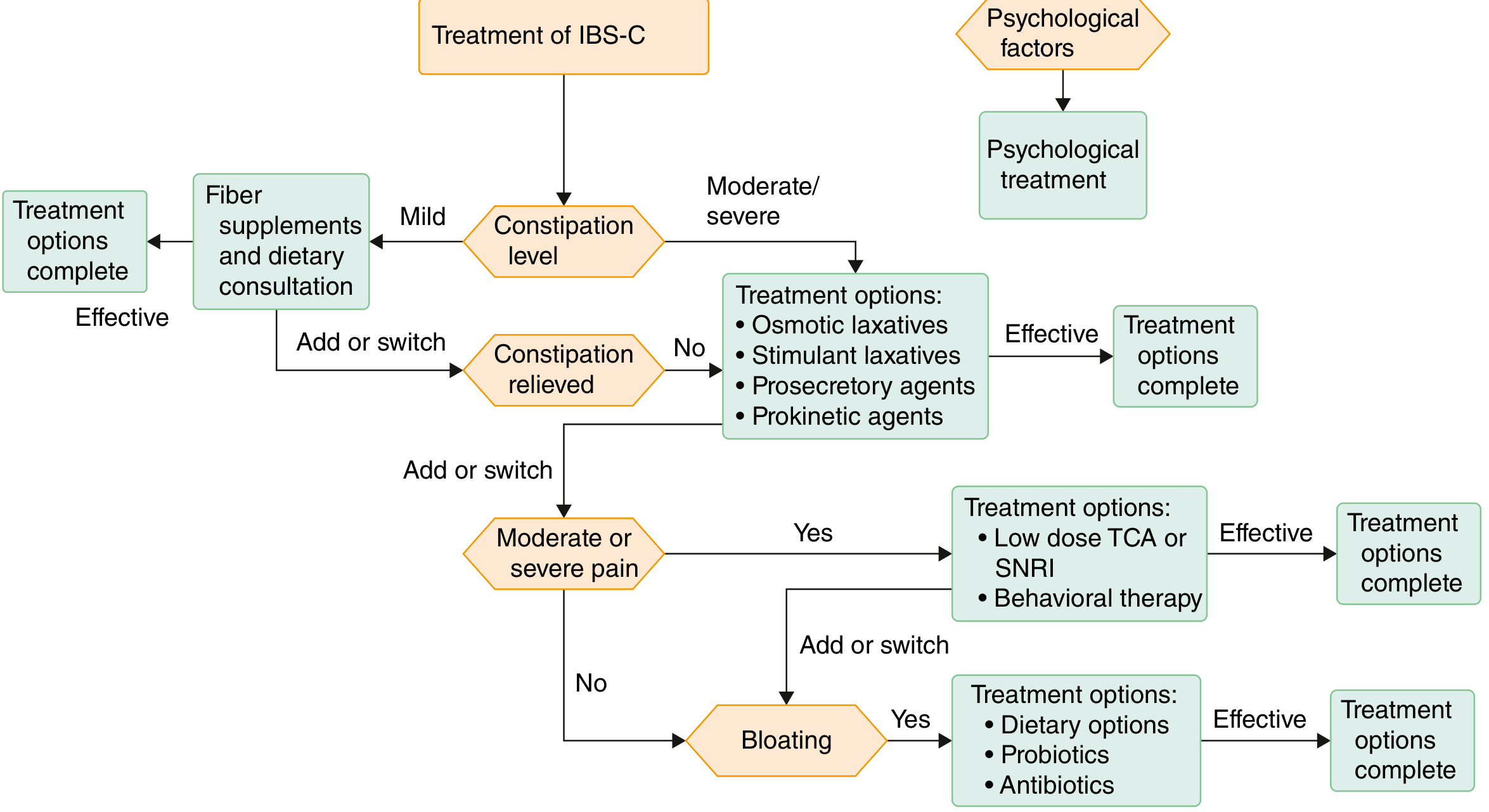
| Drug | Dose | Mechanism | Notes |
|---|---|---|---|
| Osmotic laxatives (PEG, lactulose) | Standard doses | Draws water into lumen | First-line for constipation relief |
| Linaclotide | 290 µg daily | Guanylate cyclase-C agonist → ↑Cl⁻/HCO₃⁻ secretion; also reduces visceral nerve firing → ↓pain | Diarrhea most common SE |
| Plecanatide | 3 mg daily | Same class as linaclotide (GC-C agonist) | Similar efficacy, similar SE profile |
| Tenapanor | 50 mg BID | NHE3 inhibitor → ↓Na⁺/water reabsorption | Diarrhea as common SE |
| Lubiprostone | 8 µg BID | ClC-2 channel activator → ↑intestinal secretion | Nausea common SE |
4. IBS-D Specific Pharmacotherapy
Treatment algorithm:
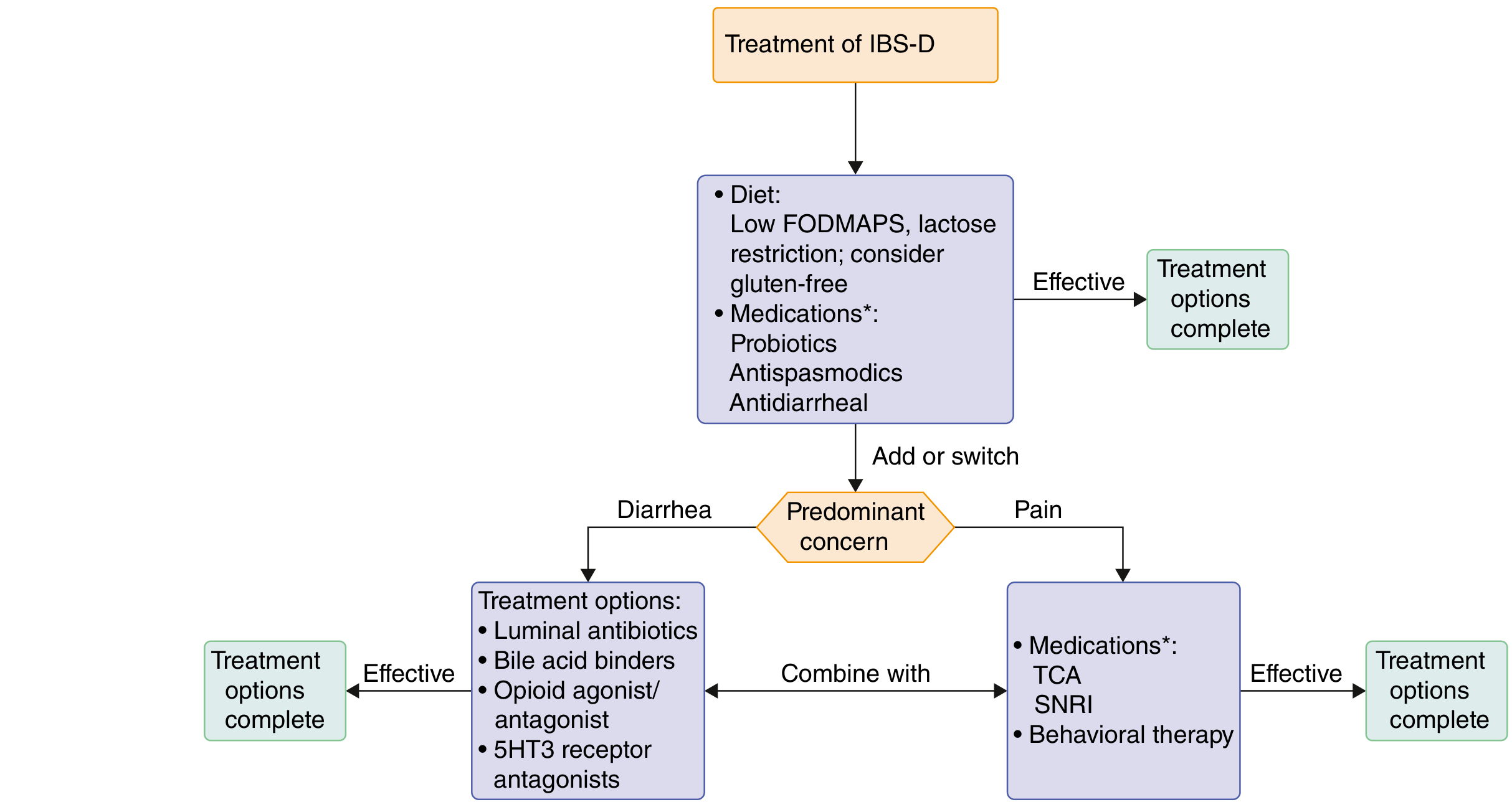
| Drug | Dose | Notes |
|---|---|---|
| Loperamide | PRN | Peripheral opioid agonist; reduces stool frequency but does NOT improve global IBS symptoms or pain. Best for mild-pain IBS-D. |
| Eluxadoline | 100 mg BID (or 75 mg BID if not tolerated) | µ- and κ-opioid agonist + δ-opioid antagonist; reduces diarrhea AND abdominal pain. CI: no gallbladder, hepatic impairment, biliary obstruction, SOD, alcohol use disorder. |
| Rifaximin | 550 mg TID × 14 days | Minimally absorbed antibiotic; approved for IBS-D. Up to 3 retreatment courses effective. |
| Alosetron | Restricted use (REMS program) | 5-HT₃ receptor antagonist; for women with severe IBS-D failing conventional treatment. Risk of ischemic colitis (1.1/1000 patient-years). |
| Bile acid sequestrants (cholestyramine, colestipol) | Standard doses | If bile acid diarrhea confirmed or suspected (affects ~25% of IBS-D). |
5. Psychological / Behavioral Therapies
~30% reduction in IBS symptoms vs. usual care. Recommended for patients who:
- Understand the role of brain-gut behavioral therapy
- Have persistent symptoms despite standard care
- Experience significant avoidance behaviors or distress
| Therapy | Key Focus |
|---|---|
| Cognitive-behavioral therapy (CBT) | Reduces maladaptive thoughts influencing GI symptoms; standard or minimal-contact formats available |
| Gut-directed hypnotherapy | Relaxation + reinterpretation of visceral signals |
| Mindfulness meditation | Stress reduction, symptom acceptance |
| Psychotherapy / relaxation training | Reduces stress-sensitive symptoms |
| Emotional awareness and expression therapy | Addresses suppressed emotional responses that exacerbate gut symptoms |
A 2024 systematic review (PMID 38777133, Gastroenterology) and a 2025 Lancet GH network meta-analysis (PMID 41077057) both confirm brain-gut behavioral therapies reduce abdominal pain and global IBS symptoms significantly.
Summary by Subtype
| Subtype | First-Line | Add if Insufficient |
|---|---|---|
| IBS-C | Low-FODMAP + soluble fiber + osmotic laxatives | Linaclotide / plecanatide / tenapanor; TCA/SNRI for pain |
| IBS-D | Low-FODMAP diet + loperamide or antispasmodic | Rifaximin; eluxadoline; alosetron (refractory women) |
| All | Education + dietary modification | Antispasmodics; probiotics (especially for bloating); psychological therapies for moderate-severe |
Prognosis
30-45% of patients have persistent symptoms for up to 12 years. Worse prognosis is associated with: anxiety, negative perception of stressors, female sex, younger age, and comorbid depression.
- Goldman-Cecil Medicine, Chapter 123 (Lin Chang)
This is a shared conversation. Sign in to Orris to start your own chat.