
Tuberculosis pleural effusion full details for md exam answer 15 marks structured answer
python3 -c " import pdfplumber # Read Sharma Mohan PDF - search for TB pleural effusion path = '/home/daytona/workspace/attachments/01d1338f-01ed-46b7-baf5-7fa344d16def/Sharma mohan latest_compressed-compressed (1).pdf' with pdfplumber.open(path) as pdf: print(f'Total pages: {len(pdf.pages)}') # Search for TB pleural effusion content for i, page in enumerate(pdf.pages): text = page.extract_text() if text and ('tubercul' in text.lower() or 'pleural effusion' in text.lower()): print(f'--- Page {i+1} ---') print(text[:2000]) print() " 2>&1 | head -300
python3 -c " import pdfplumber # Read Light's pleural disease PDF path = '/home/daytona/workspace/attachments/01d1338f-01ed-46b7-baf5-7fa344d16def/lights pleural dz_compressed.pdf' with pdfplumber.open(path) as pdf: print(f'Total pages: {len(pdf.pages)}') for i, page in enumerate(pdf.pages): text = page.extract_text() if text and 'tubercul' in text.lower(): print(f'--- Page {i+1} ---') print(text[:2500]) print() " 2>&1 | head -400
python3 -c " import pdfplumber # Try Sharma Mohan PDF with different approach path = '/home/daytona/workspace/attachments/01d1338f-01ed-46b7-baf5-7fa344d16def/Sharma mohan latest_compressed-compressed (1).pdf' with pdfplumber.open(path) as pdf: print(f'Total pages: {len(pdf.pages)}') # Get first few pages to see content structure for i in range(min(5, len(pdf.pages))): text = page = pdf.pages[i].extract_text() if text: print(f'--- Page {i+1} ---') print(text[:500]) print() " 2>&1
python3 -c " import pdfplumber path = '/home/daytona/workspace/attachments/01d1338f-01ed-46b7-baf5-7fa344d16def/Sharma mohan latest_compressed-compressed (1).pdf' with pdfplumber.open(path) as pdf: # Find TB pleural effusion chapter for i, page in enumerate(pdf.pages): text = page.extract_text() if text and ('pleural' in text.lower()) and ('tubercul' in text.lower()): # Check for chapter headings if any(kw in text.lower() for kw in ['chapter', 'pleuritis', 'pleural tuberculosis', 'pleural effusion']): print(f'--- Page {i+1} ---') print(text[:3000]) print() " 2>&1 | head -500
python3 -c " import pdfplumber path = '/home/daytona/workspace/attachments/01d1338f-01ed-46b7-baf5-7fa344d16def/Sharma mohan latest_compressed-compressed (1).pdf' with pdfplumber.open(path) as pdf: # Search more broadly for pleural content found_pages = [] for i, page in enumerate(pdf.pages): text = page.extract_text() if text and 'pleural' in text.lower(): found_pages.append(i+1) print('Pages with pleural content:', found_pages[:30]) # Print first matching page in full if found_pages: pg = pdf.pages[found_pages[0]-1].extract_text() print(f'--- Page {found_pages[0]} content ---') print(pg[:3000]) " 2>&1
TUBERCULOSIS PLEURAL EFFUSION
MD Examination Answer — 15 Marks
1. INTRODUCTION & EPIDEMIOLOGY (1 mark)
2. PATHOGENESIS (2 marks)
- Sensitised T-lymphocytes react to mycobacterial proteins in the pleural space
- Rapid exudative effusion results from increased vascular permeability driven by cytokines
- Animal studies: intrapleural tuberculin injection in sensitized guinea pigs → immediate exudate; blocked by antilymphocyte serum
- Supported by the historically negative culture rates (~80%) in pleural fluid
- Improved culture techniques (liquid media + biopsy) now identify bacilli in >60% of cases
- Tuberculous pleuritis = paucibacillary infection with subsequent intense immunologic reaction
- Initial response: neutrophil-predominant acute inflammation → evolves into lymphocyte-driven chronic reaction with granuloma formation
- Lymphocyte activity inversely correlates with culture positivity — sufficient lymphocytes can sterilize the pleural space (explains spontaneous resolution)
| Feature | TB Pleuritis | TB Empyema |
|---|---|---|
| Mechanism | Paucibacillary + immune reaction | High mycobacterial load |
| Fluid | Serous/lymphocytic exudate | Purulent |
| Culture | Usually negative | Positive |
| Spontaneous resolution | Possible | Unlikely |
3. CLINICAL FEATURES (2 marks)
- Acute illness (~two-thirds of cases): mimics bacterial pneumonia — cough, pleuritic chest pain (~75%), fever, dyspnea
- Chronic illness (~one-third): low-grade fever, weakness, anorexia, weight loss, night sweats
- Almost always unilateral
- Usually small to moderate in size; occasionally large enough to occupy the entire hemithorax
- Up to 86% have coexisting parenchymal disease on imaging; the effusion is almost always ipsilateral to the parenchymal lesion
- Even without radiographic parenchymal involvement, a subpleural focus is usually present (induced sputum positive in ~55% of such patients)
- Dense parenchymal consolidation rupturing into pleural space → TB empyema (often with pneumothorax; high risk of bronchopleural fistula)
- Empyema necessitans: percutaneous decompression of TB empyema
- Fibrothorax: residual pleural fibrosis in ~50% of patients at 1 year
4. RADIOLOGICAL FEATURES (1 mark)
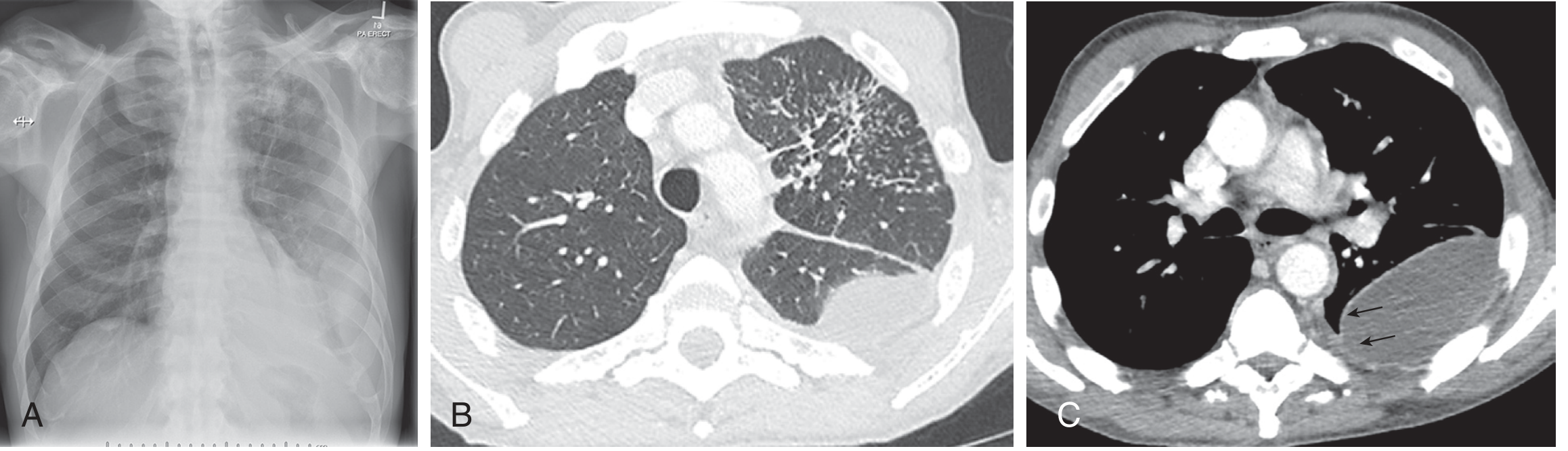
- CXR: unilateral homogeneous opacity obliterating costophrenic angle; associated upper-lobe or apical consolidation; mediastinal shift if large
- CT chest: more sensitive; encapsulated/loculated collections; smooth pleural enhancement ("split-pleura" sign); mediastinal lymphadenopathy; tree-in-bud nodules indicating parenchymal involvement
- Ultrasound: confirms free vs. loculated effusion; guides thoracentesis
5. PLEURAL FLUID ANALYSIS (3 marks)
- Pleural fluid protein / serum protein > 0.5
- Pleural fluid LDH / serum LDH > 0.6
- Pleural fluid LDH > two-thirds upper normal serum LDH
Biochemistry:
| Parameter | Finding |
|---|---|
| Protein | >3 g/dL; often >5 g/dL (suggests TB pleuritis) |
| LDH | Elevated |
| Glucose | Usually normal; may be reduced |
| pH | Usually normal; may be reduced in empyema |
Cytology / Cell Count:
- Lymphocyte-predominant exudate (small lymphocytes) — the hallmark
- In ~11% of cases: PMN predominance (early disease)
- In ~17% of cases: lymphocytes <50%
- Mesothelial cells: characteristically absent or very sparse
Diagnostic Markers (most important for MD exam):
| Marker | Cut-off | Sensitivity | Specificity | Notes |
|---|---|---|---|---|
| Adenosine Deaminase (ADA) | >40 IU/L (Harrison's) / >50 U/L (Cecil) | ~90% | ~90% | Most useful; especially when effusion is lymphocytic; enzyme released by T-lymphocytes |
| Interferon-γ (IFN-γ) | >140 pg/mL | ~90% | ~97% | Direct ELISA measurement required; IFN-γ release assays on pleural fluid are insufficiently sensitive |
| PCR for mycobacterial DNA | Positive | Variable | High | Useful especially with negative cultures |
| Pleural fluid culture (AFB) | Positive | ~30–40% | 100% | Low yield; liquid media improves yield; time-consuming |
| Smear (AFB) | Positive | <10–20% | 100% | Very low sensitivity |
Key point: Combining ADA + differential cell count + clinical context substantially improves diagnostic accuracy. ADA >50 IU/L in a lymphocytic exudate is strongly suggestive.
6. DIAGNOSIS (2 marks)
Step-by-Step Diagnostic Approach:
- Send fluid for: biochemistry (protein, LDH, glucose), cytology + differential, AFB smear & culture, ADA, IFN-γ, PCR
- Induced sputum for AFB smear and culture — positive in ~50% even without radiographic parenchymal disease
- MODS (Microscopic Observation Drug Susceptibility) assay: liquid culture with drug susceptibility; WHO-approved; faster, cheaper, provides resistance data
- Thoracoscopy (medical/VATS): ideal — highest yield, allows direct visualization and directed biopsy
- Image-guided percutaneous needle biopsy: has largely replaced closed biopsy in high-income settings
- Blind needle biopsy (Abrams needle): still important in high-TB-prevalence/resource-limited settings; combined with ADA + cell differential; ultrasound guidance improves yield
- Biopsy culture yield > pleural fluid culture yield
- Caseating granuloma on pleural biopsy, OR
- AFB culture positive (fluid/biopsy/sputum), OR
- ADA >40 IU/L + lymphocytic exudate + compatible clinical picture + exclusion of other causes
7. TREATMENT (2 marks)
Antituberculous Therapy (ATT)
| Phase | Duration | Drugs |
|---|---|---|
| Intensive phase | 2 months | Isoniazid (H) + Rifampicin (R) + Pyrazinamide (Z) + Ethambutol (E) → 2HRZE |
| Continuation phase | 4 months | Isoniazid + Rifampicin → 4HR |
| Total | 6 months |
- Fever resolves in ~2 weeks
- Effusion resolves within 6 weeks with treatment
- ~50% have mild residual pleural fibrosis at 1 year (usually no functional impairment)
Role of Corticosteroids
- May reduce time to resolution and degree of residual pleural fibrosis
- Evidence is of low quality; adverse events are more frequent
- Should only be initiated after commencing ATT
- Caution in HIV-infected patients (possible Kaposi sarcoma risk)
Fibrinolytic Agents (intrapleural)
- Proposed to improve drainage and reduce residual thickening
- Clinical significance of residual thickening is uncertain; routine use not established
Therapeutic Thoracentesis
- Large effusions causing significant dyspnea: drain to relieve symptoms
- Not routinely required for small-moderate effusions if patient is on ATT
Paradoxical Worsening
- Effusion may worsen after starting ATT or develop during treatment for parenchymal TB
- Represents immune reconstitution/paradoxical reaction
- Must first exclude wrong diagnosis; if TB confirmed, continue treatment
8. DIFFERENTIAL DIAGNOSIS OF LYMPHOCYTIC EXUDATE (1 mark)
| Condition | Distinguishing features |
|---|---|
| Malignant effusion | Positive cytology, low ADA, imaging |
| Lymphoma | Low ADA, LDH very high, CT mass |
| Parapneumonic effusion | PMN-predominant; ADA may be elevated |
| Rheumatoid pleurisy | Low glucose (<30 mg/dL), RF positive |
| Chylothorax | Triglycerides >110 mg/dL, milky |
| Fungal (Cryptococcus) | Immunocompromised, antigen titre |
9. COMPLICATIONS (1 mark)
| Complication | Notes |
|---|---|
| Fibrothorax/trapped lung | ~50% at 1 year; may rarely need decortication |
| TB empyema | Direct infection; purulent; culture positive; requires drainage ± surgery |
| Empyema necessitans | Rare; TB empyema decompresses percutaneously |
| Bronchopleural fistula | Complicates TB empyema especially after lung rupture |
| Paradoxical worsening | During ATT; immune reconstitution |
| MDR-TB | Consider if culture positive; MODS assay guides therapy |
SUMMARY TABLE (Quick Revision)
| Feature | TB Pleural Effusion |
|---|---|
| Type | Exudate (Light's criteria) |
| Side | Unilateral (almost always) |
| Cells | Lymphocyte-predominant (>50%) |
| ADA | >40 IU/L (highly sensitive + specific) |
| IFN-γ | >140 pg/mL |
| Glucose | Normal or reduced |
| Protein | Often >5 g/dL |
| Gold standard diagnosis | Pleural biopsy (caseating granuloma / AFB culture) |
| Treatment | 2HRZE + 4HR (same as pulmonary TB) |
| Steroids | Low-quality evidence; initiate after ATT |
| Resolution with treatment | Fever: 2 weeks; effusion: 6 weeks |
| Section | Marks |
|---|---|
| Introduction + Epidemiology | 1 |
| Pathogenesis (dual mechanism, spectrum concept) | 2 |
| Clinical Features | 2 |
| Radiology | 1 |
| Pleural Fluid Analysis + Diagnostic Markers | 3 |
| Diagnosis (stepwise approach, gold standard) | 2 |
| Treatment (ATT regimen, steroids, fibrinolytics) | 2 |
| DD of lymphocytic exudate | 1 |
| Complications | 1 |
| Total | 15 |
- Pathogenesis: paucibacillary + delayed hypersensitivity as a spectrum, not two separate disorders
- ADA >40 IU/L in a lymphocytic exudate = key diagnostic pointer
- IFN-γ >140 pg/mL — direct ELISA required (not IGRA)
- Pleural biopsy = gold standard; thoracoscopy = highest yield
- Treatment is identical to pulmonary TB: 2HRZE/4HR
- Paradoxical worsening during ATT is recognized and should not trigger treatment withdrawal
- Corticosteroids: low-quality evidence, always start ATT first
Where is the answer
TUBERCULOSIS PLEURAL EFFUSION
MD Examination Answer — 15 Marks
1. INTRODUCTION & EPIDEMIOLOGY (1 mark)
2. PATHOGENESIS (2 marks)
- Sensitised T-lymphocytes react to mycobacterial proteins → cytokine-driven vascular permeability → exudate
- Explains historically negative culture results (~80%)
- Improved liquid culture + biopsy identifies bacilli in >60% of cases
- Initial neutrophilic acute inflammation → evolves to lymphocyte-driven chronic reaction + granuloma formation
- Lymphocyte activity inversely correlates with culture positivity
- Sufficient lymphocytic activity can sterilise the pleural space → explains spontaneous resolution
| Feature | TB Pleuritis | TB Empyema |
|---|---|---|
| Mechanism | Paucibacillary + immune reaction | High mycobacterial load |
| Fluid | Serous, lymphocytic exudate | Purulent |
| Culture | Usually negative | Positive |
| Spontaneous resolution | Possible | Unlikely |
3. CLINICAL FEATURES (2 marks)
- Almost always unilateral
- Usually small to moderate in size (occasionally massive)
- Up to 86% have coexisting parenchymal disease — effusion always on the same side
- Even without radiographic parenchymal involvement, induced sputum is positive in ~55%
4. RADIOLOGY (1 mark)
- CXR: unilateral homogeneous opacity; obliterated costophrenic angle; associated apical/upper lobe consolidation
- CT chest: encapsulated/loculated collections; smooth pleural enhancement ("split-pleura" sign); mediastinal lymphadenopathy; tree-in-bud nodules
- Ultrasound: free vs. loculated; guides thoracentesis
5. PLEURAL FLUID ANALYSIS (3 marks)
- PF protein / serum protein > 0.5
- PF LDH / serum LDH > 0.6
- PF LDH > 2/3 upper limit of normal serum LDH
Biochemistry:
| Parameter | Finding |
|---|---|
| Protein | >3 g/dL; often >5 g/dL (characteristic of TB) |
| LDH | Elevated |
| Glucose | Normal or mildly reduced |
| pH | Normal (reduced in empyema) |
Cytology:
- Lymphocyte-predominant (hallmark) — small mature lymphocytes
- PMN predominance in ~11% (early disease)
- Mesothelial cells: characteristically absent or very sparse
Diagnostic Markers:
| Marker | Cut-off | Notes |
|---|---|---|
| ADA (Adenosine Deaminase) | >40 IU/L | Most clinically useful; released by T-lymphocytes; sensitivity ~90%, specificity ~90% |
| IFN-γ | >140 pg/mL | High accuracy; requires direct ELISA — NOT IGRA (insufficiently sensitive on PF) |
| PCR (mycobacterial DNA) | Positive | Variable sensitivity; high specificity |
| AFB culture (PF) | Positive | Low sensitivity (~30–40%); liquid media improves yield; gold standard if positive |
| AFB smear (PF) | Positive | Very low sensitivity (<20%) |
Key point: ADA + differential cell count + clinical context used in combination substantially improves diagnostic accuracy. ADA >50 IU/L in a lymphocytic exudate (Cecil's cut-off) is strongly suggestive.
6. DIAGNOSIS (2 marks)
Stepwise Approach:
- Thoracoscopy (medical / VATS): ideal — highest yield; direct visualization + directed biopsy
- Image-guided percutaneous needle biopsy: replaced closed biopsy in high-income settings
- Blind needle biopsy (Abrams needle): important in high-TB-prevalence/resource-limited settings; combine with ADA + differential; ultrasound guidance improves yield
- Biopsy culture yield > pleural fluid culture yield
- Caseating granuloma on pleural biopsy
- Positive AFB culture (fluid / biopsy / sputum)
- ADA >40 IU/L + lymphocytic exudate + compatible clinical picture + exclusion of alternative diagnoses
7. TREATMENT (2 marks)
Antituberculous Therapy (ATT)
| Phase | Duration | Drugs |
|---|---|---|
| Intensive phase | 2 months | HRZE — 2HRZE |
| Continuation phase | 4 months | HR — 4HR |
| Total | 6 months |
- Fever resolves: ~2 weeks
- Effusion resolves: ~6 weeks
- Residual pleural fibrosis: ~50% at 1 year (usually no functional impairment)
Corticosteroids
- May reduce time to resolution and residual fibrosis
- Evidence is low quality; more adverse events
- Always start ATT first, then add steroids if indicated
- Caution in HIV patients (possible Kaposi sarcoma risk)
Therapeutic Thoracentesis
- For large effusions causing significant dyspnea
- Not routinely required for small-moderate effusions on ATT
Intrapleural Fibrinolytics
- May improve drainage and reduce residual thickening
- Clinical benefit uncertain; not routine practice
Paradoxical Worsening
- Effusion worsens after starting ATT or new effusion develops during treatment for pulmonary TB
- First exclude wrong diagnosis; if TB confirmed → continue ATT (immune reconstitution reaction)
8. DIFFERENTIAL DIAGNOSIS OF LYMPHOCYTIC EXUDATE (1 mark)
| Condition | Key Distinguishing Feature |
|---|---|
| Malignant effusion | Positive cytology; low ADA; imaging mass |
| Lymphoma | Very high LDH; CT mediastinal mass |
| Rheumatoid pleurisy | Glucose <30 mg/dL; RF positive; low complement |
| Chylothorax | Triglycerides >110 mg/dL; milky fluid |
| Fungal (Cryptococcus) | Immunocompromised; antigen titre positive |
| Sarcoidosis | Bilateral; hilar lymphadenopathy; ACE elevated |
9. COMPLICATIONS (1 mark)
| Complication | Notes |
|---|---|
| Fibrothorax / Trapped lung | ~50% at 1 year; rarely requires decortication |
| TB Empyema | Purulent, culture positive; requires drainage ± surgery |
| Empyema necessitans | Rare; spontaneous percutaneous decompression |
| Bronchopleural fistula | Complicates TB empyema after lung rupture |
| Paradoxical worsening | During ATT; immune reconstitution |
| MDR-TB | Culture + drug susceptibility testing essential |
RAPID REVISION TABLE
| Feature | TB Pleural Effusion |
|---|---|
| Type | Exudate (Light's criteria) |
| Side | Unilateral (almost always) |
| Cells | Lymphocyte-predominant |
| ADA | >40 IU/L |
| IFN-γ | >140 pg/mL |
| Protein | Often >5 g/dL |
| Gold standard | Pleural biopsy (granuloma/AFB) |
| Treatment | 2HRZE + 4HR |
| Fever resolution | ~2 weeks |
| Effusion resolution | ~6 weeks |
| Residual fibrosis | ~50% at 1 year |