
Metabolism of branches chain aminoacids
Reading File
Branched-chain amino acids (BCAAs) - leucine, isoleucine, and valine - are metabolized primarily in muscle (unlike most amino acids which are handled by the liver). The key steps are transamination, followed by oxidative decarboxylation of the alpha-keto acids by the branched-chain alpha-keto acid dehydrogenase (BCKD) complex.
Searching sources...
Finding Sources
Searching the Web
branched chain amino acid metabolism biochemistry pathway BCAA
Reading File
Finding Sources
Found the key Lippincott Biochemistry section. Let me read it in full.
Reading File
Finding Sources
Reading File
Reading File
Loading Image
Now I have comprehensive information. Let me also fetch the main BCAA pathway diagram.
Loading Image
That was the THF diagram (unrelated). Let me get the actual BCAA pathway figure.
Finding Sources
Loading Image
I now have all the information needed for a thorough answer. Let me compile it.
Metabolism of Branched-Chain Amino Acids (BCAAs)
The BCAAs are leucine, isoleucine, and valine - all three are essential amino acids with a distinctive branched carbon side chain. They are unique among amino acids in that their catabolism occurs primarily in peripheral tissues (especially skeletal muscle), rather than in the liver.
Overview
| Amino Acid | Glucogenic / Ketogenic | End Products |
|---|---|---|
| Valine | Glucogenic only | Succinyl CoA |
| Isoleucine | Both glucogenic and ketogenic | Acetyl CoA + Succinyl CoA |
| Leucine | Ketogenic only | Acetoacetate + Acetyl CoA |
Shared Catabolic Steps (Common to All Three BCAAs)
Step 1: Transamination
The amino group of each BCAA is transferred to α-ketoglutarate, forming the corresponding branched-chain α-keto acid (BCKA) and glutamate. This reaction is catalyzed by a single enzyme, branched-chain amino acid aminotransferase (BCAT), which:
- Requires vitamin B6 (pyridoxal phosphate) as coenzyme
- Is expressed primarily in skeletal muscle (BCAT2 isoform)
- Has low activity in the liver (unlike most other transamination reactions)
The three α-keto acids produced are:
- Valine → α-ketoisovalerate
- Leucine → α-ketoisocaproate
- Isoleucine → α-keto-β-methylvalerate
Step 2: Oxidative Decarboxylation (Rate-limiting step)
The three BCKAs are all substrates for the branched-chain α-keto acid dehydrogenase (BCKD) complex, located in the mitochondria. This reaction:
- Removes the carboxyl group and attaches CoA
- Produces NADH and CO2
- Is irreversible
BCKD is structurally analogous to:
- Pyruvate dehydrogenase (PDH)
- α-Ketoglutarate dehydrogenase
All three complexes share the same dihydrolipoyl dehydrogenase (E3) component.
Coenzymes required by BCKD:
- Thiamine pyrophosphate (TPP) - vitamin B1
- Lipoic acid
- FAD
- NAD+
- Coenzyme A
Regulation of BCKD:
- Inactivated by phosphorylation via BCKD kinase (BCKDK) - this is the normal resting state
- Activated by dephosphorylation via phosphatase (PPM1K)
- The BCKAs themselves inhibit BCKDK (thus stimulating their own oxidation - a classic product-feedback mechanism)
- Insulin activates BCKD by inhibiting BCKDK
Step 3: Dehydrogenation
The CoA thioesters produced by BCKD are further oxidized to produce α-β-unsaturated acyl CoA derivatives and FADH2. These reactions are analogous to the FAD-linked dehydrogenation step in fatty acid β-oxidation.
Individual Catabolic Pathways
Valine (Glucogenic)
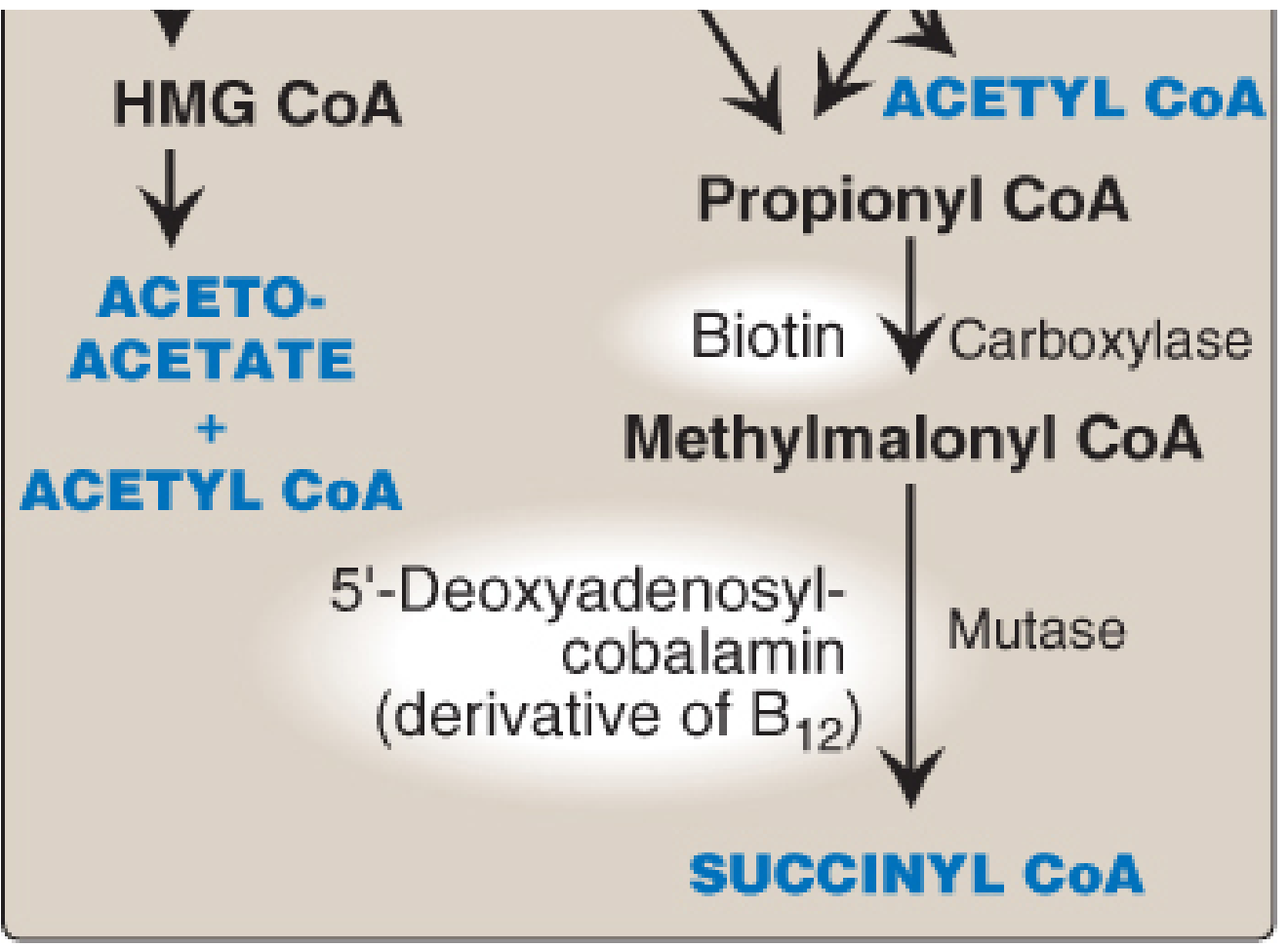
Valine → α-ketoisovalerate → isobutyryl CoA → methylmalonyl CoA → succinyl CoA (enters TCA cycle)
The propionyl CoA intermediate is converted to succinyl CoA via:
- Propionyl CoA carboxylase (requires biotin)
- Methylmalonyl CoA mutase (requires vitamin B12 as adenosylcobalamin)
Isoleucine (Glucogenic + Ketogenic)
Isoleucine → α-keto-β-methylvalerate → 2-methylbutyryl CoA → propionyl CoA + acetyl CoA
- Propionyl CoA → methylmalonyl CoA → succinyl CoA (glucogenic)
- Acetyl CoA is directly ketogenic
Leucine (Ketogenic only)
Leucine → α-ketoisocaproate → isovaleryl CoA → β-methylcrotonyl CoA → HMG-CoA → acetoacetate + acetyl CoA
- The β-methylcrotonyl CoA carboxylase step requires biotin
- Leucine is the only amino acid that is purely ketogenic (along with lysine)
- Leucine is also the primary regulator of protein synthesis via mTOR pathway
End Products Summary Diagram
Clinical Correlations
Maple Syrup Urine Disease (MSUD)
- Caused by a deficiency of the BCKD complex (any of its subunits: E1α, E1β, E2, or E3)
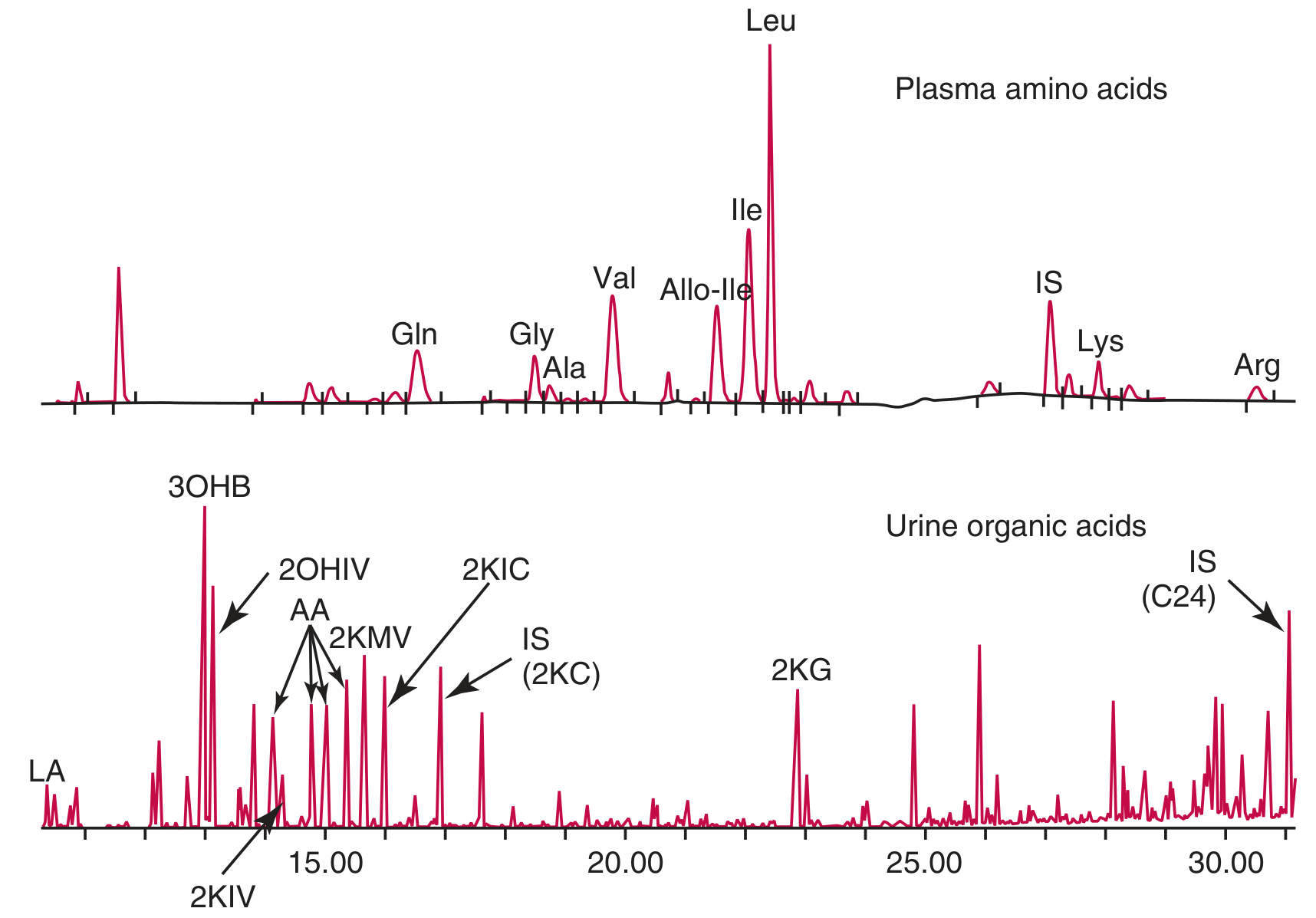
- Results in accumulation of all three BCAAs and their toxic keto-acids in blood and urine
- The keto-acids (especially α-ketoisocaproate from leucine) are responsible for the characteristic sweet/maple syrup odor
- Alloisoleucine (not normally present) accumulates and is a pathognomonic marker
Labs in MSUD:
Clinical features: vomiting, lethargy progressing to coma, developmental delay, ataxia, cerebral edema
Treatment: dietary restriction of BCAAs (especially leucine), acute episodes need IV mannitol, hypertonic saline, IV glucose. Liver transplantation is curative.
Isovaleric Acidemia
- Deficiency of isovaleryl CoA dehydrogenase (step in leucine catabolism)
- Presents with neurologic problems and a "sweaty feet" odor in body fluids (from isovalerate accumulation)
Methylmalonic Acidemia
- Deficiency in methylmalonyl CoA mutase or vitamin B12 deficiency
- Impairs conversion of propionyl CoA → succinyl CoA
- Affects valine, isoleucine, methionine, and threonine catabolism (all generate propionyl CoA)
Physiological Roles of BCAAs
- Energy substrate - particularly during exercise and fasting in skeletal muscle
- Protein synthesis - BCAAs (especially leucine) activate the mTOR pathway to stimulate muscle protein synthesis
- Nitrogen transport - muscle BCAT transfers nitrogen to glutamate, which can donate it to alanine (alanine cycle) or glutamine for transport to the liver/kidney
- Neurotransmitter synthesis - in the brain, BCAAs provide nitrogen for synthesis of glutamate and GABA
- Biochemistry, 8th ed - Lippincott Illustrated Reviews, pp. 748-752 (H. Branched-chain amino acid degradation)
- Tietz Textbook of Laboratory Medicine, 7th ed, p. 2473 (MSUD chromatographic profiles)
This is a shared conversation. Sign in to Orris to start your own chat.