
Suggest youtube channel to study pathology and score good marks
Here are some excellent YouTube channels for studying pathology:
Searching the Web
best YouTube channels to study pathology medical students 2024 2025
Here is a curated list of the best YouTube channels for studying pathology, organized by learning style and purpose:
Top YouTube Channels for Pathology
1. Pathology Made Simple (Dr. Najeeb Lectures)
- youtube.com/@DrNajeeblectures
- One of the most popular channels among medical students worldwide. Dr. Najeeb uses detailed hand-drawn diagrams to explain complex pathological mechanisms in a memorable way. Great for building strong conceptual foundations.
- Best for: Understanding mechanisms, systemic pathology, histopathology
2. Ninja Nerd
- youtube.com/@NinjaNerdLectures
- Extremely high-quality, whiteboard-style videos covering pathology, physiology, and pharmacology together. Excellent for USMLE Step 1 and final exams. The integration of pathophysiology with pathology makes it stand out.
- Best for: Integrated learning, board exam prep, visual learners
3. Osmosis
- youtube.com/@osmosis
- Backed by over 100 healthcare professionals. Known for clean animations and high-yield summaries. Each video typically covers disease mechanism, presentation, diagnosis, and treatment - perfect for exams.
- Best for: High-yield exam review, quick understanding of diseases
4. Armando Hasudungan
- youtube.com/@armandohasudungan
- Hand-drawn, narrated explanations of pathology and biology topics. Very calm and methodical style, great for visual learners who want to understand step-by-step.
- Best for: Visual learners, foundational concepts, cellular pathology
5. Pathology Central
- youtube.com/channel/UC_C1NfzSg96ybalbjl8XydA
- Dedicated purely to pathology for medical students and educators. Focuses on quality instruction of basic and advanced pathology concepts.
- Best for: Pure pathology focus, medical educators and students
6. Medicosis Perfectionalis
- youtube.com/@MedicOsisPerfectionalis
- A physician educator who covers pathology and medicine with detailed, visual, case-based explanations. Very strong on clinical correlation.
- Best for: Clinical pathology, USMLE, detailed visual explanations
7. Pathoma (Dr. Husain Sattar)
- Not free on YouTube, but Dr. Sattar's explanations are legendary. Some preview content is available on YouTube. The Pathoma book + videos is the gold standard resource for USMLE Step 1 pathology.
- Best for: Board exam mastery, high-yield pathology
8. Strong Medicine
- youtube.com/@StrongMedicine
- Created by a physician, covers pathophysiology and pathology at a deeper mechanistic level. Great for students who want to go beyond surface-level memorization.
- Best for: Advanced understanding, mechanisms of disease
Study Tips to Score High in Pathology
| Strategy | Details |
|---|---|
| Watch + Read together | Pair YouTube videos with a textbook (Robbins, Pathoma) |
| Active recall | After each video, close it and write down key points from memory |
| Case-based learning | Use Osmosis/Medicosis for case-style thinking |
| Spaced repetition | Use Anki flashcards alongside videos |
| Focus on mechanisms | Don't just memorize - understand why pathology happens |
| High-yield focus | Use Ninja Nerd or Osmosis for exam prep in final weeks |
Recommended combo for exam success:
- Conceptual foundation: Dr. Najeeb or Armando Hasudungan
- Daily study: Ninja Nerd + Osmosis
- Exam crunch: Osmosis High-Yield + Medicosis Perfectionalis
- Boards: Pathoma (paid, but worth it)
Search for pathology mnemonics and quick reference diagrams
Reading File
Searching the Web
pathology mnemonics high yield medical students quick reference
Finding Sources
Searching the Web
pathology mnemonics diagram cheat sheet inflammation neoplasia cell injury
Finding Sources
Loading Image
Loading Image
Searching the Web
pathology necrosis types mnemonic diagram inflammation cardinal signs
Loading Image
Here is your complete pathology mnemonics + quick reference guide, organized by major topic:
Pathology Mnemonics & Quick Reference Diagrams
1. CELL INJURY - Quick Reference Diagram

Reversible injury features - mnemonic: "MR CELL"
- M - Mitochondrial swelling
- R - Ribosomal detachment
- C - Cellular swelling
- E - ER (endoplasmic reticulum) swelling
- L - Lipid accumulation
- L - Loss of microvilli
Irreversible injury features - mnemonic: "PKL" (nuclear changes)
- P - Pyknosis (nuclear condensation)
- K - Karyorrhexis (fragmentation)
- L - Karyolysis (nuclear pallor/dissolution)
2. SIX TYPES OF NECROSIS - Quick Reference Diagram
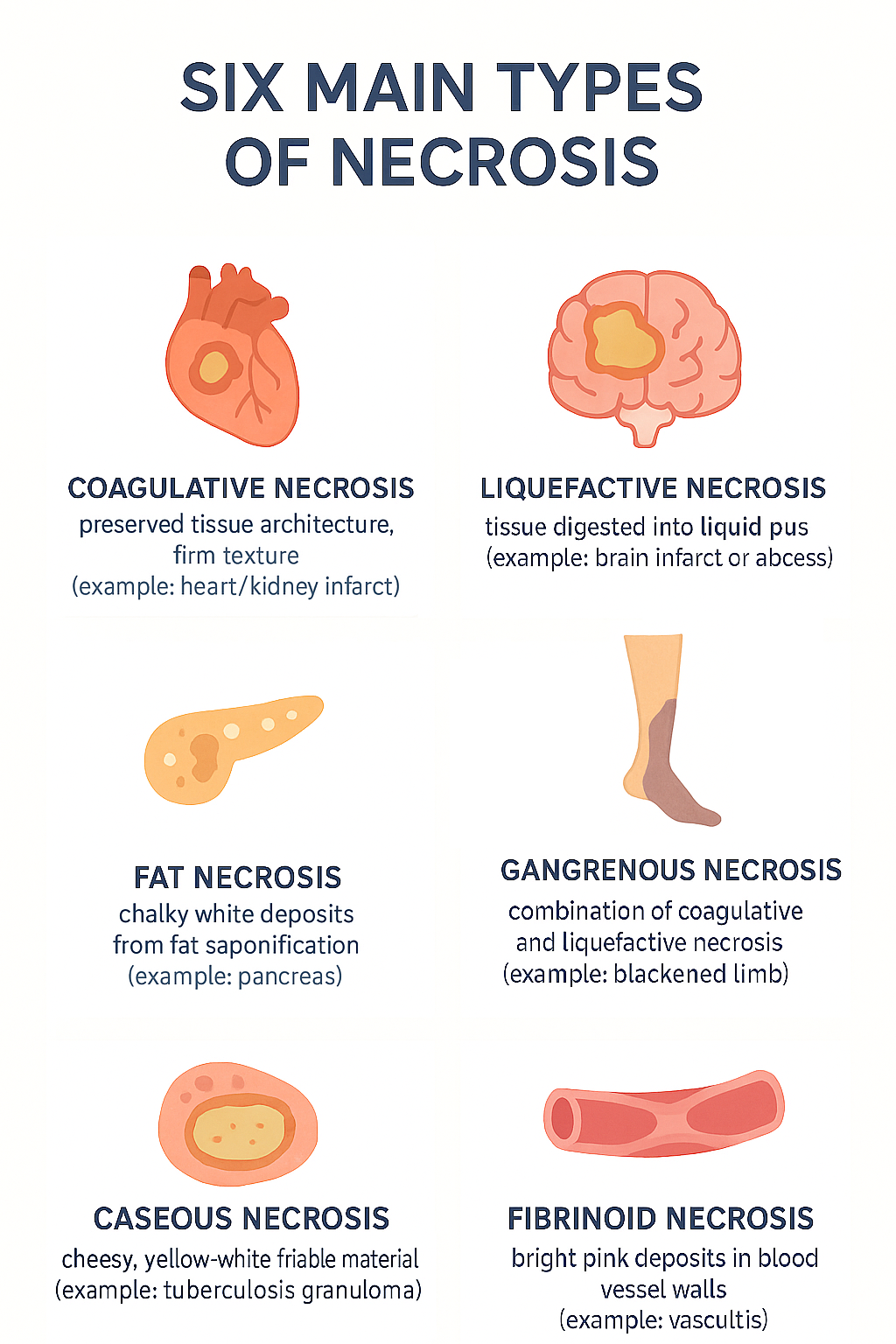
Mnemonic: "Can Little Fat Girls Fight Cancers?"
| Letter | Type | Classic Location | Key Feature |
|---|---|---|---|
| C | Coagulative | Heart, kidney (infarcts) | Preserved ghost outlines |
| L | Liquefactive | Brain, abscesses | Liquid pus, neutrophils |
| F | Fat | Pancreas | Chalky white, saponification |
| G | Gangrenous | Limbs | Black, dry or wet |
| F | Fibrinoid | Blood vessel walls | Vasculitis, bright pink |
| C | Caseous | Tuberculosis granuloma | Cheesy yellow-white material |
3. PATHOGENESIS OVERVIEW DIAGRAM
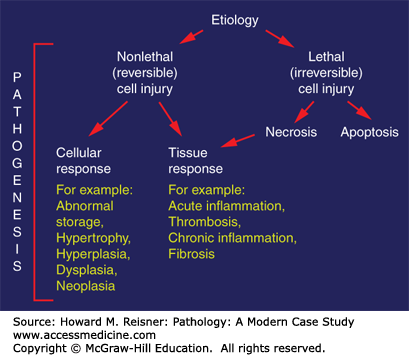
4. INFLAMMATION MNEMONICS
Cardinal Signs of Inflammation: "PRISH"
| Letter | Latin | English |
|---|---|---|
| P | Pallor (none) | - |
| R | Rubor | Redness |
| I | Loss of function (Functio laesa) | |
| S | Swelling (Tumor) | |
| H | Heat (Calor) + Pain (Dolor) |
Better mnemonic: "SHARP"
- S - Swelling (Tumor)
- H - Heat (Calor)
- A - Ache/Pain (Dolor)
- R - Redness (Rubor)
- P - Pain + loss of function (Dolor + Functio laesa)
Acute vs Chronic Inflammation:
| Feature | Acute | Chronic |
|---|---|---|
| Duration | Days | Weeks - months |
| Main cells | Neutrophils | Lymphocytes, macrophages, plasma cells |
| Onset | Fast | Slow |
| Outcome | Resolution or progression | Fibrosis, granuloma |
Mnemonic for chronic inflammation cells: "MEGA-P"
- M - Macrophages
- E - Eosinophils (parasites/allergy)
- G - Giant cells
- A - Activated lymphocytes
- P - Plasma cells
5. CELLULAR ADAPTATIONS - Mnemonic: "HAMDA"
| Letter | Adaptation | Direction | Example |
|---|---|---|---|
| H | Hypertrophy | Cell size ↑ | Cardiac muscle in HTN |
| A | Atrophy | Cell size ↓ | Disuse, denervation |
| M | Metaplasia | Cell type change | Barrett's esophagus (squamous → columnar) |
| D | Dysplasia | Disordered growth | Pre-cancer |
| A | Aplasia/Hyperplasia | Cell number ↑ | Endometrial hyperplasia |
6. APOPTOSIS vs NECROSIS - Quick Comparison
Mnemonic: Apoptosis = "ATP and Programmed" | Necrosis = "No ATP, No Plan"
| Feature | Apoptosis | Necrosis |
|---|---|---|
| Cause | Programmed (physiological) | Pathological |
| Cell size | Shrinks | Swells |
| Membrane | Intact | Ruptures |
| Inflammation | NO | YES |
| ATP needed | YES | No |
| Fragments | Apoptotic bodies | Cell debris |
| Caspases | YES | No |
7. GRANULOMA-FORMING CONDITIONS - Mnemonic: "SARCOID BEAST"
- S - Sarcoidosis
- A - Actinomyces
- R - Rheumatoid arthritis
- C - Crohn's disease
- O - Other fungi (Histoplasma, Coccidioides)
- I - Immune reactions (berylliosis)
- D - Drug reactions
- B - Brucellosis
- E - Extrinsic allergic alveolitis
- A - Aspergillosis (rare)
- S - Schistosomiasis / Syphilis
- T - TB (classic!)
8. TUMOR MARKERS MNEMONIC - "CEA = Colon, Esophagus, Any GI"
| Marker | Cancer | Mnemonic |
|---|---|---|
| CEA | Colon, pancreas, gastric | Colon Eats Alot |
| AFP | Liver (HCC), testicular | Alpha Fetal = liver/fetal |
| PSA | Prostate | Prostate Screening Antigen |
| CA-125 | Ovary | 125 Ovarian |
| CA 19-9 | Pancreas | 19-9 = Pancreas (pan=19) |
| HCG | Choriocarcinoma, testicular | Human Chorionic Gonadotropin |
| S-100 | Melanoma, neural | Skin/Nerve = S-100 |
9. QUICK ONLINE RESOURCES FOR MORE MNEMONICS
| Resource | What you get | Link |
|---|---|---|
| Geeky Medics | Clinical mnemonics organized by system | geekymedics.com/medical-mnemonics |
| Osmosis Blog | Top 10 medical mnemonics with illustrations | osmosis.org/blog |
| Quizlet - Pathology Mnemonics | Flashcard deck, exam-ready | quizlet.com/364173196 |
| WebPath Utah | Histology image index with gross + micro images | webpath.med.utah.edu |
| Libre Pathology | Free wiki with necrosis, stains, classification | librepathology.org |
Pro tip: Pair these mnemonics with Anki flashcard decks (search "Pathoma Anki deck" or "Robbins Anki deck" on Reddit/Anki shared decks) for spaced repetition - it's the fastest way to make these stick before exams.That covers the major high-yield pathology topics with mnemonics and visual diagrams. Want me to go deeper on any specific area - for example, neoplasia, hemodynamics, immunopathology, or organ-specific pathology (liver, kidney, lung, heart)? I can generate detailed mnemonics + diagrams for any of those.
This is a shared conversation. Sign in to Orris to start your own chat.