
Explain types of joints for 10 marks
Reading File
Now let me search the library for joints content:
Finding Sources
Finding Sources
Reading File
Reading File
Reading File
Reading File
Loading Image
Now I have rich content from multiple authoritative textbooks. Let me fetch the synovial joints diagram as well.
Finding Sources
Reading File
I now have comprehensive, authoritative content from multiple textbooks. Let me compile a thorough 10-mark answer.
Types of Joints
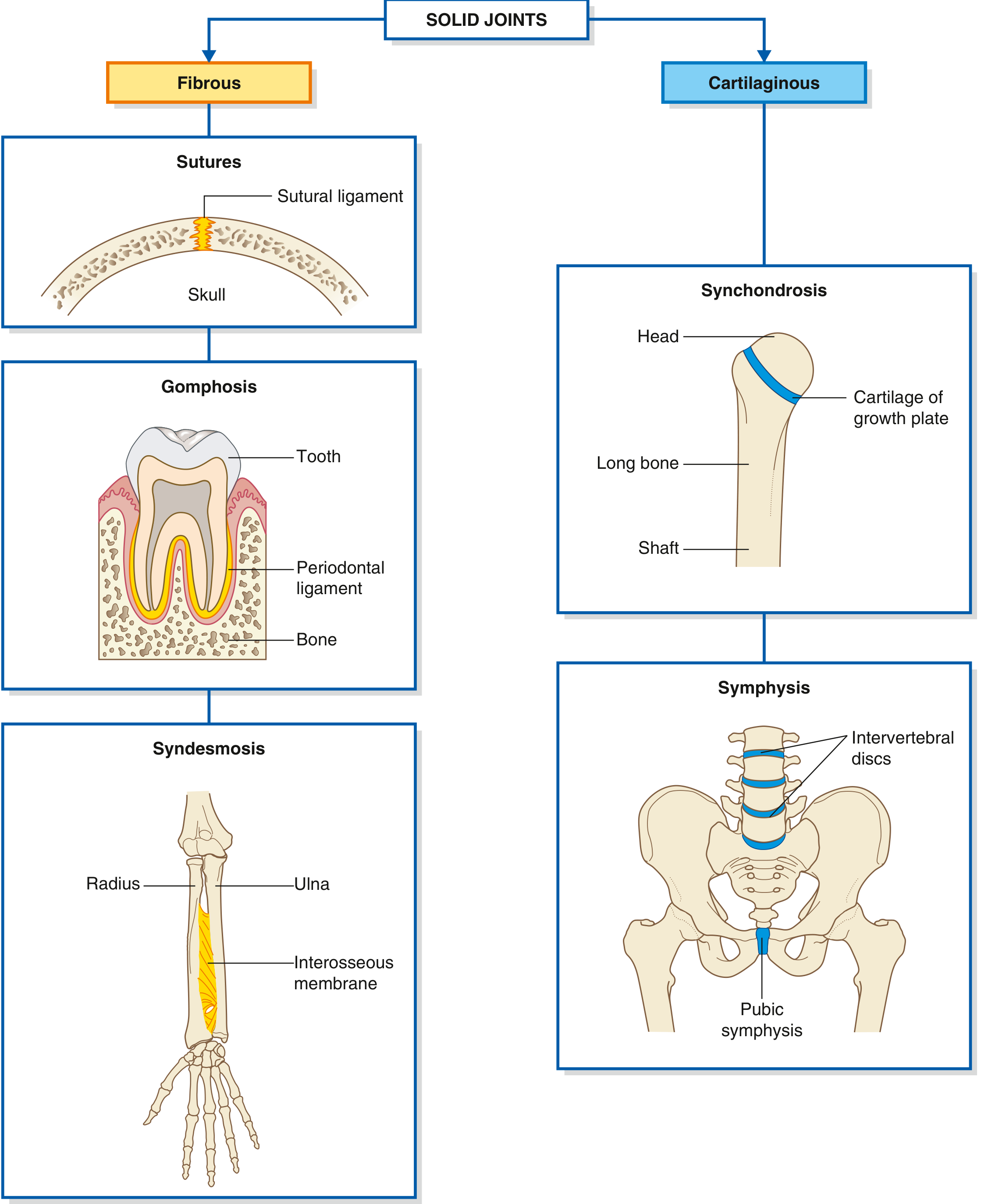
A joint (articulation) is the point of contact between two or more bones, cartilage, or a bone and cartilage. Joints are classified based on structural composition (the tissue binding them) and functional mobility (the degree of movement they permit).
Classification Overview
| Class | Structural Basis | Mobility | Also Called |
|---|---|---|---|
| Fibrous | Dense connective tissue | Minimally mobile | Synarthroses |
| Cartilaginous | Hyaline cartilage or fibrocartilage | Slightly mobile | Amphiarthroses |
| Synovial | Synovial cavity + fluid | Freely mobile | Diarthroses |
(Source: Firestein & Kelley's Textbook of Rheumatology, Table 1.1)
1. Fibrous Joints (Synarthroses)
Bones are connected directly by dense fibrous connective tissue with no joint cavity. Movement is minimal or absent.
Subtypes:
a) Sutures
- Found only in the skull
- Bones are linked by a thin layer of connective tissue called the sutural ligament
- Allow slight flexibility at birth to accommodate brain growth, then eventually ossify
- Example: coronal suture, sagittal suture
b) Gomphoses
- Found only between teeth and jawbone
- The tooth root is held in the bony socket by the periodontal ligament (short collagen fibers)
- Example: tooth in its alveolar socket
c) Syndesmoses
- Two bones are united by a ligament or interosseous membrane
- Allow slightly more movement than sutures
- Example: the interosseous membrane between the radius and ulna; ligamentum flavum between vertebral laminae
2. Cartilaginous Joints (Amphiarthroses)
Bones are joined by hyaline cartilage or fibrocartilage. Movement is limited but more than fibrous joints.
Subtypes:
a) Synchondroses (Primary cartilaginous joints)
- Bones are united by hyaline cartilage
- Usually temporary - the cartilage eventually ossifies
- Example: epiphyseal growth plate (physis) between the head and shaft of a long bone; joint between 1st rib and sternum
b) Symphyses (Secondary cartilaginous joints)
- Bones are united by fibrocartilage
- Designed to be strong yet slightly flexible
- Example: pubic symphysis, intervertebral discs
3. Synovial Joints (Diarthroses)
The most common and functionally important joints. They are characterized by:
- A synovial cavity filled with synovial fluid (containing hyaluronic acid, lubricin, phospholipids)
- A fibrous capsule enclosing the joint
- Articular cartilage covering the opposing bone ends
- A synovial membrane (inner lining of the capsule) that produces synovial fluid
Synovial joints allow nearly frictionless motion and represent the major functional joints of the skeleton (elbow, shoulder, knee, hip, wrist, ankle).
Subtypes of Synovial Joints (by shape and axes of movement):
Synovial joints are classified as uniaxial (1 axis), biaxial (2 axes), or multiaxial (multiple axes).
| Type | Movement | Example |
|---|---|---|
| Plane (gliding) | Gliding/sliding in multiple planes | Acromioclavicular, intercarpal, facet joints |
| Hinge | Flexion & extension only (uniaxial) | Elbow (humero-ulnar), ankle, interphalangeal |
| Pivot | Rotation only (uniaxial) | Atlanto-axial joint, proximal radioulnar joint |
| Bicondylar | Mainly one axis + limited rotation | Knee joint |
| Condyloid (Ellipsoid) | Flexion, extension, abduction, adduction (biaxial) | Wrist (radiocarpal), metacarpophalangeal joints |
| Saddle | Flexion, extension, abduction, adduction (biaxial) | Carpometacarpal joint of thumb, sternoclavicular |
| Ball-and-socket | All movements including rotation (multiaxial) | Hip joint, glenohumeral (shoulder) joint |
(Sources: Gray's Anatomy for Students; Imaging Anatomy Atlas Vol. 3)
Summary
JOINTS
├── Fibrous (Synarthroses) → Sutures | Gomphoses | Syndesmoses
├── Cartilaginous (Amphiarthroses) → Synchondroses | Symphyses
└── Synovial (Diarthroses) → Plane | Hinge | Pivot | Bicondylar
                                     Condyloid | Saddle | Ball-and-socket
Key Points to Remember:
- Fibrous joints = no cavity, minimal movement (skull sutures being the classic example)
- Cartilaginous joints = no cavity, slight movement (intervertebral discs allow shock absorption)
- Synovial joints = have a cavity with fluid, freely moveable; the ball-and-socket (hip, shoulder) has the greatest range of motion of all joint types
- The functional terms (synarthrosis, amphiarthrosis, diarthrosis) correlate with structural terms (fibrous, cartilaginous, synovial)
Sources: Firestein & Kelley's Textbook of Rheumatology; Gray's Anatomy for Students; Imaging Anatomy Text and Atlas Vol. 3; General Anatomy and Musculoskeletal System - THIEME Atlas
In one page
Types of Joints
A joint is the point of contact between two or more bones. Joints are classified by structure (tissue binding them) and function (degree of movement).
1. Fibrous Joints (Synarthroses) - Immovable
Bones connected by dense connective tissue; no joint cavity.
- Sutures - skull bones linked by sutural ligament (e.g., coronal suture)
- Gomphoses - tooth held in socket by periodontal ligament
- Syndesmoses - bones linked by ligament/interosseous membrane (e.g., radius-ulna)
2. Cartilaginous Joints (Amphiarthroses) - Slightly Moveable
Bones joined by cartilage; no joint cavity.
- Synchondroses - hyaline cartilage; usually temporary (e.g., epiphyseal growth plate)
- Symphyses - fibrocartilage; strong yet flexible (e.g., pubic symphysis, intervertebral discs)
3. Synovial Joints (Diarthroses) - Freely Moveable
Have a synovial cavity, articular cartilage, fibrous capsule, and synovial fluid. Most common functional joints.
| Type | Movement | Example |
|---|---|---|
| Plane | Gliding | Acromioclavicular, facet joints |
| Hinge | Flexion/extension only | Elbow, ankle |
| Pivot | Rotation only | Atlanto-axial, proximal radioulnar |
| Condyloid | Flexion, extension, abduction, adduction | Wrist, metacarpophalangeal |
| Saddle | Same as condyloid + wider range | Carpometacarpal of thumb |
| Ball-and-socket | All movements (greatest ROM) | Hip, shoulder |
Quick Summary
| Joint Type | Structure | Mobility | Example |
|---|---|---|---|
| Fibrous | Connective tissue | None/minimal | Skull sutures |
| Cartilaginous | Cartilage | Slight | Intervertebral disc |
| Synovial | Cavity + fluid | Free | Hip, knee, elbow |
/one oage
Looks like you'd like this as a one-page document. What format would you prefer?
Asking for Preferences
What file format do you want?
Reading File
Running Command
mkdir -p /tmp/workspace/joints && ls /tmp/workspace/joints
Writing File
~/joints/generate_pdf.py
from reportlab.lib.pagesizes import A4
from reportlab.lib import colors
from reportlab.lib.styles import getSampleStyleSheet, ParagraphStyle
from reportlab.lib.units import mm, cm
from reportlab.platypus import SimpleDocTemplate, Paragraph, Spacer, Table, TableStyle, HRFlowable
from reportlab.lib.enums import TA_CENTER, TA_LEFT

output_path = "/tmp/workspace/joints/Types_of_Joints.pdf"

doc = SimpleDocTemplate(
    output_path,
    pagesize=A4,
    leftMargin=18*mm,
    rightMargin=18*mm,
    topMargin=14*mm,
    bottomMargin=12*mm,
)

styles = getSampleStyleSheet()

# Custom styles
title_style = ParagraphStyle(
    "Title", parent=styles["Title"],
    fontSize=18, textColor=colors.HexColor("#1a3a5c"),
    spaceAfter=2*mm, alignment=TA_CENTER, fontName="Helvetica-Bold"
)
subtitle_style = ParagraphStyle(
    "Subtitle", parent=styles["Normal"],
    fontSize=9, textColor=colors.HexColor("#555555"),
    spaceAfter=4*mm, alignment=TA_CENTER, fontName="Helvetica-Oblique"
)
h1_style = ParagraphStyle(
    "H1", parent=styles["Normal"],
    fontSize=11, textColor=colors.white,
    fontName="Helvetica-Bold", alignment=TA_LEFT,
    leftIndent=4, spaceBefore=3*mm, spaceAfter=1*mm,
)
h2_style = ParagraphStyle(
    "H2", parent=styles["Normal"],
    fontSize=9.5, textColor=colors.HexColor("#1a3a5c"),
    fontName="Helvetica-Bold", spaceBefore=2*mm, spaceAfter=1*mm,
)
body_style = ParagraphStyle(
    "Body", parent=styles["Normal"],
    fontSize=8.5, leading=12,
    fontName="Helvetica", spaceAfter=1.5*mm,
)
bullet_style = ParagraphStyle(
    "Bullet", parent=styles["Normal"],
    fontSize=8.5, leading=11.5, leftIndent=12,
    bulletIndent=3, fontName="Helvetica",
)
note_style = ParagraphStyle(
    "Note", parent=styles["Normal"],
    fontSize=7.5, textColor=colors.HexColor("#444444"),
    fontName="Helvetica-Oblique", alignment=TA_CENTER, spaceBefore=2*mm,
)

def section_header(text, color="#1a3a5c"):
    """A colored banner for section headings."""
    bg = colors.HexColor(color)
    data = [[Paragraph(text, h1_style)]]
    t = Table(data, colWidths=[174*mm])
    t.setStyle(TableStyle([
        ("BACKGROUND", (0,0), (-1,-1), bg),
        ("LEFTPADDING", (0,0), (-1,-1), 6),
        ("RIGHTPADDING", (0,0), (-1,-1), 6),
        ("TOPPADDING", (0,0), (-1,-1), 3),
        ("BOTTOMPADDING", (0,0), (-1,-1), 3),
        ("ROUNDEDCORNERS", [3, 3, 3, 3]),
    ]))
    return t

story = []

# Title
story.append(Paragraph("Types of Joints", title_style))
story.append(Paragraph("Structural & Functional Classification", subtitle_style))
story.append(HRFlowable(width="100%", thickness=1.2, color=colors.HexColor("#1a3a5c"), spaceAfter=3*mm))

# --- SECTION 1: Fibrous ---
story.append(section_header("1.  Fibrous Joints  (Synarthroses)  —  Immovable", "#c0392b"))
story.append(Spacer(1, 1.5*mm))
story.append(Paragraph(
    "Bones united by <b>dense connective tissue</b>; no joint cavity; minimal or no movement.",
    body_style
))
fibrous_data = [
    [Paragraph("<b>Subtype</b>", body_style), Paragraph("<b>Description</b>", body_style), Paragraph("<b>Example</b>", body_style)],
    [Paragraph("Sutures", body_style), Paragraph("Skull bones linked by sutural ligament; ossify with age", body_style), Paragraph("Coronal, sagittal sutures", body_style)],
    [Paragraph("Gomphoses", body_style), Paragraph("Tooth root held in socket by periodontal ligament", body_style), Paragraph("Teeth in alveolar socket", body_style)],
    [Paragraph("Syndesmoses", body_style), Paragraph("Bones joined by ligament or interosseous membrane; slight movement", body_style), Paragraph("Radius–ulna (interosseous membrane)", body_style)],
]
ft = Table(fibrous_data, colWidths=[32*mm, 88*mm, 54*mm])
ft.setStyle(TableStyle([
    ("BACKGROUND", (0,0), (-1,0), colors.HexColor("#f0d0cc")),
    ("BACKGROUND", (0,1), (-1,-1), colors.HexColor("#fdf5f4")),
    ("GRID", (0,0), (-1,-1), 0.4, colors.HexColor("#cccccc")),
    ("TOPPADDING", (0,0), (-1,-1), 3), ("BOTTOMPADDING", (0,0), (-1,-1), 3),
    ("LEFTPADDING", (0,0), (-1,-1), 5), ("RIGHTPADDING", (0,0), (-1,-1), 5),
]))
story.append(ft)
story.append(Spacer(1, 2*mm))

# --- SECTION 2: Cartilaginous ---
story.append(section_header("2.  Cartilaginous Joints  (Amphiarthroses)  —  Slightly Moveable", "#1a6b3c"))
story.append(Spacer(1, 1.5*mm))
story.append(Paragraph(
    "Bones joined by <b>hyaline cartilage or fibrocartilage</b>; no joint cavity; limited movement.",
    body_style
))
cart_data = [
    [Paragraph("<b>Subtype</b>", body_style), Paragraph("<b>Description</b>", body_style), Paragraph("<b>Example</b>", body_style)],
    [Paragraph("Synchondroses\n(Primary)", body_style), Paragraph("Hyaline cartilage; temporary — eventually ossifies", body_style), Paragraph("Epiphyseal growth plate; 1st rib–sternum", body_style)],
    [Paragraph("Symphyses\n(Secondary)", body_style), Paragraph("Fibrocartilage; strong, slightly flexible, permanent", body_style), Paragraph("Pubic symphysis, intervertebral discs", body_style)],
]
ct = Table(cart_data, colWidths=[32*mm, 88*mm, 54*mm])
ct.setStyle(TableStyle([
    ("BACKGROUND", (0,0), (-1,0), colors.HexColor("#c8e6c9")),
    ("BACKGROUND", (0,1), (-1,-1), colors.HexColor("#f4fbf5")),
    ("GRID", (0,0), (-1,-1), 0.4, colors.HexColor("#cccccc")),
    ("TOPPADDING", (0,0), (-1,-1), 3), ("BOTTOMPADDING", (0,0), (-1,-1), 3),
    ("LEFTPADDING", (0,0), (-1,-1), 5), ("RIGHTPADDING", (0,0), (-1,-1), 5),
]))
story.append(ct)
story.append(Spacer(1, 2*mm))

# --- SECTION 3: Synovial ---
story.append(section_header("3.  Synovial Joints  (Diarthroses)  —  Freely Moveable", "#1a3a5c"))
story.append(Spacer(1, 1.5*mm))
story.append(Paragraph(
    "Have a <b>synovial cavity</b> filled with synovial fluid (hyaluronic acid, lubricin). "
    "Enclosed by a <b>fibrous capsule</b>; bone ends covered by <b>articular cartilage</b>. "
    "Most numerous and functionally important joints in the body.",
    body_style
))

syn_data = [
    [Paragraph("<b>Type</b>", body_style), Paragraph("<b>Axes</b>", body_style), Paragraph("<b>Movements</b>", body_style), Paragraph("<b>Example</b>", body_style)],
    [Paragraph("Plane (Gliding)", body_style), Paragraph("Multi", body_style), Paragraph("Gliding/sliding", body_style), Paragraph("Acromioclavicular, facet joints", body_style)],
    [Paragraph("Hinge", body_style), Paragraph("Uni", body_style), Paragraph("Flexion, extension", body_style), Paragraph("Elbow, ankle, interphalangeal", body_style)],
    [Paragraph("Pivot", body_style), Paragraph("Uni", body_style), Paragraph("Rotation only", body_style), Paragraph("Atlanto-axial, proximal radioulnar", body_style)],
    [Paragraph("Bicondylar", body_style), Paragraph("Bi*", body_style), Paragraph("Flexion/extension + limited rotation", body_style), Paragraph("Knee joint", body_style)],
    [Paragraph("Condyloid\n(Ellipsoid)", body_style), Paragraph("Bi", body_style), Paragraph("Flexion, extension, abd, add, circumduction", body_style), Paragraph("Wrist, metacarpophalangeal", body_style)],
    [Paragraph("Saddle", body_style), Paragraph("Bi", body_style), Paragraph("Flexion, extension, abd, add, circumduction", body_style), Paragraph("Carpometacarpal of thumb", body_style)],
    [Paragraph("Ball-and-Socket", body_style), Paragraph("Multi", body_style), Paragraph("All movements — greatest ROM", body_style), Paragraph("Hip, shoulder (glenohumeral)", body_style)],
]
st = Table(syn_data, colWidths=[30*mm, 12*mm, 66*mm, 66*mm])
st.setStyle(TableStyle([
    ("BACKGROUND", (0,0), (-1,0), colors.HexColor("#c5d8f0")),
    ("ROWBACKGROUNDS", (0,1), (-1,-1), [colors.HexColor("#eef4fb"), colors.white]),
    ("GRID", (0,0), (-1,-1), 0.4, colors.HexColor("#cccccc")),
    ("TOPPADDING", (0,0), (-1,-1), 3), ("BOTTOMPADDING", (0,0), (-1,-1), 3),
    ("LEFTPADDING", (0,0), (-1,-1), 5), ("RIGHTPADDING", (0,0), (-1,-1), 5),
]))
story.append(st)
story.append(Spacer(1, 2*mm))

# Summary box
summary_data = [[
    Paragraph(
        "<b>Quick Summary:</b>  Fibrous = no cavity, immovable (skull sutures)  |  "
        "Cartilaginous = no cavity, slight movement (discs, symphysis)  |  "
        "Synovial = cavity + fluid, freely moveable (hip, knee, shoulder)",
        ParagraphStyle("sum", parent=styles["Normal"], fontSize=8, fontName="Helvetica",
                       textColor=colors.HexColor("#1a3a5c"))
    )
]]
sum_t = Table(summary_data, colWidths=[174*mm])
sum_t.setStyle(TableStyle([
    ("BACKGROUND", (0,0), (-1,-1), colors.HexColor("#eaf0fa")),
    ("BOX", (0,0), (-1,-1), 0.8, colors.HexColor("#1a3a5c")),
    ("TOPPADDING", (0,0), (-1,-1), 5), ("BOTTOMPADDING", (0,0), (-1,-1), 5),
    ("LEFTPADDING", (0,0), (-1,-1), 8), ("RIGHTPADDING", (0,0), (-1,-1), 8),
]))
story.append(sum_t)

# Footer
story.append(Spacer(1, 2*mm))
story.append(Paragraph(
    "Sources: Firestein & Kelley's Textbook of Rheumatology · Gray's Anatomy for Students · Imaging Anatomy Atlas Vol. 3 · THIEME General Anatomy",
    note_style
))

doc.build(story)
print(f"PDF saved to: {output_path}")
Running Command
python /tmp/workspace/joints/generate_pdf.py
Your one-page PDF is ready:
Types of Joints
PDF Document · PDF
It covers all three joint types (Fibrous, Cartilaginous, Synovial) with subtypes, descriptions, and examples in a clean color-coded table layout, plus a quick summary box at the bottom - all on a single A4 page.
This is a shared conversation. Sign in to Orris to start your own chat.