
Mechanism of action of bisphosphonate in short
Bisphosphonates bind to hydroxyapatite in bone and are taken up by osteoclasts, where they inhibit farnesyl pyrophosphate synthase (an enzyme in the mevalonate pathway). This blocks prenylation of small GTPases (Ras, Rho, Rac), disrupting osteoclast cytoskeletal function, promoting apoptosis, and ultimately reducing bone resorption.
Searching sources...
Reading File
Finding Sources
Reading File
Finding Sources
Reading File
Reading File
Loading Image
Here is a concise summary of the mechanism of action of bisphosphonates, sourced directly from Rheumatology, 2-Volume Set (Elsevier, 2022):
Mechanism of Action of Bisphosphonates
1. Structural Basis
Bisphosphonates are synthetic analogs of inorganic pyrophosphate, with the central oxygen replaced by carbon (P-C-P backbone). This makes them resistant to enzymatic hydrolysis. The two side chains (R1 and R2) determine binding affinity and antiresorptive potency.
There are two classes with distinct mechanisms:
2. Non-nitrogen-containing bisphosphonates (e.g., etidronate, clodronate)
- Incorporated into non-hydrolyzable ATP analogs inside osteoclasts
- These cytotoxic ATP analogs accumulate and directly induce osteoclast apoptosis
3. Nitrogen-containing bisphosphonates (e.g., alendronate, risedronate, zoledronate, ibandronate, pamidronate) - the more potent class
This is the main mechanism:
- Bone targeting: Bisphosphonates bind avidly to hydroxyapatite at sites of active bone resorption
- Osteoclast uptake: Active osteoclasts endocytose bisphosphonate during resorption
- Inhibition of FPPS: Inside the cell, they inhibit farnesyl pyrophosphate synthase (FPPS), a key enzyme in the mevalonate pathway (HMG-CoA → Mevalonate → FPP)
- Block prenylation: This blocks the production of farnesyl pyrophosphate (FPP) and geranylgeranyl diphosphate (GGPP), the lipid anchors needed to prenylate small GTPases (Ras, Rho, Rab, Rac)
- Osteoclast dysfunction and apoptosis: Without prenylated GTPases, osteoclasts cannot:
- Form the ruffled border (needed for acid secretion)
- Recruit or differentiate properly
- Traffic vesicles or maintain cytoskeletal integrity
- This leads to osteoclast apoptosis and reduced bone resorption
4. Net Effect on Bone
- Bone resorption decreases within 1-2 months
- Because formation and resorption are coupled, formation also slows - but a lag period allows the remodeling space to fill, increasing BMD
- BMD rises ~5-7% by year 3, then ~0.8%/year with long-term use
- ~25% of fracture risk reduction is from BMD increase; the rest comes from decreased bone turnover and improved microarchitecture
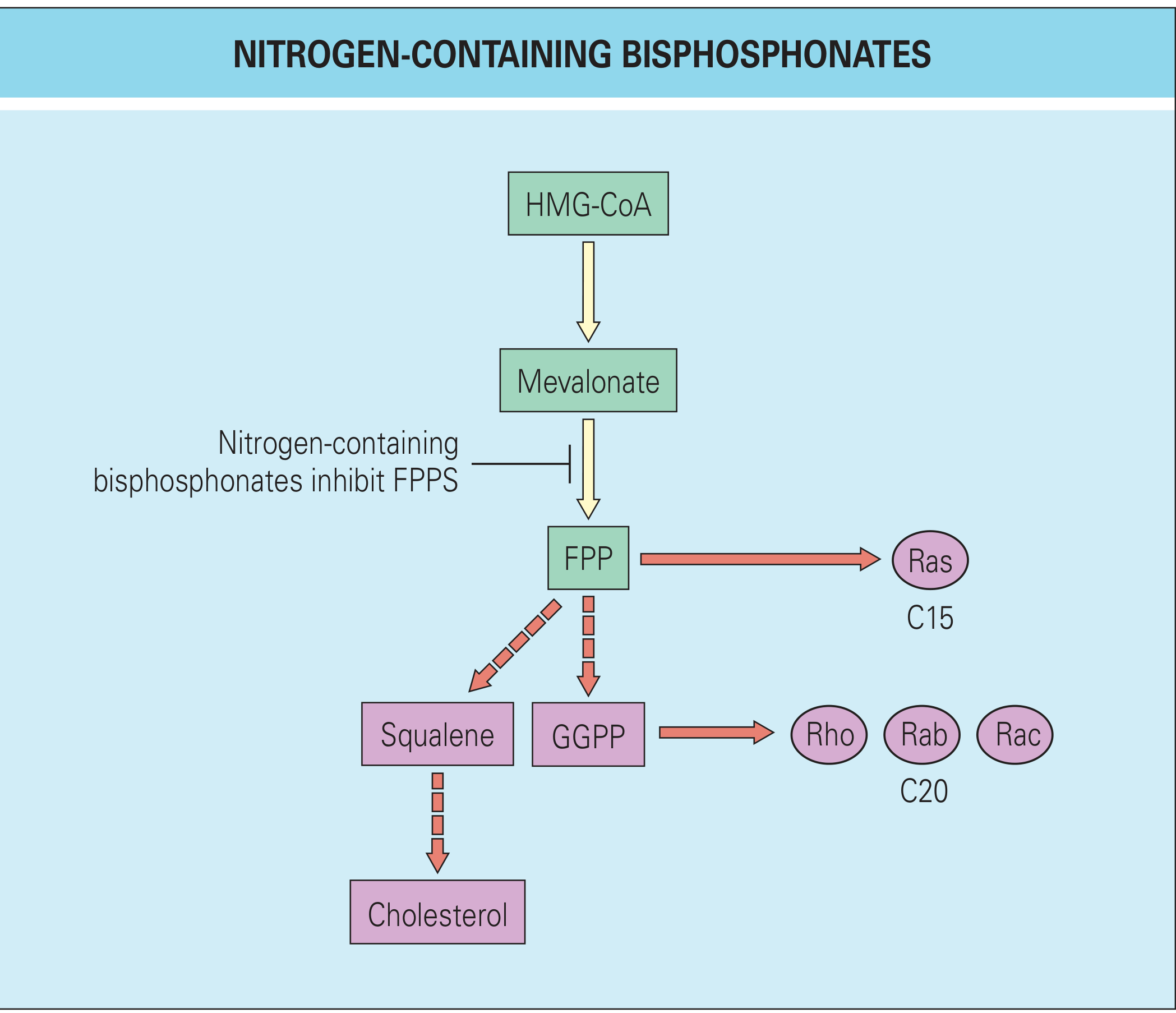
FIG. 202.3 - Nitrogen-containing bisphosphonates inhibit FPPS in the mevalonate pathway, blocking prenylation of small GTPases (Ras, Rho, Rab, Rac) critical for osteoclast survival and function.
- Rheumatology, 2-Volume Set (Elsevier, 2022), p. 1841
In short
Bisphosphonate - Mechanism of Action
Bind to hydroxyapatite in bone → taken up by osteoclasts during resorption
↓
Inhibit farnesyl pyrophosphate synthase (FPPS) in the mevalonate pathway
↓
Block prenylation of small GTPases (Ras, Rho, Rac)
↓
Osteoclast dysfunction + apoptosis → ↓ bone resorption
Non-nitrogen types (etidronate) form toxic ATP analogs → direct apoptosis. Nitrogen-containing types (alendronate, zoledronate) → FPPS inhibition (more potent).
This is a shared conversation. Sign in to Orris to start your own chat.