
Pneumothorax
Reading File
Now let me search the medical library and web in parallel for comprehensive pneumothorax coverage.
Finding Sources
Searching PubMed
"pneumothorax"[MeSH Terms] AND "management"[MeSH Terms]
Searching the Web
pneumothorax types management guidelines 2024
Good. Now let me read the most comprehensive sources - Murray & Nadel's Respiratory Medicine and Roberts & Hedges' Emergency Medicine - in parallel.
Reading File
Reading File
Now let me read the Family Medicine textbook section (which should cover types comprehensively) and more of the Murray & Nadel section on pneumothorax basics:
Reading File
Finding Sources
Excellent. Let me now read the comprehensive Murray & Nadel chapter on pneumothorax and Rosen's Emergency Medicine section:
Reading File
Reading File
Let me get more of the Rosen's section on clinical presentation, diagnosis, and management:
Reading File
Reading File
I have very rich content from two major textbooks. Let me fetch the key anatomical illustration showing bleb vs bulla, and also read the Washington Manual and Rosen's management sections:
Loading Image
Reading File
That was the pleural effusion section. Let me get the Rosen's management section for pneumothorax specifically:
Reading File
Reading File
Let me fetch the tension pneumothorax diagram:
Loading Image
Reading File
I now have comprehensive, well-sourced information to write a thorough response. Let me compile everything:
Pneumothorax
A pneumothorax is the presence of air in the pleural space - between the visceral and parietal pleura - causing partial or complete lung collapse. Normally, intrapleural pressure is slightly negative relative to atmosphere, maintaining lung expansion. When air enters this space, that gradient is lost and the lung recoils.
Classification
1. Primary Spontaneous Pneumothorax (PSP)
Occurs without clinically apparent underlying lung disease. Typically affects tall, thin young men (3:1 male predominance). The mechanism is rupture of a subpleural bleb (an air-containing outpouching of visceral pleura, <1 cm) or bulla (>1 cm, sharply demarcated thin-walled airspace). Despite the label "primary," these patients do have microscopic abnormalities - respiratory bronchiolitis, fibroelastic pleural changes, and "pleural porosity." Smoking significantly increases risk. Associated conditions include Marfan syndrome, Birt-Hogg-Dube syndrome, and mitral valve prolapse.
2. Secondary Spontaneous Pneumothorax (SSP)
Complicates underlying lung disease. Because pulmonary reserve is already reduced, even a small SSP can cause severe respiratory compromise - dyspnea is nearly universal. COPD is the most common cause in the US. Key causes:
| Category | Examples |
|---|---|
| Airway disease | COPD, asthma, cystic fibrosis |
| Infections | Necrotizing pneumonia, PJP (HIV), tuberculosis, lung abscess |
| Interstitial lung disease | Sarcoidosis, IPF, lymphangioleiomyomatosis (LAM), tuberous sclerosis |
| Neoplasms | Primary lung cancer, pulmonary/pleural metastases |
| Connective tissue | Marfan syndrome, Ehlers-Danlos, scleroderma, rheumatoid arthritis |
3. Traumatic Pneumothorax
Results from penetrating or blunt chest trauma. An occult pneumothorax (visible on CT but not CXR) is increasingly detected. Can progress rapidly in ventilated patients.
4. Iatrogenic Pneumothorax
Complicates procedures: central venous catheter placement, thoracentesis, lung biopsy, mechanical ventilation (from alveolar overdistention). The most common overall type globally given increasing use of invasive procedures and PPV.
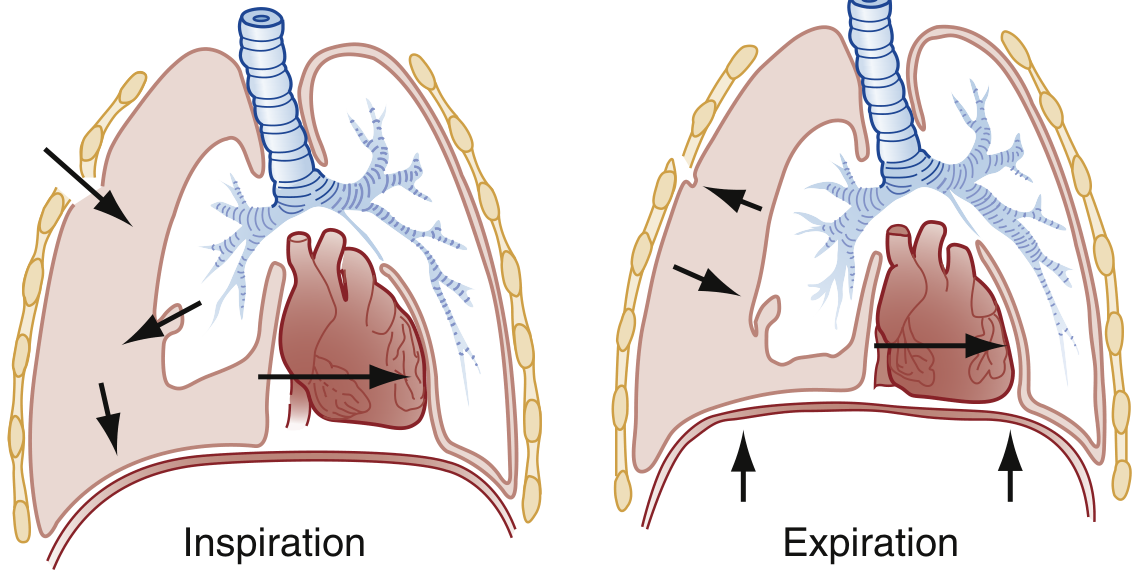
5. Tension Pneumothorax
A life-threatening variant where the alveolar-pleural defect acts as a one-way valve - air enters the pleural space on inspiration but cannot escape on expiration. Progressive positive intrapleural pressure causes:
- Complete ipsilateral lung collapse
- Mediastinal shift toward the contralateral side
- Compression of mediastinal venous structures
- Impaired venous return → cardiovascular collapse
6. Catamenial Pneumothorax
A rare type in women, occurring within 72 hours of menstruation. Associated with endometriosis of the pleura or diaphragm. Always consider this diagnosis in any young woman presenting with recurrent pneumothorax.
Pathophysiology
When the alveolar-pleural barrier ruptures, air floods the pleural space until either the defect seals or intrapleural/alveolar pressures equalize. The result:
- Loss of negative intrapleural pressure
- Ipsilateral lung collapse
- Reduced vital capacity and FRC
- Hypoxemia (due to V/Q mismatch and intrapulmonary shunting - though initially mitigated by compensatory hypoxic vasoconstriction)
In tension physiology, progressive air accumulation causes mediastinal shift and compression of the contralateral lung and mediastinal veins, ultimately reducing cardiac output.
Clinical Features
PSP:
- Sudden onset ipsilateral pleuritic chest pain and dyspnea
- Pain may dull to a steady ache over time
- Symptoms may be mild - patients sometimes wait days before seeking care
- Symptoms can spontaneously improve within 24-72 hours even without treatment, though the pneumothorax persists
Examination findings (correlate with size):
- Sinus tachycardia (most common early sign)
- Decreased or absent breath sounds on the affected side
- Hyperresonance to percussion
- Reduced chest wall movement and absent tactile fremitus
- In large pneumothorax: hypoxia, tracheal deviation away from affected side
Tension pneumothorax:
- Hypoxia, increased work of breathing, tachycardia
- Hypotension (late)
- JVD (difficult to detect)
- Tracheal deviation (late, not always present)
- Complete cardiovascular collapse if untreated
SSP: Symptoms are more severe than PSP due to limited pulmonary reserve. Dyspnea nearly universal even with small pneumothorax. Physical exam findings overlap with the underlying lung disease.
Diagnosis
Chest Radiograph
- Standard upright PA film is first-line
- Shows a visible pleural line with absent lung markings peripheral to it
- Sensitivity 28-52% (notably lower than ultrasound)
- Specificity ~99%
- Sizing (Rhea method): Average of three intrapleural distances (apical, midpoint upper half, midpoint lower half), plotted on nomogram
Point-of-Care Ultrasound (POCUS)
- Sensitivity 79-98%, specificity ~98% - significantly more sensitive than CXR
- Use a high-frequency linear transducer (phased array/curvilinear also acceptable)
- Key findings:
- Lung sliding present → rules out pneumothorax at that location
- Lung sliding absent → suggestive but not specific (also occurs with apnea, pleural adhesions)
- B-lines present → rules out pneumothorax (visceral pleura visible, layers apposed)
- Lung point → pathognomonic; transition between presence and absence of sliding represents the edge of the pneumothorax; highly specific
- M-mode: Normal = "seashore sign"; Pneumothorax = "barcode/stratosphere sign"
CT Thorax
- Gold standard for size assessment and detection of occult pneumothorax
- Identifies underlying bullae, blebs, and associated pathology
- Used to guide drainage of loculated collections
Management
Primary Spontaneous Pneumothorax
| Size/Symptoms | Management |
|---|---|
| Small, mild symptoms, stable | Conservative observation (repeat CXR in 4-6 hrs); discharge with follow-up |
| Moderate-large or significant dyspnea | Needle aspiration (first-line) or small-bore chest tube (pigtail, 14-24 Fr) |
| Failed needle aspiration | Chest tube insertion |
| Recurrent | VATS pleurodesis and/or bullectomy |
Conservative approach note: A 2020 NEJM trial (Brown et al.) showed conservative management was non-inferior to interventional treatment for PSP in stable patients.
Secondary Spontaneous Pneumothorax
- Initial treatment: chest tube drainage (do not observe conservatively - poor reserve)
- Prevention of recurrence: typically talc pleurodesis
- Chemical pleurodesis can also be considered for first episode in patients who significantly decompensate (e.g., severe COPD)
Iatrogenic / Ventilator-Related
- All patients on PPV with pneumothorax should be drained - risk of rapid progression to tension is high
- Small-bore tube (24 Fr) or pigtail catheter via Seldinger technique
- Place to water-seal drainage unit; suction at 20 cmH₂O for persistent air leaks
- Wean suction to water-seal only after air leak resolves; remove tube after confirmed lung re-expansion
Tension Pneumothorax - Emergency Management
Do not wait for imaging if clinical signs suggest tension.
- Immediate needle decompression (temporizing):
- 14-16 gauge IV catheter (adults), 18 gauge (children)
- Needle length ≥3-5 cm (longer in obese patients)
- 2nd intercostal space, midclavicular line OR 4th/5th ICS, midaxillary line
- Confirmed by rush of air under pressure or rapid hemodynamic improvement
- Definitive: tube thoracostomy - must follow needle decompression promptly
Chest Tube Management
- After insertion, attach to water-seal device
- Routine suction does NOT improve re-expansion rate (no longer routinely recommended)
- Suction reserved for lung that fails to re-expand after 24-48 hrs on water seal
- Remove directly from water seal once no pneumothorax on film, or after 4-hr clamping trial
- Air leaks persisting >4-7 days warrant surgical evaluation (VATS)
Surgical Indications
- Recurrent PSP (same or opposite side)
- Persistent air leak >4-7 days
- Failure of lung re-expansion
- Tension pneumothorax
- High-risk occupations (pilots, divers) after first episode
- First episode of SSP in patients with severely compromised lung function
Disposition
| Scenario | Disposition |
|---|---|
| Small PSP, young healthy patient, no hypoxemia | Observe 4-6 hrs → discharge with 24-48 hr follow-up |
| PSP with chest tube | Usually admit; outpatient possible with Heimlich valve + good follow-up |
| SSP | Admit (24 hr observation minimum or ongoing chest tube management) |
| Tension | ICU admission |
All patients advised: avoid air travel and scuba diving until complete resolution; smoking cessation counseled.
Recurrence: PSP recurs in ~25-50% within 5 years ipsilaterally; risk increases with each episode. SSP recurrence rates are higher and justify earlier definitive pleurodesis.
Sources:
- Rosen's Emergency Medicine (9e), Ch. 63
- Murray & Nadel's Textbook of Respiratory Medicine (7e), Ch. 110
- Roberts & Hedges' Clinical Procedures in Emergency Medicine, Ch. 9
- The Washington Manual of Medical Therapeutics
Note: Updated CHEST guidelines on pneumothorax are scheduled for release in 2026, and may revise some management thresholds. The 2023 BTS guidelines recommend considering thoracic surgery at initial presentation when prevention of recurrence is high priority (e.g., tension pneumothorax in high-risk occupations).
This is a shared conversation. Sign in to Orris to start your own chat.