
teach me about hospital acquired infections microbiology , make it short and include all important points which i must know to crack university exam
Reading File
Now let me search the medical library for hospital acquired infections content in parallel.
Finding Sources
Finding Sources
Good. Let me read the key sections from Park's (the best source for this exam topic) and Medical Microbiology in parallel.
Reading File
Reading File
Reading File
Finding Sources
Reading File
Finding Sources
Reading File
Finding Sources
Finding Sources
Reading File
I now have enough material from the textbooks. Let me also fetch the nosocomial infection pie chart image and compile the full answer.
Loading Image
Finding Sources
I now have all the key information needed. Let me compile a comprehensive, exam-focused answer.
Hospital Acquired Infections (HAI / Nosocomial Infections) - Exam Notes
1. Definition (Most Asked)
Nosocomial infection = an infection originating in a patient while in a hospital or other health care facility that:
- Was NOT present or incubating at the time of admission
- Occurs >48 hours after admission (standard cutoff)
- Also includes infections acquired in hospital but appearing after discharge
- Also includes infections in hospital staff
Park's Textbook of Preventive and Social Medicine
2. Types: Endemic vs. Epidemic
| Type | Description |
|---|---|
| Endemic | Most common; baseline level of infection in the facility |
| Epidemic | Outbreak - unusual increase above the baseline of a specific infection or organism |
3. The "Big Four" Most Common Nosocomial Infections
Memorize this order - it appears in exams repeatedly:
- Urinary Tract Infection (UTI) - most common overall (~largest slice of pie chart below)
- Surgical Site Infection (SSI)
- Pneumonia (especially Ventilator-Associated Pneumonia - VAP)
- Primary Bloodstream Infection (BSI) / Bacteraemia
Each of these is associated with an invasive device or procedure.
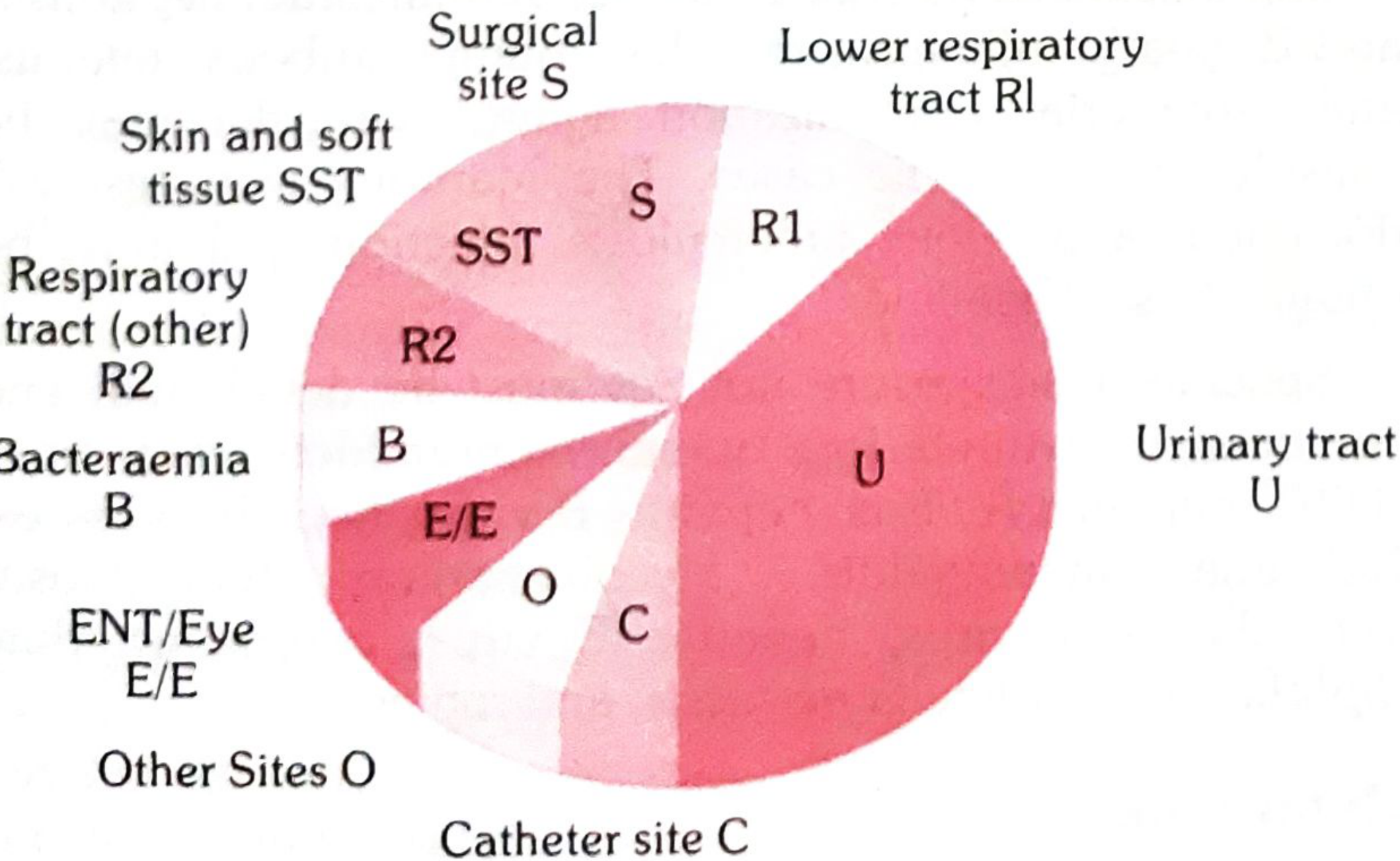
Source: Park's Textbook of Preventive and Social Medicine - French National Prevalence Survey
4. Three Angles to Analyze HAI
A. Sources
| Source | Examples |
|---|---|
| Patients | Infected wounds, UTI, TB, viral hepatitis, skin infections (boils, eczema, bed sores) |
| Hospital Staff | Skin diseases, sore throat, diarrhoea, common cold - staff can both acquire AND transmit |
| Environment | Hospital dust, water reservoirs (Pseudomonas), contaminated equipment |
B. Routes of Spread
- Direct contact - hands of nurses/doctors to patient (most common route!)
- Droplet infection - coughing/sneezing
- Airborne particles - hospital dust released during sweeping, bed making
- Hospital procedures - catheterization, IV lines, infected catgut, dressings, bedpans
C. Recipients (High-Risk Groups)
- ICU patients
- Severely ill patients
- Patients on corticosteroids (immunosuppressed)
- Urological ward patients
- Geriatric ward patients
- Special baby care units (neonates)
5. Key Pathogens (Important for Micro Exam)
Bacteria
| Pathogen | Key HAI |
|---|---|
| MRSA (Methicillin-resistant S. aureus) | Wound infections, SSI, bacteraemia - most feared gram-positive |
| Pseudomonas aeruginosa | VAP, UTI, burn infections, found in moist hospital reservoirs (sinks, ventilators, floor mops) |
| Klebsiella pneumoniae (incl. carbapenem-resistant) | Pneumonia, UTI, bloodstream - MDR strains emerging |
| E. coli | UTI (most common urinary pathogen), wound infections |
| Acinetobacter baumannii | VAP, MDR, ICU outbreaks |
| VRE (Enterococcus) | UTI, bloodstream - vancomycin resistant |
| Clostridioides difficile | Antibiotic-associated diarrhoea/colitis |
| Stenotrophomonas, Burkholderia cepacia | Opportunistic, nosocomial, MDR |
Fungi
- Candida spp. - most common fungal HAI; candidemia in ICU patients carries 2x mortality vs. non-candidal BSI
ESKAPE Pathogens (exam buzzword)
E - Enterococcus faecium
S - Staphylococcus aureus (MRSA)
K - Klebsiella pneumoniae
A - Acinetobacter baumannii
P - Pseudomonas aeruginosa
E - Enterobacter spp.
These are the 6 most problematic MDR nosocomial organisms.
6. Device-Associated HAI (High-Yield)
| Acronym | Full Name | Device | Key Organism |
|---|---|---|---|
| CAUTI | Catheter-associated UTI | Urinary catheter | E. coli, Klebsiella |
| CLABSI | Central line-associated BSI | Central venous catheter | Staph aureus, CoNS |
| VAP | Ventilator-associated pneumonia | Mechanical ventilator | Pseudomonas, Acinetobacter |
| SSI | Surgical site infection | Surgery | S. aureus, MRSA |
7. Simplified Diagnostic Criteria (Table to Memorize)
| Infection Type | Criterion |
|---|---|
| UTI | Positive urine culture (1-2 species) with ≥10⁵ bacteria/mL ± symptoms |
| SSI | Purulent discharge/abscess/cellulitis at surgical site within 1 month of operation |
| Respiratory | ≥2 of: cough + purulent sputum + new infiltrate on CXR, appearing during hospitalization |
| Vascular catheter | Inflammation/lymphangitis/purulent discharge at catheter insertion site |
| Septicaemia | Fever or rigors + ≥1 positive blood culture |
Source: WHO (2002) Prevention of Hospital-Acquired Infections, 2nd Ed.
8. Prevention Measures (Table 2 - Park's)
Proven Effective vs. NOT Effective (Very Exam-Likely)
UTI:
- ✅ Limit catheter duration, aseptic insertion, closed drainage, antimicrobial-coated catheter
- ❌ Systemic antibiotic prophylaxis, bladder irrigation
SSI:
- ✅ Clean OR environment, limit preoperative hospital stay, preoperative shower, optimal antibiotic prophylaxis
- ❌ Fumigation (classic wrong answer), preoperative shaving (increases infection risk)
Pneumonia / VAP:
- ✅ Aseptic intubation/suctioning, limit ventilator duration, non-invasive ventilation where possible, influenza vaccination for staff
- ❌ Digestive decontamination for ALL patients, changing ventilator circuit every 48-72 hours
Vascular device infections:
- ✅ Closed system, limit duration, aseptic technique at insertion, remove if infection suspected, antibiotic-coated catheter (short term)
- ❌ Antimicrobial creams for skin preparation
9. Standard Precautions (Routine Precautions)
Applied to ALL patients, regardless of diagnosis:
- Gloves for any contact with body fluids, blood, secretions
- Gown + mask + eye protection when contamination anticipated
- Wash hands promptly after contact with infective material
- Use no-touch technique wherever possible
- Promptly clean spills of infective material
- Proper waste handling
- Disinfect/sterilize patient-care equipment between patients
10. Administrative / Control Measures
- Hand washing - single most important measure (WHO "Clean Care is Safer Care" 2009 guidelines)
- Isolation - infectious patients isolated; susceptible patients kept away from source patients
- Staff health - sick staff kept away from work; staff immunizations (Hep A, B, influenza, MMR, tetanus)
- Dust control - wet dusting, vacuum cleaning; dry sweeping banned
- Disinfection - urine, faeces, sputum, instruments properly disinfected/sterilized
- Droplet control - face masks, adequate bed spacing, ventilation
- Barrier nursing / Task nursing
- Hospital Infection Control Committee - formulates policy on admission, isolation, disinfection
- Antibiotic stewardship - avoid unnecessary broad-spectrum antibiotics (prevents selection of MDR organisms)
11. Special Postexposure Policies for Staff (Must Know List)
Staff must have specific postexposure protocols for:
HIV, Hep A, Hep B, Hep C, Hep E, Neisseria meningitidis, M. tuberculosis, Varicella-zoster virus, Corynebacterium diphtheriae, Bordetella pertussis, Rabies
Quick Memory Summary
| Mnemonic | Point |
|---|---|
| >48 hours | Defines nosocomial infection timing |
| UTI = #1 | Most common HAI |
| Hands = #1 route | Most common route of transmission |
| ESKAPE | 6 key MDR nosocomial pathogens |
| No shaving, no fumigation | Proven NOT effective for SSI |
| CAUTI, CLABSI, VAP, SSI | 4 device-linked HAIs |
| ≥10⁵/mL | UTI diagnostic threshold |
| "Clean Care is Safer Care" | WHO 2009 hand hygiene guidelines |
Sources: Park's Textbook of Preventive and Social Medicine; Medical Microbiology 9e (Murray); Harrison's Principles of Internal Medicine 22E
This is a shared conversation. Sign in to Orris to start your own chat.