
Epimer mbbs biochemistry question answers
Reading File
Now let me search the medical library for epimer content alongside a web search for MBBS biochemistry exam questions.
Finding Sources
Searching the Web
epimer MBBS biochemistry MCQ questions answers epimerization examples
Good - found relevant content. Let me now read the key textbook sections on epimers and fetch the diagram image.
Reading File
Reading File
Let me also get the epimer definition and the key diagram, plus read the galactose/UDP-galactose section.
Reading File
Reading File
Loading Image
I have everything needed for a comprehensive MBBS biochemistry Q&A on epimers. Here is the full answer:
Epimers - MBBS Biochemistry: Questions & Answers
DEFINITION
Q1. What is an epimer?
A: Epimers are monosaccharides that differ from each other in the configuration of a single asymmetric (chiral) carbon atom - i.e., the position of the -OH group is reversed at only ONE carbon, while all other carbons remain identical.
- They are a subclass of diastereomers (stereoisomers that are NOT mirror images of each other).
- The enzyme that interconverts epimers is called an epimerase.
KEY EPIMER PAIRS (Most Exam-Tested)
| Epimer Pair | Carbon Differing | Enzyme Involved |
|---|---|---|
| Glucose ↔ Galactose | C-4 | UDP-hexose 4-epimerase |
| Glucose ↔ Mannose | C-2 | Phosphomannose isomerase |
| UDP-glucose ↔ UDP-galactose | C-4 | UDP-hexose 4-epimerase |
| D-glucuronic acid ↔ L-iduronic acid | C-5 | Epimerase (in GAG synthesis) |
The classic diagram (Lippincott Biochemistry, Fig. 7.4):
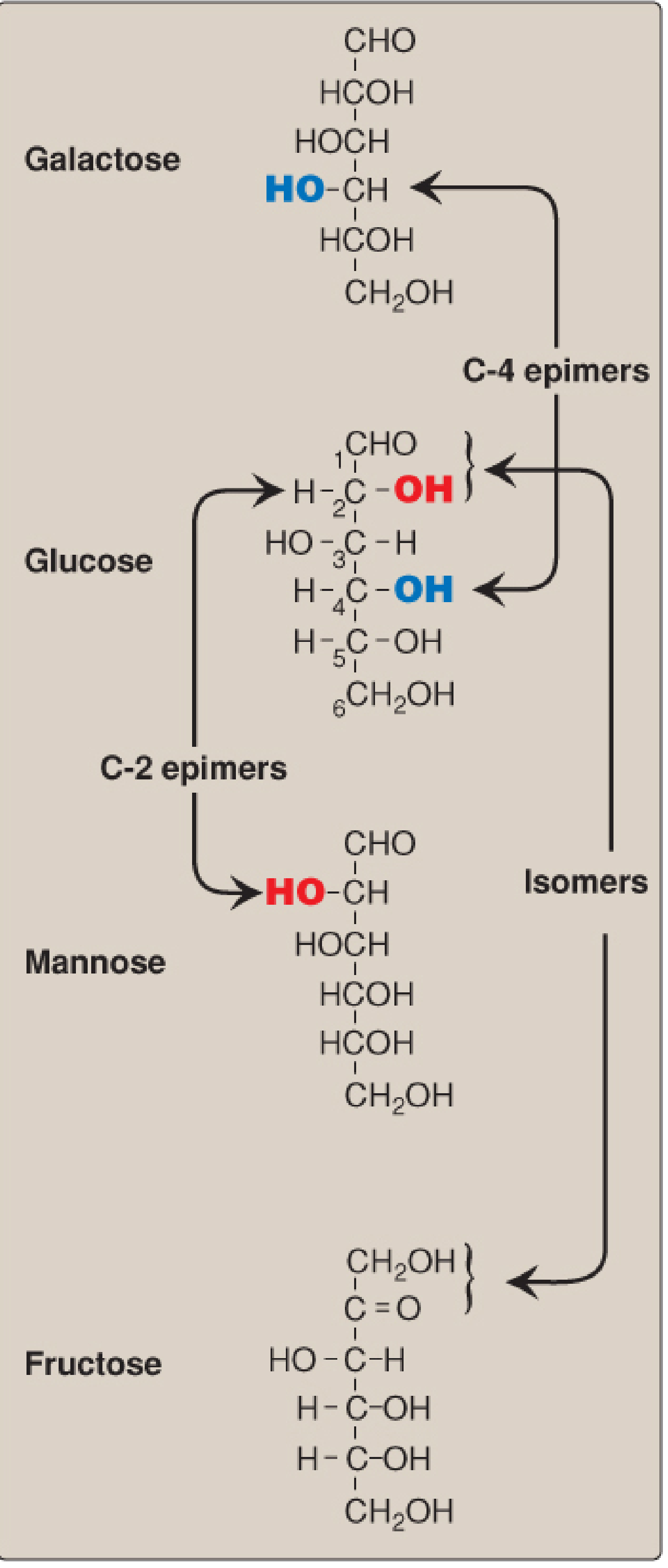
Glucose and Galactose are C-4 epimers (OH at C-4 flipped). Glucose and Mannose are C-2 epimers (OH at C-2 flipped). Fructose is a structural isomer (not an epimer) of glucose.
MCQs WITH ANSWERS
Q2. Glucose and galactose are epimers differing at which carbon?
- a) C-1
- b) C-2
- c) C-3
- d) C-4 ✓
Explanation: In galactose, the -OH at C-4 is on the opposite side compared to glucose. All other carbons are identical. They are C-4 epimers. - Lippincott Biochemistry, 8th ed.
Q3. Glucose and mannose are epimers differing at which carbon?
- a) C-1
- b) C-3
- c) C-2 ✓
- d) C-4
Explanation: Mannose is the C-2 epimer of glucose. Mannose is phosphorylated by hexokinase to mannose 6-phosphate, then converted to fructose 6-phosphate by phosphomannose isomerase.
Q4. Which of the following is an example of epimers?
- a) Glucose & fructose
- b) D-glucose & L-glucose
- c) Glucose & galactose ✓
- d) Glucose & ribose
Explanation:
- Glucose & fructose = structural isomers (keto vs. aldose)
- D-glucose & L-glucose = enantiomers (mirror images)
- Glucose & galactose = epimers (differ at C-4 only) ✓
- Glucose & ribose = different number of carbons (not isomers at all in the classical sense)
Q5. The enzyme UDP-hexose 4-epimerase catalyzes:
- a) Glucose → Mannose
- b) Mannose 6-P → Fructose 6-P
- c) UDP-galactose → UDP-glucose ✓
- d) Galactose → Galactitol
Explanation: This reaction is critical in galactose metabolism. UDP-galactose must be converted to UDP-glucose (its C-4 epimer) to enter mainstream glucose metabolism. This enzyme is also used in biosynthesis of UDP-galactose from UDP-glucose when dietary galactose is absent (e.g., lactose intolerance). - Lippincott, p.415
Q6. What type of isomerism is seen between α-D-glucose and β-D-glucose?
- a) Epimerism
- b) Enantiomerism
- c) Anomerism ✓
- d) Structural isomerism
Explanation: Anomers differ only at the anomeric carbon (C-1 for aldoses). This is NOT epimerism. The process of interconversion between α and β anomers is called mutarotation. Do NOT confuse anomers with epimers!
Q7. In glycosaminoglycan (GAG) synthesis, which pair represents C-5 epimers?
- a) Glucose & Galactose
- b) Glucose & Mannose
- c) D-glucuronic acid & L-iduronic acid ✓
- d) Glucose & Fructose
Explanation: D-glucuronic acid and L-iduronic acid are C-5 epimers found in GAGs such as heparan sulfate and dermatan sulfate. L-iduronic acid is formed from D-glucuronic acid by epimerization at C-5. - Lippincott, p. carbohydrate section
Q8. Mannose enters glycolysis via:
- a) Direct phosphorylation to glucose 6-phosphate
- b) Hexokinase → Mannose 6-P → Fructose 6-P ✓
- c) Glucokinase → Glucose 1-P
- d) UDP-hexose epimerase reaction
Explanation: Hexokinase phosphorylates mannose to mannose 6-phosphate; phosphomannose isomerase then converts it to fructose 6-phosphate, which enters glycolysis. - Lippincott, p.409
HIGH-YIELD SUMMARY TABLE
| Concept | Detail |
|---|---|
| Definition | Monosaccharides differing at only ONE asymmetric carbon |
| Enzyme | Epimerase (interconverts epimers) |
| Glucose & Galactose | C-4 epimers |
| Glucose & Mannose | C-2 epimers |
| Glucuronic acid & Iduronic acid | C-5 epimers (in GAGs) |
| NOT an epimer | Anomers (differ at anomeric C-1 only) |
| NOT an epimer | Enantiomers (mirror images of the whole molecule) |
| NOT an epimer | Fructose (structural isomer of glucose, not epimer) |
| Clinical significance | Galactosemia: defect in galactose→glucose pathway; UDP-hexose 4-epimerase deficiency |
TRICKY DISTINGUISHING POINTS (Exam Traps)
| Comparison | Epimers | Anomers | Enantiomers |
|---|---|---|---|
| Differ at | One specific C (not C-1) | Anomeric C-1 (or C-2) | ALL asymmetric carbons |
| Mirror image? | No | No | Yes |
| Example | Glu & Gal (C-4) | α-Glucose & β-Glucose | D-Glucose & L-Glucose |
| Interconversion | Epimerases | Mutarotation | Specific enzymes |
Remember: All epimers are diastereomers, but not all diastereomers are epimers. Anomers are a special subtype of diastereomers, NOT epimers.
Sources: Biochemistry, 8th ed. Lippincott Illustrated Reviews, pp. 258-261, 409, 415; Basic Medical Biochemistry, 6e.
This is a shared conversation. Sign in to Orris to start your own chat.