
Rebound hypoglycemia
Rebound hypoglycemia is the Somogyi effect - a phenomenon where hypoglycemia (usually overnight) triggers counter-regulatory hormone release (glucagon, epinephrine, cortisol, growth hormone), causing a rebound hyperglycemia. It is most classically described in insulin-treated diabetics and in neonates. The core concept: the body overcorrects low blood sugar, producing high blood sugar readings the next morning.
Searching sources...
Reading File
Finding Sources
Finding Sources
Searching PubMed
"rebound hypoglycemia" OR "Somogyi effect"
Now let me read the most relevant textbook sections in parallel for deeper content:
Reading File
Reading File
Finding Sources
Finding Sources
Finding Sources
Reading File
Reading File
Reading File
Loading Image
Reading File
I now have comprehensive information from multiple authoritative sources. Here is the full answer:
Rebound Hypoglycemia
Definition and the Somogyi Effect
Rebound hypoglycemia refers to a secondary fall in blood glucose that occurs after an initial correction or treatment of hypoglycemia. The classic description is the Somogyi effect - named after Michael Somogyi - where nocturnal hypoglycemia triggers an exaggerated counter-regulatory hormone surge that causes morning hyperglycemia, which then may be followed by another hypoglycemic dip. A 2025 review in Hormones (Athens) (PMID: 39718705) revisits this phenomenon in the context of Somogyi's own life and scientific legacy.
Counter-Regulatory Physiology (The Mechanism)
When plasma glucose falls, a cascade of defense hormones is activated (Goldman-Cecil Medicine):
| Plasma Glucose Threshold | Response |
|---|---|
| < 72 mg/dL (4.0 mmol/L) | Insulin secretion decreases |
| < 68 mg/dL (3.8 mmol/L) | Epinephrine + norepinephrine released; glucagon rises sharply |
| < 66 mg/dL (3.7 mmol/L) | Growth hormone + cortisol secreted |
- Glucagon (primary defense): acts on liver to increase glycogenolysis and gluconeogenesis
- Epinephrine/norepinephrine: suppresses insulin, boosts glucagon, decreases peripheral glucose uptake, stimulates lipolysis
- Cortisol + growth hormone: increase gluconeogenesis, antagonize insulin (slower onset, hours)
In healthy individuals, these responses prevent hypoglycemia from persisting. In insulin-treated or sulfonylurea-treated patients, this same system can overshoot - producing rebound hyperglycemia and then, if insulin is still active, a secondary hypoglycemic episode.
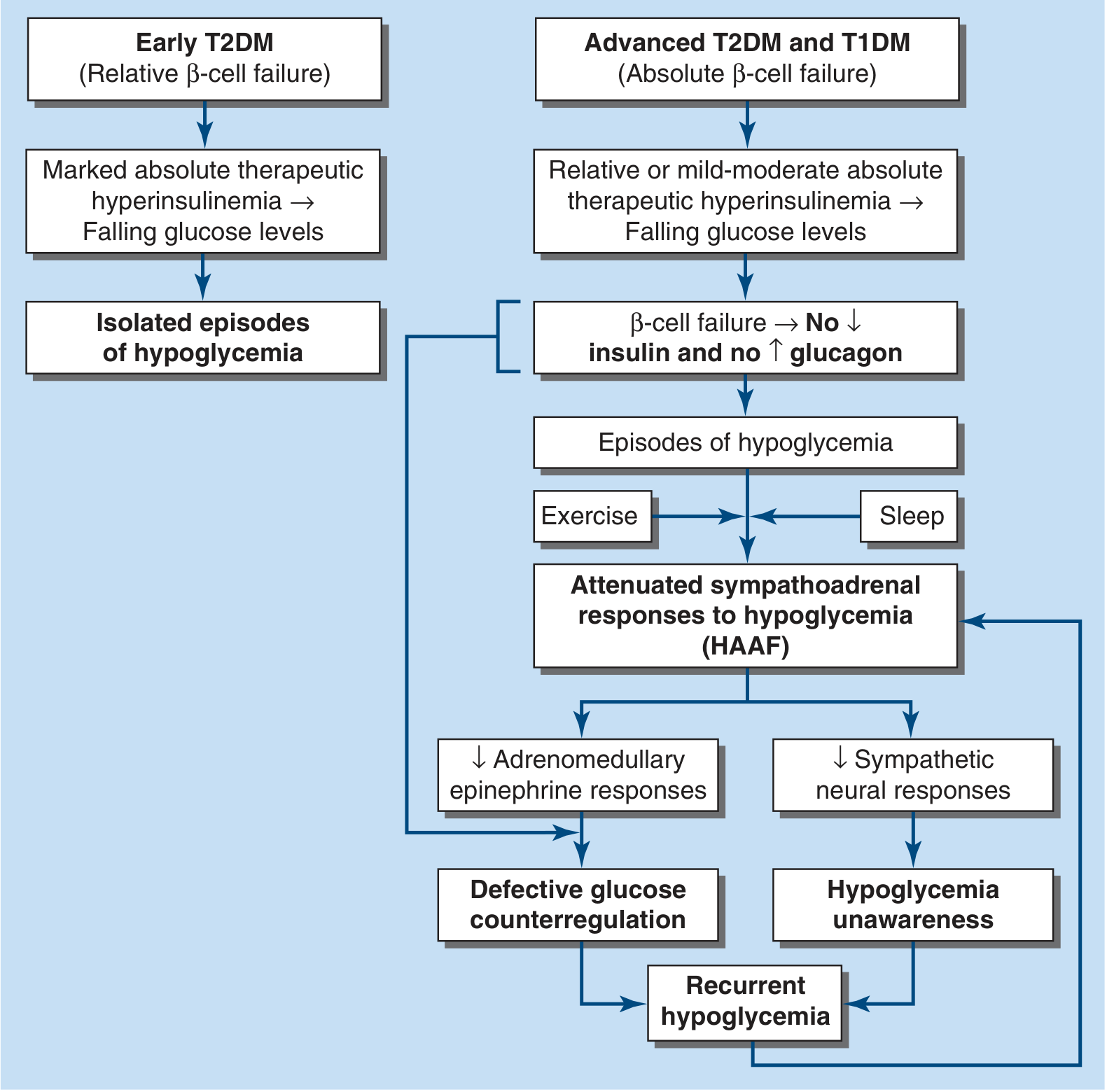
Figure: Hypoglycemia-associated autonomic failure (HAAF) in insulin-deficient diabetes - from Harrison's Principles of Internal Medicine, 22nd Ed.
Clinical Contexts Where Rebound Hypoglycemia Occurs
1. Glucagon Administration
Glucagon stimulates glycogenolysis to raise blood glucose, but it also stimulates insulin secretion - this can cause rebound hypoglycemia after the glycogen is replenished. Blood glucose monitoring is mandatory after glucagon use. - Goldman-Cecil Medicine
"Glucagon can cause rebound hypoglycemia, so the patient will need blood glucose monitoring after the administration of glucagon."
2. Sulfonylurea-Induced Hypoglycemia
Sulfonylureas cause prolonged, recurrent hypoglycemia because:
- They stimulate insulin secretion in a glucose-independent fashion
- When glucose is given to correct the hypoglycemia, it can further stimulate insulin release, worsening or recapitulating hypoglycemia
- Episodes can persist for hours to days
Management: Octreotide (a somatostatin analogue, 50 mcg SC) is used to suppress insulin secretion and prevent rebound. It is given only after initial glucose therapy, not as primary treatment. - Tintinalli's Emergency Medicine; Harrison's
3. Abrupt Cessation of Parenteral Nutrition (PN)
Rebound hypoglycemia can occur if PN is terminated abruptly, because the pancreas continues secreting insulin in response to the previously high glucose load. This is now less frequent with lipid-containing "all-in-one" PN bags. - Tietz Textbook of Laboratory Medicine
4. Hypothermia / Rewarming
Exogenous insulin administration is unwarranted in hypothermia because it may result in rebound hypoglycemia during rewarming (as metabolic rate increases and glucose utilization resumes). - Sabiston Textbook of Surgery; Mulholland & Greenfield's Surgery
5. Insulinoma
Diazoxide (a drug used for blood pressure control) must be avoided in insulinoma patients - it can trigger rebound hypoglycemia. - Katzung's Basic & Clinical Pharmacology
6. Neonates and Pediatrics (Cardiopulmonary Bypass)
Children are especially prone to rebound hypoglycemia in the context of bypass surgery because of limited glycogen stores; adults typically develop hyperglycemia instead. - Miller's Anesthesia
Hypoglycemia-Associated Autonomic Failure (HAAF) - The Vicious Cycle
A key complication in insulin-treated diabetes is HAAF. Recurrent antecedent hypoglycemia blunts subsequent counter-regulatory responses:
- Prior hypoglycemia (or sleep, or exercise) reduces the epinephrine response to a subsequent hypoglycemic episode
- This impairs both glucose counter-regulation and hypoglycemia awareness
- Results in a self-perpetuating cycle of increasingly severe and unrecognized hypoglycemia
Patients with defective counter-regulation are 25-fold more likely to experience severe iatrogenic hypoglycemia; those with hypoglycemia unawareness are at 6-fold increased risk. - Harrison's Principles of Internal Medicine, 22nd Ed.
Critically, hypoglycemia unawareness and the epinephrine component of defective counter-regulation are reversible with 2-3 weeks of strict hypoglycemia avoidance. - Harrison's
Emergency Management Summary
| Step | Action |
|---|---|
| Conscious patient | 15-20 g oral glucose (tablets, juice) |
| Altered mental status | IV dextrose 50% - 50 mL (25 g) bolus; repeat at 15 min if needed |
| No IV access | Glucagon 1 mg IM/SC (ineffective in alcohol-induced hypoglycemia or depleted glycogen) |
| Sulfonylurea-induced | Add octreotide 50 mcg SC after initial glucose correction |
| Monitoring | BG every 30 minutes for the first 2 hours to detect rebound |
| Maintenance | Continuous 5% dextrose infusion if still unconscious or nil-by-mouth; target BG > 100 mg/dL |
- Tintinalli's Emergency Medicine; Harrison's
Prevention of Recurrence
- Reduce or stop the offending drug (sulfonylurea, excess insulin)
- Treat underlying critical illness contributing to hypoglycemia
- Replace cortisol/growth hormone if deficient
- Surgical resection of insulinoma (curative); diazoxide or octreotide if surgery not possible
- For brittle nocturnal hypoglycemia: uncooked cornstarch at bedtime or overnight intragastric glucose infusion
- Scrupulous avoidance of hypoglycemia for 2-3 weeks can reverse HAAF
Create a quick reference guide for treating sulfonylurea-induced hypoglycemia
Asking for Preferences
What format should the quick reference guide be in?
I have strong context from the previous session. Let me pull a few targeted details to make the dosing and monitoring protocols precise.
Finding Sources
Finding Sources
Reading File
Reading File
Reading File
I now have everything needed for a precise, well-sourced quick reference guide.
⚡ Quick Reference: Sulfonylurea-Induced Hypoglycemia
WHY IT'S DIFFERENT
Sulfonylureas (glibenclamide, glipizide, gliclazide, glimepiride, chlorpropamide) stimulate insulin secretion in a glucose-independent manner via ATP-sensitive K⁺ channel blockade. This creates two critical problems:
- Glucose administration can further stimulate insulin release, perpetuating or worsening hypoglycemia
- Hypoglycemia can be prolonged and severe - lasting hours to days with long-acting agents
- A single pill can cause refractory hypoglycemia in high-risk patients (children, renal failure)
HIGH-RISK PATIENTS
| Factor | Risk |
|---|---|
| Impaired renal function | Reduced drug clearance - markedly prolonged effect |
| Pediatric patients | Even a single pill can be lethal |
| Drug-naive patients | No metabolic tolerance |
| Elderly | Decreased renal clearance + impaired counter-regulation |
| Concurrent alcohol use | Glycogen depletion + impaired gluconeogenesis |
| Drug interactions | NSAIDs, fluoroquinolones, clarithromycin potentiate hypoglycemia |
STEP-BY-STEP TREATMENT
STEP 1 - Correct the Hypoglycemia Immediately
| Patient Status | Treatment |
|---|---|
| Conscious, able to swallow | 15-20 g oral glucose (glucose tablets, juice, sugar) |
| Altered mental status / IV access | D50W 50 mL (25 g glucose) IV bolus; repeat at 15 min if BG still low |
| No IV access | Glucagon 1 mg IM/SC -- BUT see caution below |
Glucagon caution: NOT recommended for sulfonylurea-induced hypoglycemia as first-line. It stimulates further insulin secretion and provides only a short-lived response. Use only if IV access cannot be obtained. - Tintinalli's Emergency Medicine
STEP 2 - Add Octreotide (KEY Intervention)
Octreotide is a somatostatin analogue that suppresses insulin secretion from pancreatic beta cells via a receptor distinct from the sulfonylurea receptor.
Indication: Give after initial glucose correction, when dextrose response is inadequate or recurrent hypoglycemia occurs.
| Regimen | Dose |
|---|---|
| Adults - first episode | 50-100 mcg SC or IV |
| Adults - recurrent episodes | 50-100 mcg SC/IV every 6-8 hours OR continuous IV infusion at 125 mcg/hour |
| Pediatric dose | 0.1 mcg/kg SC or IV |
Octreotide reduces frequency of recurrent hypoglycemic episodes and decreases total glucose supplementation requirement. It does not replace the need for prolonged monitoring. - Rosen's Emergency Medicine; Tintinalli's
Do NOT give octreotide before initial glucose therapy. It is an adjunct to prevent recurrence, not a replacement for immediate glucose correction.
STEP 3 - Maintenance Glucose Infusion
- Start a continuous IV infusion of D5W targeted to maintain BG > 100 mg/dL (5.5 mmol/L)
- Titrate the infusion rate based on serial glucose checks
- Do NOT give large dextrose boluses repeatedly - this stimulates further insulin release
STEP 4 - Refractory Cases
If hypoglycemia persists despite dextrose + octreotide:
Diazoxide - directly inhibits pancreatic beta cell insulin secretion (different mechanism to octreotide)
- Dose: 300 mg IV as a slow infusion over 30 minutes, every 4 hours
- Caution: can cause hypotension - administer slowly
MONITORING PROTOCOL
| Time | Action |
|---|---|
| Continuous | Clinical observation, mental status checks |
| Every 30 min | Blood glucose for first 2 hours post-correction |
| Every 1-2 hours | Continue BG monitoring throughout observation period |
| Watch for | Rebound hypoglycemia, seizures |
DISPOSITION
| Scenario | Disposition |
|---|---|
| Any sulfonylurea-induced hypoglycemia | Admit for serial glucose monitoring - even if corrected in ED |
| Overdose / suspected ingestion | Minimum 24 hours observation |
| Pediatric / renal failure ingestion | Observe even if initially euglycemic - hypoglycemia may be delayed up to 18 hours |
| Single accidental episode, short-acting agent, euglycemic after 4h, reliable follow-up | May discharge after uneventful 4-hour observation; must eat before leaving |
"Patients with hypoglycemia caused by long-acting sulfonylurea medications should be observed in the hospital if they have recurrent hypoglycemia after a period of observation in the ED." - Rosen's Emergency Medicine
WHAT NOT TO DO
| Avoid | Reason |
|---|---|
| Relying on glucagon alone | Stimulates further insulin secretion; short-lived response; not recommended as first-line for SU hypoglycemia |
| Discharging after single BG correction | Risk of delayed/recurrent hypoglycemia lasting hours to days |
| Large repeated dextrose boluses without octreotide | Glucose-stimulated insulin release perpetuates hypoglycemia |
| Hemodialysis / charcoal hemoperfusion | Not routinely recommended despite being mentioned in case reports |
COMMON SULFONYLUREAS AT A GLANCE
| Drug | Duration of Action | Relative Risk |
|---|---|---|
| Chlorpropamide | Up to 60 hours | Very high |
| Glibenclamide (glyburide) | 16-24 hours | High |
| Glimepiride | 12-24 hours | High |
| Glipizide | 12-24 hours | Moderate-High |
| Gliclazide | 12-20 hours | Moderate |
| Tolbutamide | 6-12 hours | Lower |
SOURCES
- Tintinalli's Emergency Medicine: A Comprehensive Study Guide - Hypoglycemia chapter
- Rosen's Emergency Medicine: Concepts and Clinical Practice - Hypoglycemia/Disposition
- Harrison's Principles of Internal Medicine, 22nd Ed. (2025) - Urgent Treatment of Hypoglycemia
- Goldman-Cecil Medicine - Antidotes table (Octreotide: 1-2 mcg/kg IV/SC for SU-induced hypoglycemia)
When to administer 25% D
25% dextrose (D25W) is typically used instead of D50W when IV access is peripheral in neonates and children, or when D50W would be too hypertonic for a small vein. It delivers the same glucose load with less osmotic risk to the vessel wall.
Searching sources...
Reading File
Your credits are exhausted. You can purchase a top-up or subscribe to a plan to continue using Orris. If you're already subscribed, your daily credits will reset tomorrow.
This is a shared conversation. Sign in to Orris to start your own chat.