
Make notes on hyponatremia , chart for evaluation, causes and management
Reading File
Finding Sources
Finding Sources
Reading File
Reading File
Reading File
Reading File
Reading File
Finding Sources
Reading File
Reading File
Loading Image
Reading File
Reading File
Reading File
Reading File
Reading File
I now have comprehensive content from multiple authoritative textbooks. Let me compile the detailed notes.
Hyponatremia - Comprehensive Clinical Notes
Definition & Classification
Hyponatremia = serum sodium (Na⁺) < 135 mEq/L (some sources use <136 mEq/L).
- Mild: 130-134 mEq/L
- Moderate: 125-129 mEq/L
- Severe: < 125 mEq/L
- Critical/Symptomatic emergency: < 120 mEq/L (or < 115 mEq/L for seizures/coma)
Incidence: 15-30% of hospitalized patients; ~1.7% prevalence in the general population.
Pathophysiology
Hyponatremia in every case reflects excess free water relative to sodium. Two main mechanisms:
- Reduced renal free-water excretion - the dominant cause in most clinical settings
- Actions of ADH (vasopressin) on collecting duct → aquaporin-2 insertion → water reabsorption
- Low distal delivery of filtrate (reduced GFR, increased proximal tubule NaCl reabsorption)
- Excessive free-water intake overwhelming renal capacity (e.g., psychogenic polydipsia)
ADH release stimuli:
- Osmotic: triggered by plasma osmolality >280 mOsm/kg at the hypothalamic osmostat
- Non-osmotic: hypovolemia, hypotension, nausea, pain, stress (via carotid sinus/left atrial baroreceptors)
Brain adaptation (critical for management):
- Acute hyponatremia (<48 hrs): brain cells swell → cerebral edema → neurological symptoms
- Chronic hyponatremia (>48 hrs): brain cells export K⁺, organic osmolytes (taurine, myoinositol) → volume normalizes → symptoms diminish
- Rapid correction of chronic hyponatremia → osmotic demyelination syndrome (ODS / central pontine myelinolysis)
Classification by Osmolality
| Type | Serum Na⁺ | Plasma Osmolality | Etiology |
|---|---|---|---|
| Hypo-osmolar | <135 | Low (<280) | True hyponatremia - most clinical cases |
| Iso-osmolar | <135 | Normal (280-295) | Pseudohyponatremia - hyperlipidemia, paraproteinemia; or hyperglycemia, alcohols |
| Hyper-osmolar | <135 | High (>295) | Hyperglycemia, mannitol, glycerol |
Correction for hyperglycemia: for every 100 mg/dL rise in glucose above normal, Na⁺ falls by ~1.6-2.4 mEq/L
Diagnostic Evaluation Chart
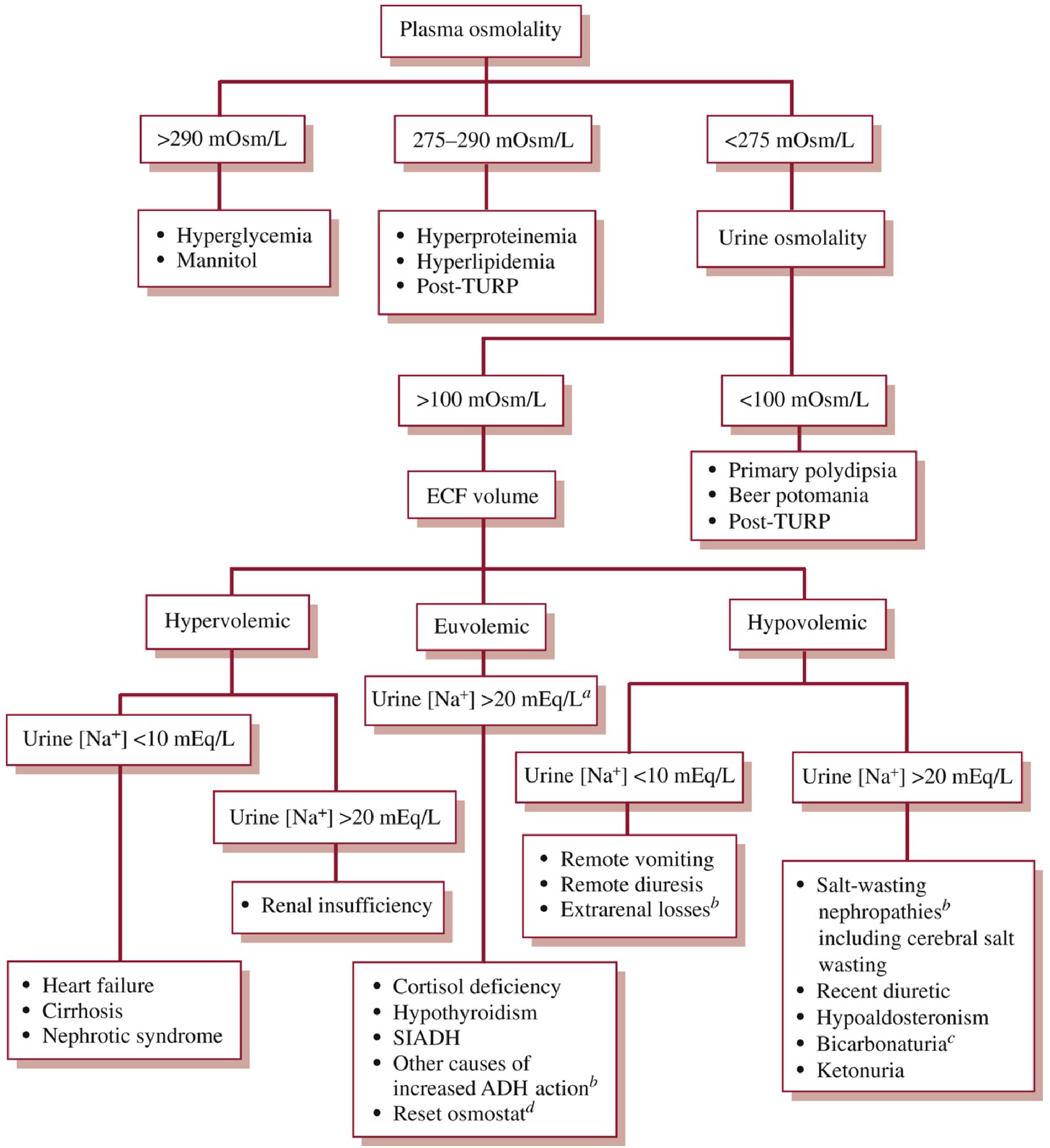
Step-by-Step Evaluation
Serum Na⁺ < 135 mEq/L
         │
         ▼
Step 1: Measure PLASMA OSMOLALITY
         │
    ┌────┴────────────────────┐
    ▼                         ▼
>290 mOsm/L            275-290 mOsm/L          <275 mOsm/L
(Hyperosmolar)         (Iso-osmolar)            (Hypo-osmolar)
    │                         │                         │
Hyperglycemia         Pseudohyponatremia         ▼
Mannitol              (Hyperlipidemia,    Step 2: Measure URINE OSMOLALITY
                      Hyperproteinemia,          │
                      Post-TURP)          ┌──────┴──────┐
                                          ▼             ▼
                                     >100 mOsm/L   <100 mOsm/L
                                    (ADH present)  (ADH absent/Max dilute urine)
                                          │         Primary polydipsia
                                          ▼         Beer potomania
                               Step 3: Assess ECF VOLUME STATUS
                                          │
                         ┌────────────────┼──────────────────┐
                         ▼                ▼                   ▼
                    HYPERVOLEMIC      EUVOLEMIC           HYPOVOLEMIC
Key Urine Indices in Evaluation
| Test | Low (<10-20 mEq/L) | High (>20 mEq/L) |
|---|---|---|
| Urine Na⁺ | Renal Na⁺ conservation (low EABV) | Renal Na⁺ wasting or SIADH |
| Urine osmolality | <100 mOsm → maximal free water excretion | >100 mOsm → ADH effect present |
Causes (by Volume Status)
1. HYPOVOLEMIC HYPONATREMIA
Total body Na⁺ ↓ (sodium loss > water loss); ADH released due to volume depletion
Extrarenal losses (Urine Na⁺ < 10 mEq/L):
- Vomiting, diarrhea, GI suction
- Sweating, burns
- Third-spacing: bowel obstruction, pancreatitis, rhabdomyolysis
Renal losses (Urine Na⁺ > 20 mEq/L):
- Thiazide diuretics (most common drug cause in adults)
- Loop diuretics
- Mineralocorticoid deficiency / Hypoaldosteronism
- Salt-wasting nephropathies (including cerebral salt wasting)
- Osmotic diuresis (glycosuria, urea diuresis)
- Renal tubular acidosis
- Bicarbonaturia (from vomiting-induced alkalosis or proximal RTA)
- Ketonuria
2. EUVOLEMIC HYPONATREMIA
Total body water ↑, Na⁺ near normal; most common form in clinical practice
SIADH (most important - Urine Na⁺ > 20 mEq/L, Urine Osm > plasma Osm):
Diagnostic criteria for SIADH:
- Hypo-osmolar hyponatremia
- Urine osmolality > 100 mOsm/kg (inappropriately concentrated)
- Urine Na⁺ > 20-40 mEq/L
- Clinically euvolemic
- Normal thyroid and adrenal function
- No diuretics
Causes of SIADH:
| Category | Examples |
|---|---|
| CNS | Meningitis, encephalitis, subarachnoid hemorrhage, stroke, head trauma, brain tumor, GBS, acute porphyria |
| Pulmonary | Pneumonia, TB, lung abscess, aspergillosis, positive-pressure ventilation |
| Malignancy | Small cell lung cancer (most common - 10-45%), head/neck tumors, other solid tumors, lymphoma, thymoma |
| Drugs | SSRIs, SNRIs, opioids, antipsychotics, carbamazepine, oxcarbazepine, chlorpropamide, cyclophosphamide, cisplatin, vincristine, vinblastine, NSAIDs, desmopressin, oxytocin, ecstasy (MDMA), nicotine |
| Other | Nausea (potent ADH stimulus), pain, HIV/AIDS, acute psychosis |
Other euvolemic causes:
- Hypothyroidism - reduced cardiac output → baroreceptor-mediated ADH release
- Adrenal insufficiency (cortisol deficiency) - CRH stimulates ADH; aldosterone deficiency causes Na⁺ loss
- Reset osmostat - osmostat set at lower threshold; urine can be appropriately diluted after water load
- Primary polydipsia - urine Osm < 100 mOsm/kg (maximally dilute); psychiatric illness, medications
- Beer potomania - low dietary solute + high free water; very low urine Osm
3. HYPERVOLEMIC HYPONATREMIA
Total body Na⁺ ↑ but total body water rises more; effective arterial blood volume (EABV) is low
Urine Na⁺ < 10 mEq/L (avid renal Na⁺ retention):
- Heart failure - low cardiac output → baroreceptor activation → ADH + RAAS
- Cirrhosis - splanchnic vasodilation → reduced EABV → ADH + RAAS
- Nephrotic syndrome - hypoalbuminemia → reduced oncotic pressure → edema
Urine Na⁺ > 20 mEq/L:
- Renal failure (acute or chronic) - reduced GFR limits distal delivery
Clinical Features
Symptoms (severity correlates with rate of fall and degree)
| Severity | Na⁺ Level | Symptoms |
|---|---|---|
| Mild | 130-134 | Often asymptomatic; nausea, malaise |
| Moderate | 125-129 | Headache, lethargy, fatigue, confusion |
| Severe | 115-125 | Disorientation, muscle cramps, altered consciousness |
| Critical | <115 | Seizures, coma, respiratory arrest, herniation |
- Acute hyponatremia (developing <48 hrs): symptoms appear at higher Na⁺ levels due to rapid cerebral edema
- Chronic hyponatremia (>48-72 hrs): adapted brain cells - symptoms appear at lower Na⁺ levels
- Special risk: Pre-menopausal women are more vulnerable to cerebral herniation from acute hyponatremia
Management
General Principles
- Identify and treat the underlying cause
- Determine acuity (acute <48 hrs vs. chronic >48 hrs)
- Assess symptom severity (mild/moderate vs. severe)
- Correct at a safe rate to avoid ODS
Rate of Correction (Critical!)
| Situation | Target Rate |
|---|---|
| Chronic hyponatremia (>48 hrs) | ≤ 8 mEq/L in 24 hrs (some guidelines: ≤10 mEq/L/24h) |
| Acute symptomatic (<48 hrs) | 4-6 mEq/L in first 4-6 hours to reverse symptoms, then slow |
| Maximum in any 24-hr period | ≤ 10-12 mEq/L (exceeding this risks ODS) |
High-risk patients for ODS: Alcoholism, malnutrition, hypokalemia, liver disease, elderly
Formula (Adrogue-Madias): Change in serum Na⁺ per liter of infusate:
ΔNa⁺ = (Infusate Na⁺ - Serum Na⁺) ÷ (TBW + 1) TBW = 0.6 × lean body weight (men), 0.5 × lean body weight (women)
Infusate sodium concentrations:
| Fluid | Na⁺ (mEq/L) |
|---|---|
| 3% hypertonic saline | 513 |
| 0.9% normal saline | 154 |
| Lactated Ringer's | 130 |
| 0.45% half-normal saline | 77 |
| D5W | 0 |
Management by Type
A. Hypovolemic Hyponatremia
- Isotonic saline (0.9% NaCl) - replaces volume deficit
- Volume repletion removes the ADH stimulus → spontaneous water excretion
- Risk: Na⁺ can rise rapidly once volume is restored; monitor closely
- If adrenal insufficiency: hydrocortisone replacement
B. Euvolemic Hyponatremia (SIADH)
| Severity | Treatment |
|---|---|
| Mild, asymptomatic | Fluid restriction (typically 800-1000 mL/day; <1.5 L/day per Goldman-Cecil guidelines) |
| Moderate, symptomatic | Fluid restriction + address underlying cause |
| Severe/refractory SIADH | Options below |
Additional SIADH treatments:
- Oral salt tablets + loop diuretics (furosemide) - increases solute excretion
- Demeclocycline 600-1200 mg/day - causes nephrogenic DI; onset slow (days); useful in chronic SIADH (avoid in liver disease)
- Urea (30-60 g/day orally) - increases urine solute excretion; effective but unpalatable
- Vaptans (V2-receptor antagonists):
- Tolvaptan (oral): 15 mg/day → titrate to 30-60 mg if needed - causes selective free water excretion ("aquaresis"); avoid if liver disease; do not initiate in hospital for chronic hyponatremia (rapid correction risk)
- Conivaptan (IV): approved for euvolemic and hypervolemic hyponatremia in hospital setting
- Not recommended for >30 days due to hepatotoxicity concerns
- Treat the cause: Chemotherapy for SCLC, stop offending drugs, treat pneumonia/CNS disease
C. Hypervolemic Hyponatremia
- Fluid and Na⁺ restriction (cornerstone)
- Treat underlying condition:
- Heart failure: ACE inhibitors, diuretics, optimize cardiac function
- Cirrhosis: Fluid restriction to 1.5 L/day for Na⁺ <130 mEq/L; tolvaptan as bridge to transplant only; avoid in hepatotoxicity risk
- Renal failure: dialysis when indicated
- Loop diuretics (furosemide) for symptom relief in fluid-overloaded states
- Vaptans: modest short-term benefit in CHF/cirrhosis but no survival benefit
D. Acute Severe/Symptomatic Hyponatremia
(Na⁺ ≤ 120 mEq/L with seizures, coma, or herniation signs)
- 3% Hypertonic saline - indicated immediately
- Goal: raise Na⁺ by 4-6 mEq/L in first hour to halt cerebral edema
- Infusion rate: ~100 mL of 3% NaCl over 10-20 minutes, repeat up to 3 times if needed (European guidelines)
- Or: 1-2 mL/kg/hr of 3% NaCl
- Once symptoms improve, slow correction to ≤8 mEq/L total in 24 hrs
- Monitor serum Na⁺ every 2-4 hours
Overcorrection emergency:
- If Na⁺ rises too fast → stop all Na⁺ infusions
- Give D5W or DDAVP (desmopressin 2-4 mcg IV) to re-lower Na⁺
- Can "re-lower" sodium deliberately with free water if overcorrection occurs
Summary Management Table
| Category | Key Treatment |
|---|---|
| Hypovolemic - extrarenal | 0.9% NS IV; treat cause |
| Hypovolemic - adrenal | Hydrocortisone + NS |
| SIADH - mild | Fluid restriction 800-1000 mL/day |
| SIADH - moderate | Fluid restriction + salt tabs + furosemide |
| SIADH - severe/refractory | Tolvaptan / Conivaptan / Urea / Demeclocycline |
| Acute symptomatic | 3% Hypertonic saline + close monitoring |
| Hypervolemic (CHF/cirrhosis) | Fluid + Na⁺ restriction; loop diuretics; treat primary disease |
| Hypervolemic (renal failure) | Dialysis; fluid restriction |
| Overcorrection (ODS risk) | D5W + DDAVP; stop all Na⁺ sources |
Osmotic Demyelination Syndrome (ODS)
- Previously "central pontine myelinolysis"
- Caused by rapid osmotic shifts shrinking cerebral vascular endothelial cells → blood-brain barrier breakdown → oligodendrocyte damage
- Clinical features: Flaccid paralysis, dysarthria, dysphagia, locked-in syndrome
- Imaging: MRI shows T2 hyperintensity in pons (and extrapontine)
- Prevention: Never exceed 8-10 mEq/L correction in 24 hours in chronic hyponatremia
- Risk factors: Alcoholism, malnutrition, hypokalemia, liver disease, elderly females
Special Situations
| Context | Notes |
|---|---|
| Post-TURP / post-hysteroscopy | Irrigation fluid absorption → iso/hypo-osmolar Na⁺ ↓; treat with 0.9% NS and furosemide |
| Exercise-associated | Excess hypotonic fluid intake + non-osmotic ADH; give hypertonic saline if symptomatic |
| Psychogenic polydipsia | Water restriction; treat underlying psychiatric disorder |
| Malignancy | SIADH workup; treat cancer; chemo agents (cyclophosphamide, cisplatin) can cause SIADH |
| HIV | Multiple causes - adrenal insufficiency, SIADH, hypovolemia from GI losses |
| Hypothyroidism | Correct with thyroid hormone replacement |
| Perioperative | Hypotonic IV fluids + ADH surge; use isotonic fluids perioperatively |
Sources: Washington Manual of Medical Therapeutics; Rosen's Emergency Medicine; Goldman-Cecil Medicine; Brenner and Rector's The Kidney - all editions consulted via the medical library.
This is a shared conversation. Sign in to Orris to start your own chat.