
What happens if kcl ivf is put at high speed?
Rapid intravenous infusion of potassium chloride (KCl) is extremely dangerous and potentially fatal. High-speed KCl IV can cause sudden cardiac arrhythmias - including ventricular fibrillation and cardiac arrest - because a rapid spike in serum potassium disrupts the cardiac conduction system. This is one of the most serious medication errors in clinical practice.
Searching sources...
Reading File
Finding Sources
Searching the Web
KCl IV high speed rapid infusion dangers cardiac effects
Reading File
Reading File
Let me also fetch the ECG image showing hyperkalemia effects.
Loading Image
Here is a complete, evidence-based answer:
KCl IV at High Speed: What Happens and Why It's Dangerous
The Core Problem - Acute Hyperkalemia
When KCl is infused too rapidly, serum potassium spikes faster than the body can redistribute or excrete it. This causes acute hyperkalemia, which has a predictable and potentially fatal progression of effects on the heart.
Cardiac Effects (Most Dangerous)
Rapid infusion causes the following ECG changes in sequence as potassium rises:
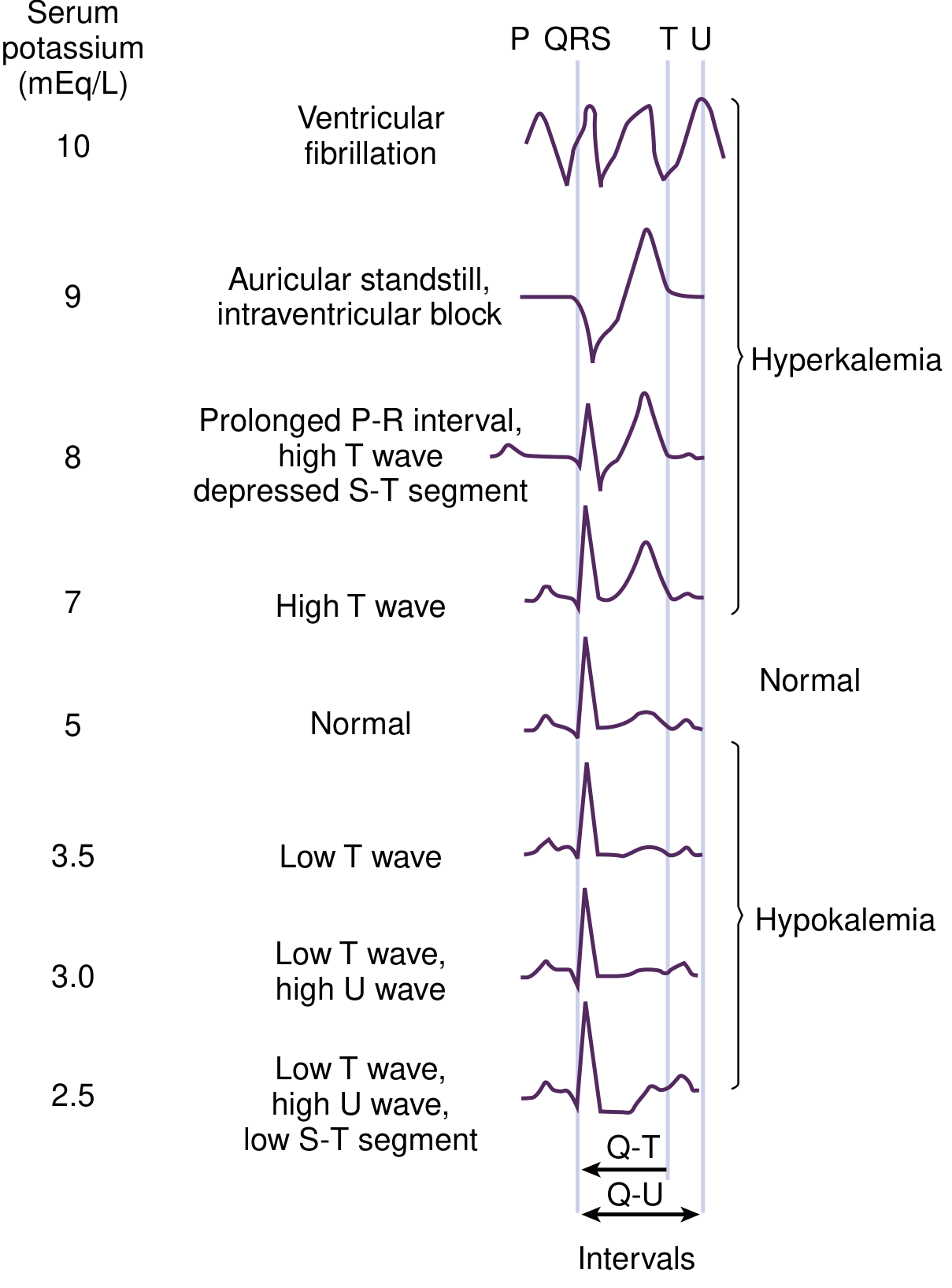
| Serum K+ (mEq/L) | ECG Finding |
|---|---|
| ~6-7 | Tall, peaked (tented) T waves |
| ~7-8 | Prolonged PR interval, widened QRS, depressed ST segment |
| ~9 | Auricular standstill, intraventricular block |
| ~10 | Ventricular fibrillation → cardiac arrest |
Rapid IV infusion can drive serum potassium through all these stages within minutes, before any intervention is possible. The FDA labeling for concentrated KCl explicitly warns that "administration of concentrated potassium solutions can cause cardiac conduction disorders (including complete heart block) and other cardiac arrhythmias at any time during infusion."
Safe Rate Guidelines (What Textbooks Say)
- Peripheral vein: Do NOT exceed 8 mEq/hour (because KCl is also irritative and causes phlebitis/vein necrosis at higher rates)
- Central vein with continuous ECG monitoring: Up to 10-20 mEq/hour is acceptable in severe symptomatic hypokalemia
- Absolute maximum: Generally not exceeding 240 mEq/day
- IV KCl must never be given faster than 10 mmol/hour without continuous ECG monitoring
- Goal of IV therapy is to remove the patient from immediate danger only - not to correct the entire deficit
(Morgan & Mikhail's Clinical Anesthesiology, 7e; National Kidney Foundation Primer on Kidney Diseases, 8e)
Local / Vascular Effects
- KCl infused peripherally at high speed causes venous irritation, burning pain, and can cause phlebitis or necrosis of the peripheral vein
- One surgical textbook (Pye's Surgical Handicraft) notes that concentrated KCl must be given by central route only - peripheral injection will cause necrosis and skin loss
- Undiluted KCl given as IV push (bolus) is an extreme hazard and is listed as a "never event" in medication safety
Other Systemic Effects
- Muscle weakness / paralysis - hyperkalemia depolarizes cell membranes, impairing neuromuscular function
- Respiratory failure - if respiratory muscles are affected
- Renal effects - the kidney can normally excrete up to ~500 mEq K+/day if levels rise slowly, but rapid infusion overwhelms this capacity entirely
Why KCl Is a "High-Alert Medication"
Concentrated KCl ampoules have been involved in numerous fatal medication errors worldwide (ampoules of concentrated KCl look similar to saline). The ISMP (Institute for Safe Medication Practices) and most hospital systems require:
- KCl to be available only in pre-diluted, premixed IV bags (not as concentrated ampoules on wards)
- Infusion only via a calibrated infusion pump
- Continuous cardiac monitoring for rates >10 mEq/hour
- Plasma potassium rechecked every 2-3 hours during infusion
Bottom line: Rapid IV KCl causes acute hyperkalemia, which produces progressive and potentially fatal cardiac arrhythmias including ventricular fibrillation and cardiac arrest. It is one of the most dangerous medication errors in clinical practice and is strictly rate-limited for this reason.
This is a shared conversation. Sign in to Orris to start your own chat.