
Make a short note on rabbies microbiology
I'll read the medical library skill first, then research rabies microbiology.
Reading File
Now let me search the library for rabies microbiology content in parallel:
Finding Sources
Finding Sources
Excellent sources found. Let me read the most relevant microbiology sections in parallel:
Reading File
Reading File
Reading File
Now let me read the pathology and clinical sections from Harrison's for Negri bodies and pathogenesis:
Reading File
Finding Sources
Let me read the dedicated microbiology section from Jawetz and fetch a relevant image:
Reading File
Loading Image
Now let me also fetch the Negri bodies histology image:
Loading Image
I now have rich, authoritative content from multiple sources. Here is a comprehensive short note on rabies microbiology:
Rabies - Microbiology Notes
1. Classification
Rabies virus belongs to the family Rhabdoviridae, genus Lyssavirus (type 1). The name "rhabdovirus" derives from the Greek word for rod, reflecting its characteristic bullet-shaped morphology. Six other Lyssavirus species (serotypes 2, 3, 4, etc.) can cause rabies-like disease but are antigenically distinct, and existing vaccines may not protect against them. - Harrison's Principles of Internal Medicine 22E, p. 1694; Park's Textbook of Preventive and Social Medicine
2. Morphology & Structure
| Feature | Details |
|---|---|
| Shape | Bullet-shaped (truncated at one end) |
| Size | ~180 nm × 75 nm |
| Genome | Single-stranded, negative-sense (antisense) RNA; nonsegmented; 11,932 nucleotides |
| Envelope | Present (lipid bilayer) |
| Proteins encoded | 5 proteins: Nucleocapsid (N), Phosphoprotein (P), Matrix protein (M), Glycoprotein (G), Large polymerase (L) |
The G (glycoprotein) on the virus surface is the only antigen capable of inducing virus-neutralizing antibodies and is the primary target of protective immunity. It has also been cloned and expressed in E. coli for development of recombinant vaccines. The nucleoprotein (N) antigen is the internal protein used in complement fixation and immunofluorescence tests. - Park's Textbook of Preventive and Social Medicine
3. Street Virus vs. Fixed Virus
Two important variants of rabies virus are recognized:
- Street virus: Virus recovered from naturally occurring (wild) cases of rabies. It is pathogenic for all mammals, forms Negri bodies, and has a long, variable incubation period (20-60 days in dogs).
- Fixed virus (Pasteur strain): Produced by serial intracerebral passage of street virus in rabbits. The incubation period becomes fixed and constant at 4-6 days. It no longer forms Negri bodies, does not replicate in extra-neural tissues, and is used to prepare anti-rabies vaccines. Under certain conditions (e.g., inadequately inactivated vaccine), fixed virus can still be pathogenic. - Park's Textbook of Preventive and Social Medicine
4. Pathogenesis
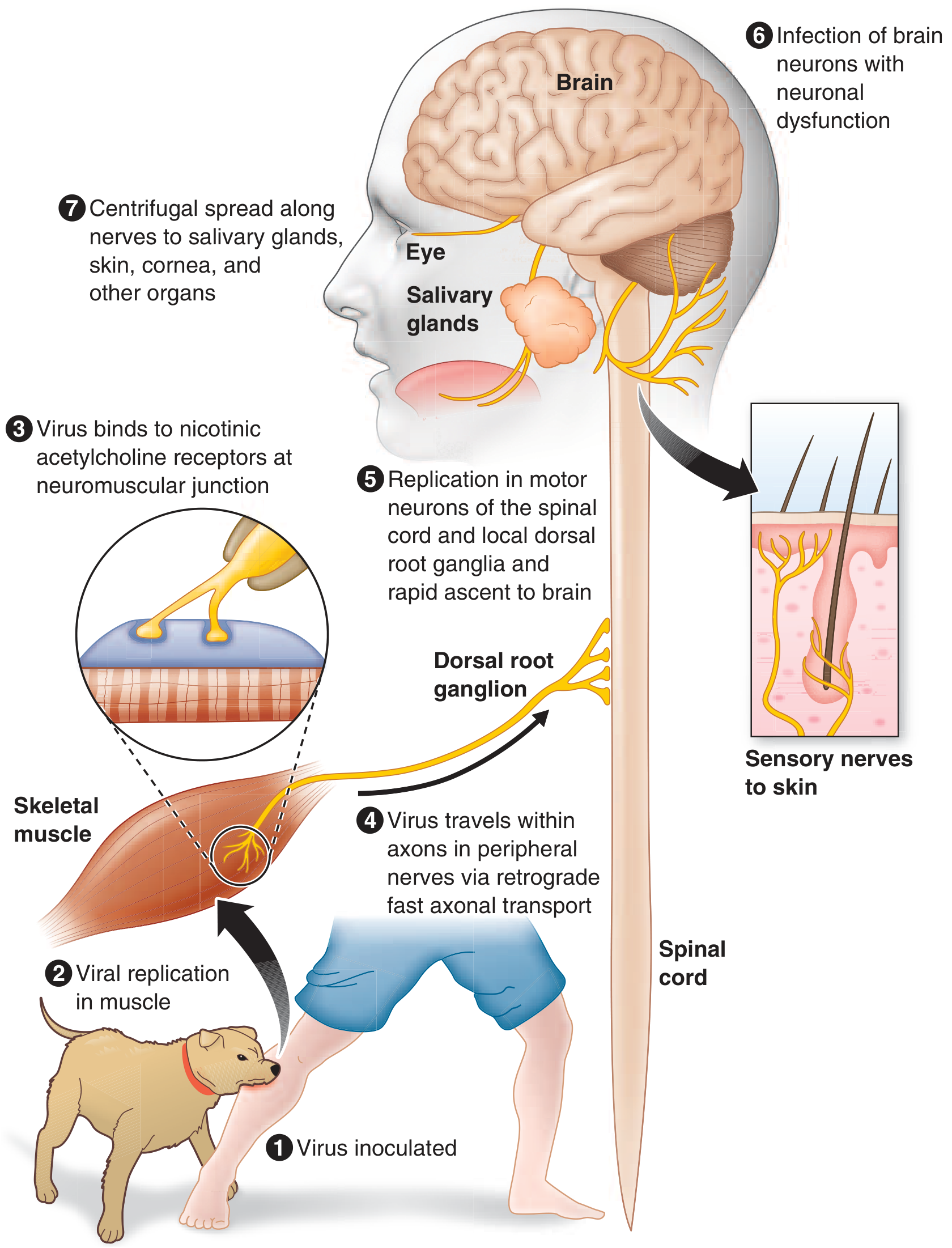
The sequence of events:
- Inoculation - Virus enters through a bite wound, scratch, or mucosal contact with infected saliva.
- Local replication - Virus replicates in muscle or connective tissue at the bite site.
- Receptor binding - Virus binds to nicotinic acetylcholine receptors at neuromuscular junctions.
- Centripetal spread - Virus travels via retrograde fast axonal transport (up to ~250 mm/day) along peripheral nerves toward the spinal cord and brainstem.
- CNS infection - Rapidly disseminates through the CNS via axonal connections. Neurons are prominently infected; astrocyte infection is unusual.
- Centrifugal spread - After CNS infection, virus spreads outward along sensory and autonomic nerves to salivary glands, skin, cornea, heart, adrenal glands, and other organs.
- Salivary excretion - Virus replicates in acinar cells of the salivary glands and is shed in saliva (in dogs, virus appears in saliva 3-4 days before clinical signs). The submaxillary salivary gland has the highest viral titers.
Note: There is no documented hematogenous spread of rabies virus. - Harrison's 22E, Jawetz Medical Microbiology 28E
5. Negri Bodies (Pathognomonic Finding)
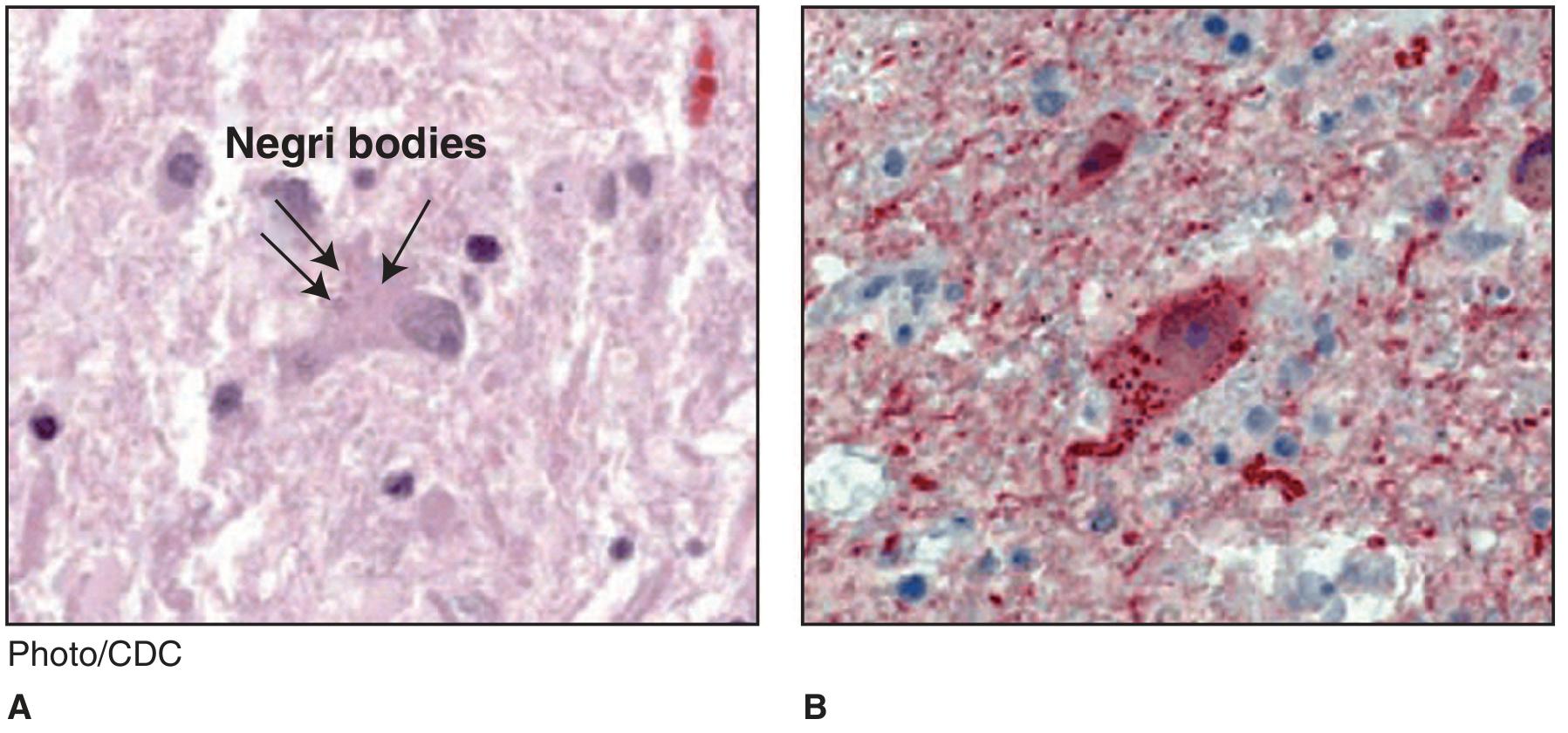
- Negri bodies are eosinophilic, cytoplasmic inclusions in infected neurons composed of viral nucleocapsids (N protein + RNA).
- They are pathognomonic for rabies.
- Commonly found in Purkinje cells of the cerebellum and hippocampal neurons (pyramidal cells).
- Seen in only ~80% of cases - their absence does NOT rule out rabies.
- Absent in infections with fixed virus.
- Modern diagnosis relies on fluorescent antibody (FAT) and RT-PCR, which are more sensitive. - Jawetz Medical Microbiology 28E
6. Reservoir & Transmission
- Primary reservoir: Dogs (worldwide), bats (USA), raccoons, skunks, foxes.
- Transmission: Bite of a rabid animal (most common). Rarely through scratches, mucous membrane contact, or corneal transplants.
- Source of infection: Saliva of infected animals (virus present 3-4 days before symptoms in dogs/cats).
- All warm-blooded animals are susceptible. Rabies in humans is a dead-end infection (no survival value for the virus).
7. Incubation Period
- Usually 20-90 days (range: days to >1 year).
- Shorter in children than adults.
- Shorter when bite is on the face or head (shorter nerve distance to CNS) - highest attack rate.
- Lowest mortality when bitten on the legs. - Jawetz Medical Microbiology 28E
8. Laboratory Diagnosis
| Test | Specimen | Notes |
|---|---|---|
| Fluorescent Antibody Test (FAT) | Brain tissue (post-mortem) | Gold standard; detects viral antigen |
| RT-PCR | Saliva, CSF, skin biopsy (nuchal) | Most sensitive; detects viral RNA |
| Negri body detection (H&E) | Brain tissue | Positive in ~80%; classical but less sensitive |
| Serum/CSF neutralizing antibodies | Blood, CSF | Diagnostic in unimmunized patients; appear late |
| Viral isolation | Intracerebral mouse inoculation | Time-consuming; less used now |
9. Vaccines
- Human vaccines contain only inactivated (killed) rabies virus (e.g., HDCV - Human Diploid Cell Vaccine, PCECV).
- Animal vaccines may contain live attenuated virus.
- Surface glycoprotein is the key immunogen - neutralizing antibody titers are the index of protection.
- Serum antibody titer is used to assess protection level. - Jawetz Medical Microbiology 28E; Park's Textbook
10. Key Microbiological Facts at a Glance
| Property | Detail |
|---|---|
| Family | Rhabdoviridae |
| Genus | Lyssavirus (type 1) |
| Genome | ssRNA, negative-sense, non-segmented |
| Shape | Bullet-shaped |
| Key antigen | G protein (neutralizing antibody target) |
| Pathognomonic finding | Negri bodies (eosinophilic cytoplasmic inclusions) |
| Spread to CNS | Retrograde fast axonal transport |
| Receptor | Nicotinic acetylcholine receptor |
| Street vs. fixed | Street = wild, long IP, Negri bodies; Fixed = short IP, no Negri bodies, used in vaccines |
| Diagnosis | FAT (gold standard), RT-PCR, Negri bodies |
| Treatment | No proven treatment once symptoms appear |
Sources: Harrison's Principles of Internal Medicine 22E (2025); Jawetz, Melnick & Adelberg's Medical Microbiology 28E; Park's Textbook of Preventive and Social Medicine
This is a shared conversation. Sign in to Orris to start your own chat.