
If patient has rhd how to decide whether patient is ideal to start on acitrome
Reading File
Quick Answer: In RHD (Rheumatic Heart Disease), Acitrom (acenocoumarol) is an oral anticoagulant (vitamin K antagonist) indicated mainly when there is mitral stenosis with atrial fibrillation, prior embolism, or a prosthetic valve. The decision to start involves assessing the indication, bleeding risk, INR monitoring feasibility, and contraindications.
Searching sources...
Finding Sources
Finding Sources
Searching the Web
Acitrom acenocoumarol indications RHD rheumatic heart disease criteria for starting anticoagulation
Let me get deeper clinical content on this specific topic from the textbooks.
Finding Sources
Finding Sources
Reading File
Finding Sources
Reading File
Finding Sources
I now have sufficient information to give a comprehensive, well-structured answer.
Deciding Whether to Start Acitrom (Acenocoumarol) in RHD
Acitrom is an oral vitamin K antagonist (VKA) - the same class as warfarin - and in the Indian context it is the most commonly used VKA for long-term anticoagulation in RHD. The decision to start involves three steps: establishing the indication, ruling out contraindications, and confirming the patient is suitable for INR monitoring.
Step 1: Confirm a Clear Indication
Acitrom is indicated in RHD patients in the following situations:
| Indication | INR Target |
|---|---|
| Mitral stenosis + Atrial fibrillation (paroxysmal, persistent, or permanent) | 2.5 - 3.5 |
| Mitral stenosis + Prior systemic embolism (even in sinus rhythm) | 2.5 - 3.5 |
| Mitral stenosis + Left atrial thrombus on echo | 2.5 - 3.5 |
| Mechanical prosthetic valve (post-surgical replacement) | 2.5 - 3.5 (mitral); 2.0 - 3.0 (aortic) |
| Mitral stenosis in sinus rhythm with left atrial diameter >55 mm or spontaneous echo contrast | 2.0 - 3.0 (Class IIa, reasonable) |
Key point from Goldman-Cecil Medicine: "Because patients with concomitant mitral stenosis and atrial fibrillation have an extraordinarily high risk for systemic embolism, they should undergo chronic anticoagulation with warfarin at an INR target of 2.5 to 3.5 unless there is a serious contraindication... Atrial fibrillation with rheumatic mitral stenosis or a mechanical heart valve requires VKA anticoagulation instead of direct-acting oral anticoagulants (DOACs)." - Goldman-Cecil Medicine
DOACs (rivaroxaban, apixaban, dabigatran) are NOT acceptable substitutes for rheumatic AF or mechanical valves - VKA (Acitrom/warfarin) is mandatory in these scenarios.
Step 2: Assess Contraindications (When NOT to Start)
Absolute contraindications:
- Active bleeding (GI, intracranial, etc.)
- Recent hemorrhagic stroke or intracranial bleed
- Pregnancy (especially first trimester and near term - fetal warfarin syndrome risk)
- Severe thrombocytopenia (platelets <50,000)
- Known bleeding disorders (hemophilia, severe liver failure with coagulopathy)
Relative contraindications (weigh risk vs. benefit):
- Recent major surgery or trauma
- Uncontrolled hypertension (BP >180/110 mmHg)
- Active peptic ulcer disease
- Heavy alcohol use or poor compliance
- Inability to monitor INR (no access to lab)
- Falls risk in elderly
Step 3: Confirm Patient Suitability (Practical Checklist)
Before starting Acitrom, assess:
- Indication confirmed - AF, prior embolism, mechanical valve, large LA with spontaneous echo contrast?
- Baseline investigations done - CBC, liver function tests, renal function, baseline INR/PT, baseline ECG and echo
- INR monitoring is feasible - Patient lives near a lab, can come for regular INR checks (initially weekly until stable, then monthly)
- Interacting drugs identified - Many drugs alter Acitrom metabolism (NSAIDs increase bleeding risk; antibiotics, antifungals, amiodarone potentiate it; rifampicin reduces it)
- Dietary consistency - Patient counselled about consistent vitamin K intake (green leafy vegetables affect INR)
- Patient counselled about bleeding signs and when to seek emergency care
- No active bleeding source (check for history of GI bleed, haematuria, epistaxis)
Important Note: RHD in Sinus Rhythm Without AF
- Mild-to-moderate mitral stenosis in sinus rhythm without prior embolism or LA thrombus - Acitrom is generally NOT routinely indicated
- Anticoagulation in this scenario remains controversial and is individualized based on echo findings (LA size, spontaneous contrast)
Summary Decision Algorithm
RHD Patient
    |
    ├─ Has AF / Prior embolism / Mechanical valve?
    │       YES → Acitrom INDICATED (mandatory VKA, not DOAC)
    │
    ├─ Sinus rhythm + Large LA (>55mm) or spontaneous echo contrast?
    │       YES → Acitrom REASONABLE (Class IIa)
    │
    ├─ Sinus rhythm + No above risk factors?
    │       → Acitrom NOT routinely indicated
    |
    └─ Any indication present?
            Check contraindications → If none, confirm INR monitoring feasibility → Start Acitrom
Starting dose of Acitrom: Typically 2-4 mg/day, adjusted based on INR response. INR is checked after 3-4 days of initiation, then weekly until 2 consecutive therapeutic readings, then monthly. The therapeutic range is 2.0-3.0 for most indications and 2.5-3.5 for mitral stenosis with AF or mechanical mitral valves.
Patient have suspected tbm
Reading File
Before I give a full answer - could you clarify what aspect of TBM (Tuberculous Meningitis) you need?
Asking for Preferences
What do you need help with for the suspected TBM patient?
Searching sources...
Finding Sources
Searching the Web
tuberculous meningitis diagnosis treatment guidelines 2024 CSF criteria ATT steroids
Reading File
Reading File
Reading Web Page
https://emedicine.medscape.com/article/1166190-treatment
Reading File
Finding Sources
Reading File
Reading File
I now have comprehensive information for a complete answer. Let me also fetch the MRI image from the textbook to include visually.
Loading Image
Here is a complete clinical guide to suspected TBM.
Tuberculous Meningitis (TBM) - Complete Clinical Guide
1. Clinical Presentation
TBM characteristically has a subacute onset over 1-2 weeks - slower than typical bacterial meningitis. Key features:
Classical symptoms:
- Headache (>50% of cases), low-grade fever, malaise, anorexia for days to weeks
- Neck rigidity / meningism (75% of cases), Kernig's and Brudzinski's signs
- Lethargy, confusion, altered sensorium
Features that point specifically toward TBM:
- Cranial nerve palsies - especially ocular (CN III, IV, VI) due to basal exudate (20% of cases)
- Symptoms >5 days before presentation
- History of TB exposure or contact, prior TB, or immunocompromise (HIV)
- Evidence of TB elsewhere - pulmonary TB on CXR in ~2/3 of cases
- Systemic TB features: weight loss, night sweats, prolonged cough >2 weeks
Risk factors: HIV, malnutrition, diabetes, steroid use, young children, immigrants from high-burden countries.
2. Diagnosis
Uniform Case Scoring System (Marais Criteria)
Use this scoring system to classify TBM before confirmatory results:
| Category | Feature | Points |
|---|---|---|
| Clinical (max 6) | Symptom duration >5 days | 4 |
| Systemic TB symptoms (weight loss, night sweats, cough >2 wk) | 2 | |
| TB contact / positive TST/IGRA (child <10 yr) | 2 | |
| Focal neurological deficit (excluding CN palsy) | 1 | |
| Cranial nerve palsy | 1 | |
| Altered consciousness | 1 | |
| CSF (max 4) | Clear appearance | 1 |
| Cells 10-500/μL | 1 | |
| Lymphocyte predominance >50% | 1 | |
| Protein >1 g/L | 1 | |
| CSF:plasma glucose <50% or CSF glucose <2.2 mmol/L | 1 | |
| Neuroimaging (max 6) | Hydrocephalus | 1 |
| Basal meningeal enhancement | 2 | |
| Tuberculoma | 2 | |
| Infarct | 1 | |
| Pre-contrast basal hyperdensity (CT) | 2 | |
| TB elsewhere (max 4) | CXR - active TB (non-miliary) | 2 |
| CXR - miliary TB | 4 | |
| CT/MRI/US evidence of extracranial TB | 2 |
Classification:
- Definite TBM: AFB on CSF smear, positive CSF culture, or positive Xpert MTB/RIF + suggestive clinical features
- Probable TBM: Score ≥12 (if neuroimaging available) or ≥10 (if no neuroimaging). At least 2 points must come from CSF or imaging criteria
- Possible TBM: Score 6-11 (imaging available) or 6-9 (no imaging); alternative diagnosis not confirmed
CSF Analysis (Lumbar Puncture - cornerstone of diagnosis)
| Parameter | Typical TBM Finding |
|---|---|
| Opening pressure | Raised (often >200 mm H₂O) |
| Appearance | Clear / slightly turbid / xanthochromic |
| White cells | 10-1000/μL, lymphocyte predominance (early = neutrophils) |
| Protein | Elevated: 1-8 g/L (100-800 mg/dL) |
| Glucose | Low (<45 mg/dL); CSF:blood glucose <50% |
| AFB smear | Positive in only 10-40% (low sensitivity); do at least 3 samples |
| Culture | Gold standard - positive in up to 80%; takes 4-8 weeks |
| Xpert MTB/RIF | Sensitivity ~80%, specificity high - preferred first test |
| ADA (adenosine deaminase) | Elevated (>10 U/L supportive) |
Harrison's 22e: "AFBs are infrequently seen on direct smear of CSF sediment, but repeated lumbar punctures increase the yield. Culture is diagnostic in up to 80% and remains the gold standard. Xpert MTB/RIF has sensitivity up to 80% and is the preferred initial option. A negative result does NOT exclude TBM."
Important: Do NOT delay ATT for culture results. Treat empirically if clinical suspicion is high.
Neuroimaging
MRI with gadolinium is preferred over CT. Classic findings:
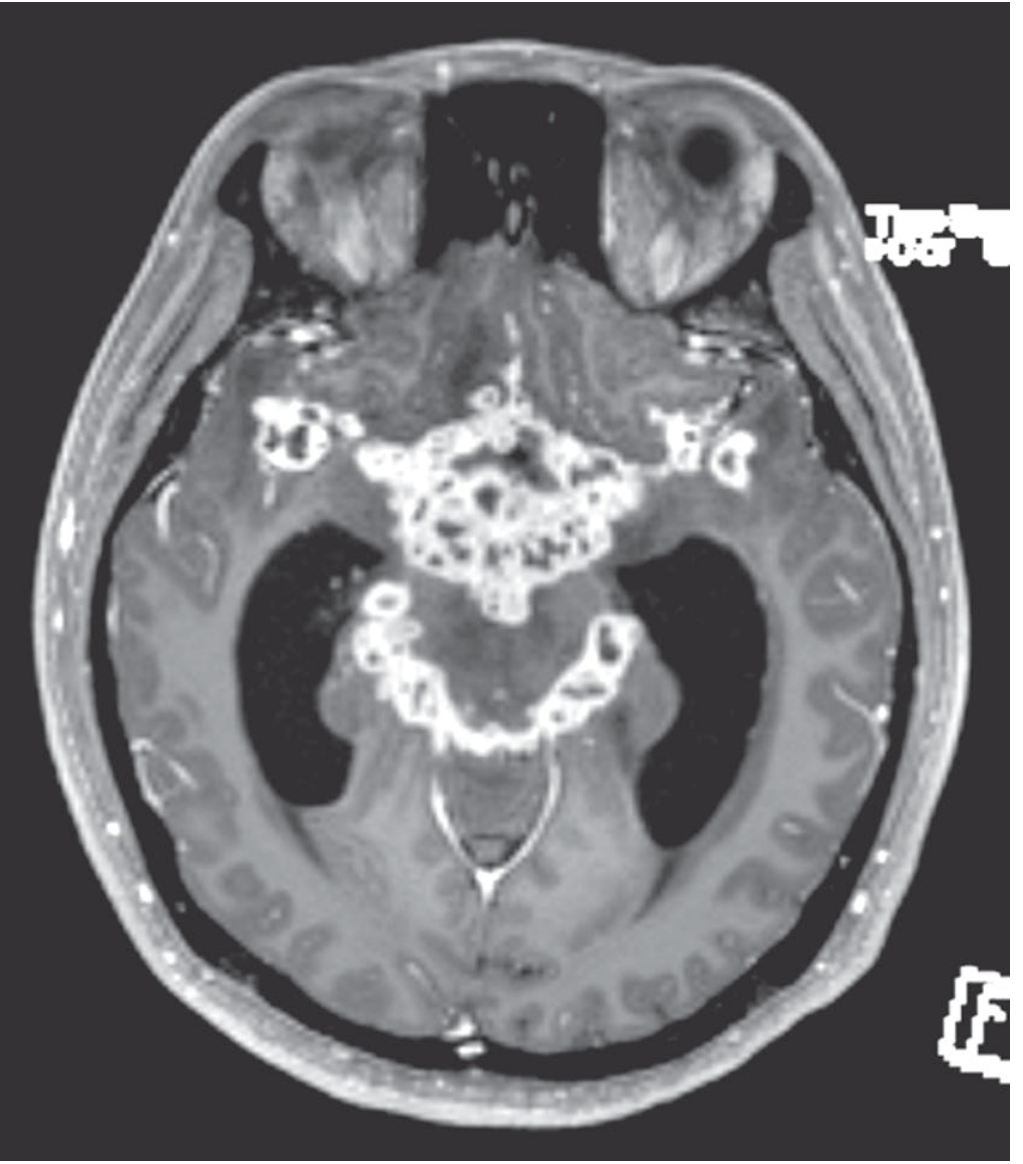
MRI in TBM: Gadolinium enhancement of the basal meninges (bright white areas at the base of brain), multiple abscesses, and hydrocephalus - from Adams & Victor's Principles of Neurology
- Basal meningeal enhancement (most characteristic)
- Hydrocephalus (communicating, due to obstruction of basal cisterns)
- Infarcts (from vasculitis of perforating arteries)
- Tuberculomas (ring-enhancing lesions)
Other Investigations
- CXR - look for pulmonary TB, miliary pattern
- Mantoux / TST - helpful if positive, but negative in immunocompromised
- IGRA (Interferon-gamma release assay) - QuantiFERON
- Sputum AFB / GeneXpert if pulmonary involvement suspected
- HIV serology - mandatory in all TBM cases
- Blood: CBC, LFT, RFT, electrolytes (hyponatremia from SIADH is common)
- Fundoscopy - papilledema, choroidal tubercles
3. Treatment
ATT Regimen
| Phase | Duration | Drugs | Notes |
|---|---|---|---|
| Intensive | 2 months | HRZE (INH + Rifampicin + Pyrazinamide + Ethambutol) | Four-drug regimen |
| Continuation | 7-10 months | HR (INH + Rifampicin) | Total duration 9-12 months for TBM |
Total duration: 9-12 months (longer than pulmonary TB due to CNS penetration issues)
Drug doses (adults):
- Isoniazid (H/INH): 5 mg/kg/day (max 300 mg) - best CNS penetration
- Rifampicin (R/RIF): 10 mg/kg/day (max 600 mg)
- Pyrazinamide (Z/PZA): 20-35 mg/kg/day
- Ethambutol (E/EMB): 15 mg/kg/day
Note: Ethambutol and ethionamide have poor CSF penetration once inflammation resolves. Fluoroquinolones (levofloxacin/moxifloxacin) have excellent CNS penetration and are useful in MDR-TBM as fourth drugs.
Add pyridoxine 50 mg/day with INH to prevent peripheral neuropathy.
Adjunctive Corticosteroids (MANDATORY)
Corticosteroids reduce mortality and should be given in all TBM patients (except special circumstances).
Dexamethasone regimen (WHO/guidelines):
| Weeks | Route | Dose |
|---|---|---|
| Week 1 | IV | 0.4 mg/kg/day |
| Week 2 | IV | 0.3 mg/kg/day |
| Week 3 | IV | 0.2 mg/kg/day |
| Week 4 | IV | 0.1 mg/kg/day |
| Weeks 5-6 | Oral | 4 mg/day, then taper by 1 mg/week |
Total steroid duration: 6-8 weeks with tapering.
Harrison's 22e: "Clinical trials demonstrated that patients given adjunctive glucocorticoids experience faster resolution of CSF abnormalities and elevated CSF pressure, resulting in lower rates of death or severe disability and relapse. Dexamethasone significantly enhanced survival among persons >14 years."
Note on HIV patients: A recent placebo-controlled trial showed no benefit from adjunctive dexamethasone in TBM patients with HIV - individualise this decision.
Alternatively, prednisolone 60 mg/day orally, tapered over 6-8 weeks, is acceptable.
4. Complications and Monitoring
Common Complications
| Complication | Mechanism | Management |
|---|---|---|
| Hydrocephalus | Basal exudate blocking CSF flow | Serial LPs; VP shunt or EVD if progressive |
| Stroke / Infarct | Vasculitis of perforating arteries | Supportive; optimise ATT |
| Hyponatremia | SIADH (very common) | Fluid restriction, hypertonic saline if severe |
| Seizures | Cortical irritation, infarct, TB | AEDs; levetiracetam or phenytoin |
| Cranial nerve palsies | Basal exudate | Usually improve with treatment |
| Raised ICP | Hydrocephalus | Mannitol, dexamethasone, LP, shunt |
| Arachnoiditis | Chronic inflammation | Steroids, hyaluronidase intrathecally in some cases |
Note on VP shunting: Required in up to 25% of cases with obstructive hydrocephalus. Shunt complications (infection, malfunction) occur in 20-40% of cases.
Monitoring During Treatment
- Serial LPs - monitor CSF cell count, protein, glucose response
- Serial neuroimaging (especially if tuberculoma present - may initially enlarge before resolving)
- LFTs monthly - INH and RIF are hepatotoxic; stop ATT if symptomatic hepatitis or ALT >3x ULN with symptoms
- Visual acuity and color vision - Ethambutol can cause optic neuropathy (check monthly)
- Serum sodium - watch for SIADH
- GCS / neurological status - daily in acute phase
- Uric acid - Pyrazinamide causes hyperuricemia
5. Prognosis
- Overall mortality: ~10-20% in treated cases; up to ~50% when treatment is delayed to the coma stage
- Neurological sequelae in 20-30% of survivors: cognitive impairment, seizures, hemiparesis, visual defects, deafness
- HIV co-infection worsens prognosis significantly (mortality ~21% or higher)
- Key message: Early diagnosis and immediate ATT initiation is the single most important determinant of outcome
Summary - Immediate Action in Suspected TBM
Suspected TBM
    ↓
1. Urgent CT/MRI head (rule out mass lesion before LP)
2. Lumbar puncture → CSF for: cells, protein, glucose, AFB smear, culture, Xpert MTB/RIF, ADA
3. CXR, HIV test, LFT, RFT, electrolytes, CBC
4. Start ATT IMMEDIATELY (do not wait for culture)
    → 2HRZE / 7-10HR
5. Add Dexamethasone (taper over 6-8 weeks)
6. Pyridoxine 50mg/day with INH
7. Monitor for hyponatremia, raised ICP, seizures
8. Neurosurgery consult if hydrocephalus develops
(Sources: Harrison's Principles of Internal Medicine 22e, Adams & Victor's Principles of Neurology 12e, Marais Uniform Case Definition Criteria, Index-TB Guidelines India, Medscape TBM Guidelines)
This is a shared conversation. Sign in to Orris to start your own chat.