
Step by step procedure for abdominal hysterectomy
Reading File
Finding Sources
Searching the Web
abdominal hysterectomy surgical procedure steps technique
I found two excellent sources. Let me read both the Berek & Novak's and Sabiston sections simultaneously.
Reading File
Reading File
Excellent content found. Now let me read the detailed Berek & Novak's section on the actual abdominal hysterectomy procedure steps, and continue the Sabiston section.
Reading File
Reading File
I have excellent comprehensive content from both textbooks. Let me read more of the Berek & Novak's section to get the full step-by-step technique details.
Reading File
I need to read the core surgical steps section that was truncated in the first Berek & Novak's read:
Reading File
Reading File
I now have comprehensive, detailed content from both Berek & Novak's Gynecology and Sabiston's Textbook of Surgery. Here is the complete step-by-step procedure:
Abdominal Hysterectomy — Step-by-Step Procedure
Preoperative Preparation
Antibiotic prophylaxis: Cefazolin 1–2 g IV (3 g in obese patients) given 30–60 minutes before skin incision. Redose after 3 hours of surgery or with excessive blood loss.
Skin prep: Chlorhexidine-alcohol prep is preferred over povidone-iodine (lower SSI risk). Hair around the incision is clipped (not shaved). The patient bathes with chlorhexidine preoperatively.
Bowel prep: Not routinely required for benign disease.
Patient Positioning
- Dorsal supine position
- After anesthesia induction: place legs in stirrups → perform pelvic examination to confirm preoperative findings
- Insert Foley catheter to decompress the bladder; cleanse vagina with chlorhexidine or iodine solution
- Return legs to flat position
Surgical Technique
Step 1 — Incision
The incision choice depends on:
- Simplicity and exposure required
- Need for potential enlargement
- Wound strength and cosmesis
- Location of prior scars
Options: low transverse (Pfannenstiel) for most benign cases; vertical midline when wider access is needed (large uterus, malignancy, adhesions). The skin is opened with a scalpel, carrying down through subcutaneous tissue and fascia. The fascia is divided with lateral traction applied to its edges, and the peritoneum is opened sharply to minimize risk of enterotomy.
Step 2 — Abdominal Exploration
- Peritoneal cytology specimens collected before exploration if indicated
- Systematic exploration: liver, gallbladder, stomach, kidneys, para-aortic nodes, small and large bowel, and pelvis
Step 3 — Retractor Placement
- Self-retaining retractors placed (Balfour, O'Connor-O'Sullivan, or Bookwalter for obese patients)
- Small bowel packed out of the pelvis with moist laparotomy pads
Step 4 — Elevation of the Uterus
- Broad ligament clamps (e.g., Heaney or Ballantine) placed at each cornu, crossing the round ligament — this elevates and manipulates the uterus throughout the procedure
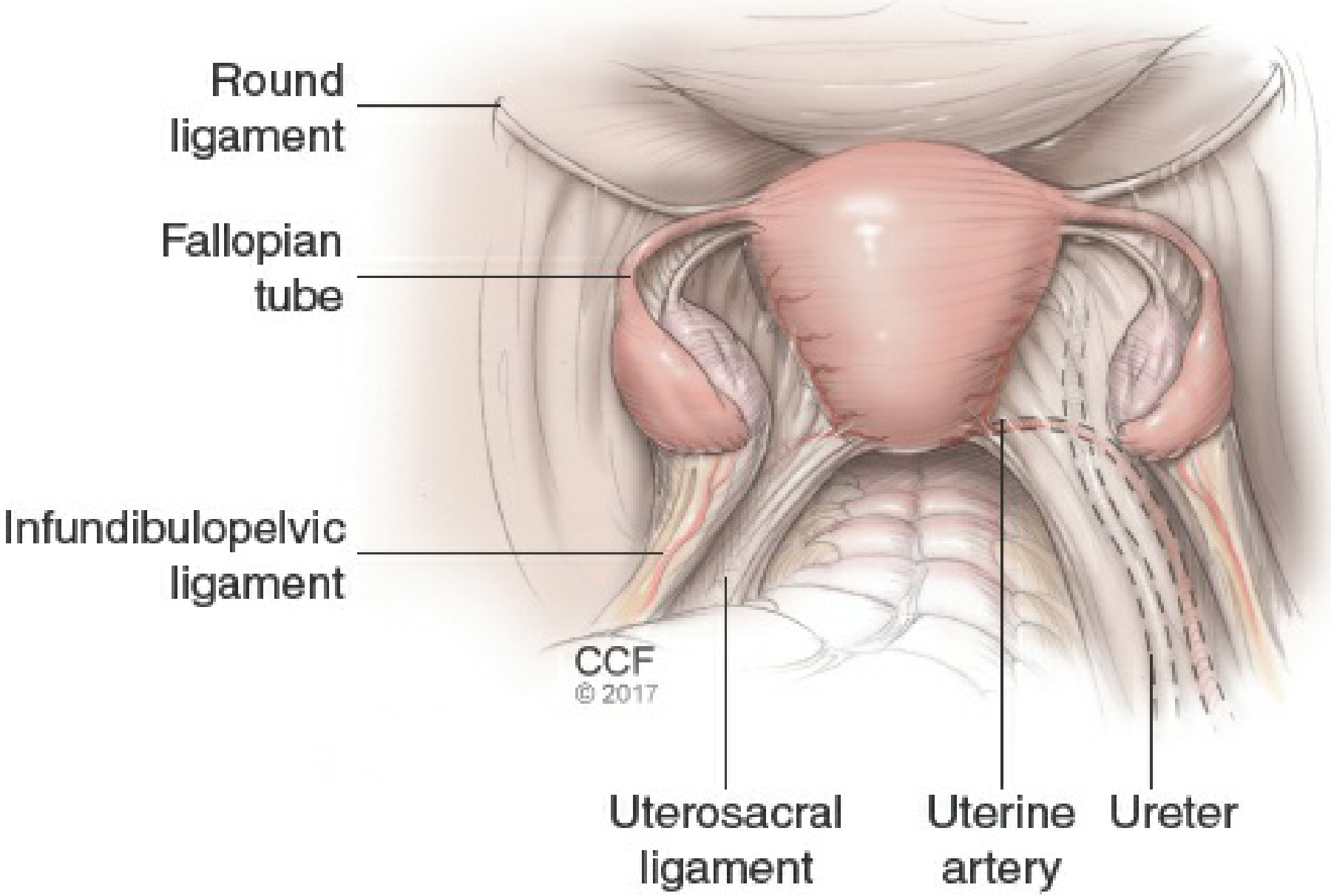
Step 5 — Round Ligament Ligation and Transection
- Uterus deviated to the left to stretch the right round ligament
- The distal round ligament is ligated with a suture ligature (or divided with electrosurgery) and cut
- This separates the anterior and posterior leaves of the broad ligament
- The anterior leaf of the broad ligament is incised with Metzenbaum scissors or electrosurgery along the vesicouterine fold, separating the bladder peritoneum from the lower uterine segment
- Repeated on the left side
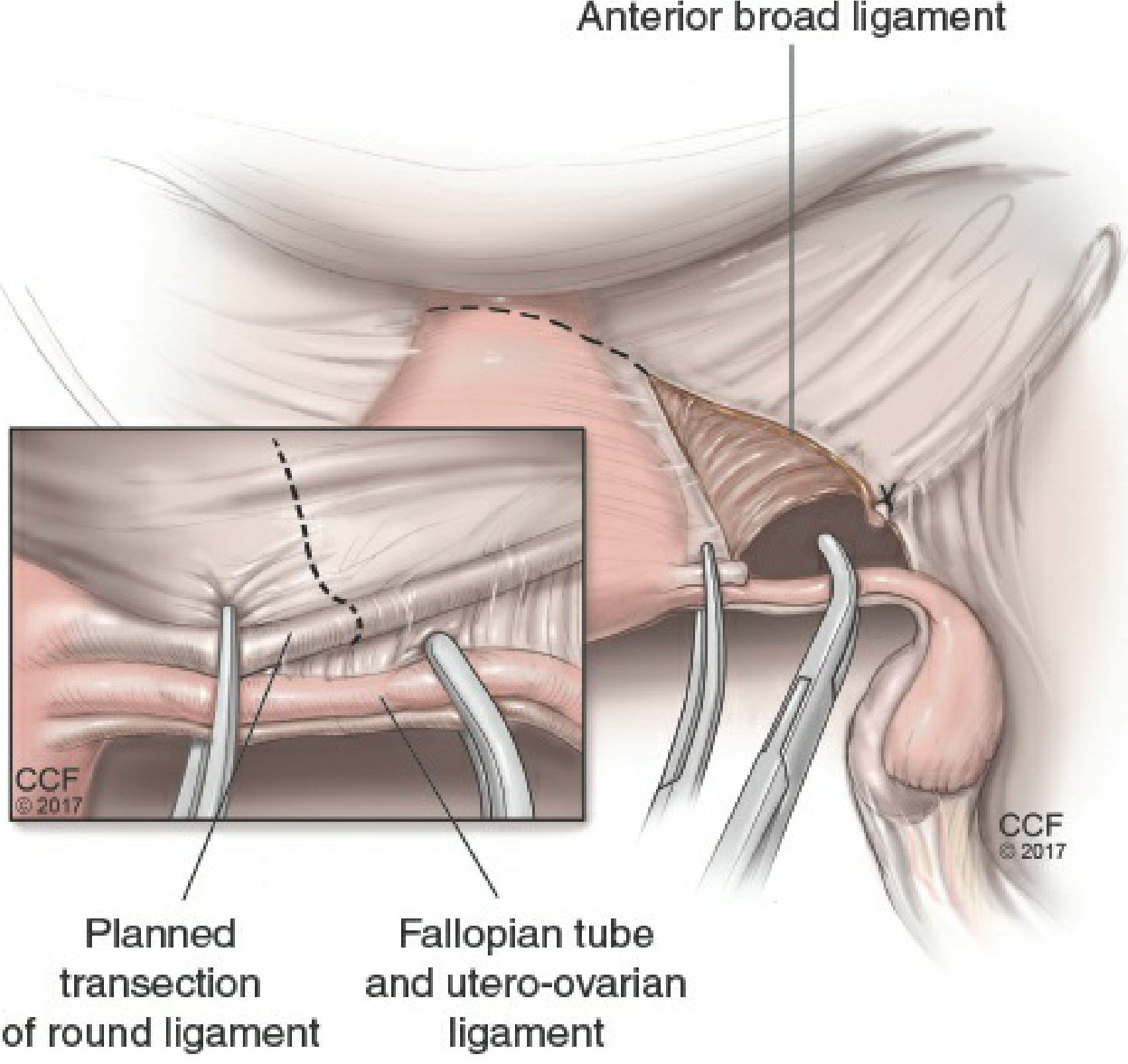
Step 6 — Ureter Identification
- The retroperitoneum is entered by extending the incision cephalad on the posterior leaf of the broad ligament, staying lateral to the infundibulopelvic ligament and iliac vessels
- The external iliac artery is identified along the medial psoas muscle by blunt dissection
- Following it cephalad to the common iliac bifurcation, the ureter is identified crossing the common iliac artery
- The ureter is left attached to the medial broad ligament leaf to protect its blood supply — this is critical throughout the remainder of the procedure
Step 7 — Utero-Ovarian / Infundibulopelvic (IP) Ligament Ligation
If ovaries are preserved:
- Uterus retracted toward pubic symphysis and deviated to one side
- The utero-ovarian ligaments are clamped bilaterally with curved Heaney or Ballantine clamps, cut, and ligated (free tie + suture ligature) at each uterine cornua
- Opportunistic salpingectomy may be performed at this point if desired
If ovaries are removed (BSO):
- The peritoneal opening is enlarged toward the infundibulopelvic ligament (ovarian vessels) cephalad and to the uterine artery caudad
- This releases the ureter from proximity to the ovarian vessels
- A curved Heaney/Ballantine clamp is placed lateral to the ovary across the IP ligament; the vessels are doubly clamped, incised, and doubly ligated
- Remaining posterior broad ligament leaves are incised inferiorly to skeletonize the uterine vessels
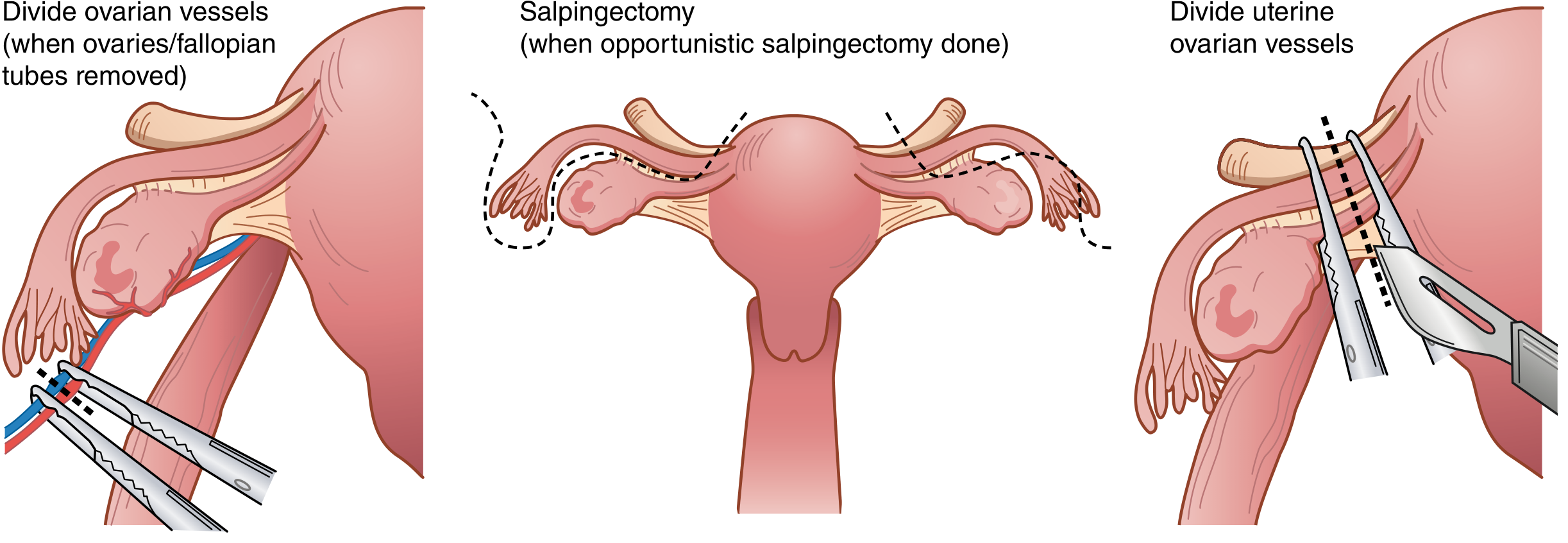
Step 8 — Development of the Bladder Flap
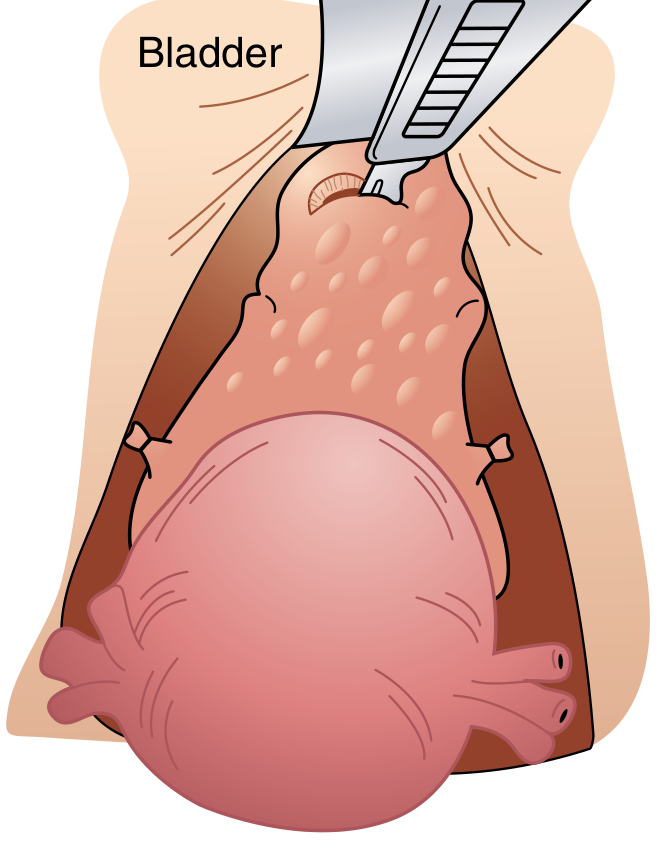
- The vesicouterine peritoneum (anterior leaf) is further incised and dissected
- The bladder is dissected off the cervix sharply with Metzenbaum scissors or electrocautery
- The bladder is pushed and retracted inferiorly, well below the level of the cervix, before any colpotomy is made
- This is the most important step to avoid bladder injury
Step 9 — Uterine Vessel Ligation
- A curved Heaney or Zeppelin clamp is placed across the uterine vessels (uterine artery and vein) at the level of the internal cervical os, perpendicular to the uterus
- The pedicle is cut and suture ligated (transfixion stitch)
- Performed bilaterally — the ureter must be clearly visualized and free of the clamp (it passes within ~1 cm of the uterine artery)
Step 10 — Cardinal Ligament Ligation
- A straight Zeppelin or Heaney clamp is placed medial to the uterine vessel pedicle, 2–3 cm parallel to the uterus across the cardinal ligament
- The ligament is cut and the pedicle suture ligated
- This step is repeated in serial bites on each side, progressing inferiorly until the cervicovaginal junction is reached
Step 11 — Uterosacral Ligament Division
- If the rectum needs mobilization from the posterior cervix, the posterior peritoneum between the uterosacral ligaments just beneath the cervix is incised
- The relatively avascular plane here allows the rectum to be mobilized inferiorly out of the field
- The uterosacral ligaments are included in the final clamps placed for uterine removal
Step 12 — Colpotomy and Removal of the Uterus
- The uterus is placed on cephalad traction and the tip of the cervix palpated
- Curved Heaney clamps are placed bilaterally incorporating the uterosacral ligament and upper vagina just below the cervix (taking care not to foreshorten the vagina)
- The uterus and cervix are removed with a scalpel or curved scissors, cutting just above the clamps
- The specimen is passed off the field
Step 13 — Vaginal Cuff Closure
- A figure-of-eight suture (0 braided absorbable) is placed at each vaginal angle for traction and hemostasis
- Heaney transfixion stitches are placed incorporating the uterosacral and cardinal ligaments at the vaginal angles — this provides apical support
- The vaginal cuff is closed with running-locked or figure-of-eight sutures
- Alternatively: interrupted or running sutures with the lateral apex sutures incorporating the ipsilateral uterosacral ligament
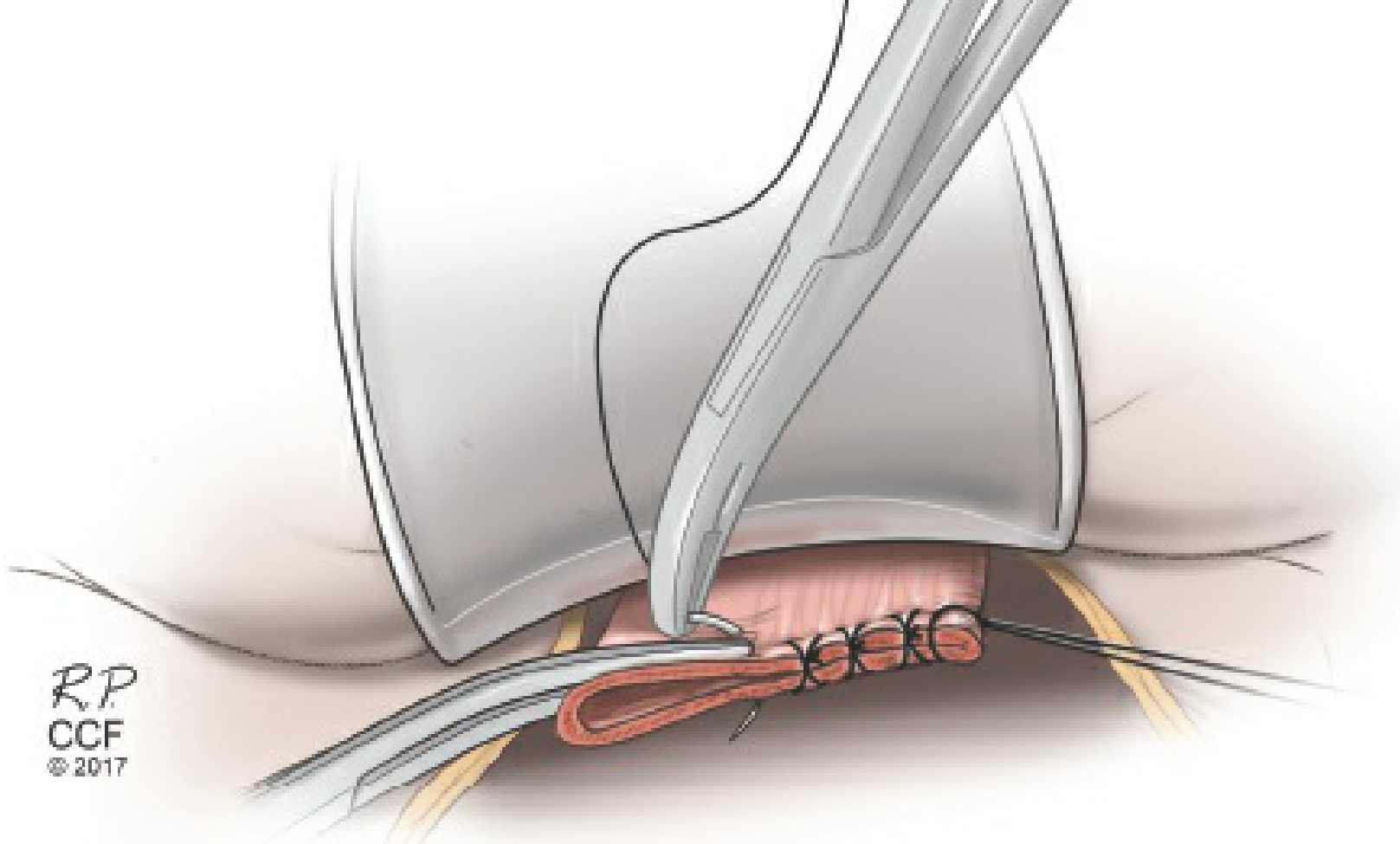
Step 14 — Irrigation and Final Hemostasis
- The pelvis is thoroughly irrigated with normal saline
- Meticulous hemostasis of all vascular pedicles is ensured
- Ureters are inspected to confirm they are intact and non-dilated (peristalsis should be visible)
Step 15 — Peritoneal and Fascial Closure
- The pelvic peritoneum is not reapproximated (evidence shows no benefit)
- The parietal peritoneum is also left open
- Fascia is closed with interrupted or continuous 0 or 1 monofilament absorbable suture; bites taken ~1 cm from edge, ~1 cm apart
Step 16 — Skin Closure
- Subcutaneous tissue irrigated with hemostasis achieved
- Subcutaneous fat closed if ≥2 cm depth (reduces wound disruption)
- Skin closed with staples or subcuticular sutures
- Dressing applied for ~24 hours
Postoperative Management
| Domain | Guidance |
|---|---|
| Bladder catheter | Remove within 24 hours; check post-void residual if concerned |
| Diet | Resume as soon as alert; early solid feeds speed bowel recovery |
| Ambulation | Begin POD1; reduces DVT and pneumonia risk |
| Pain | Preemptive gabapentin, acetaminophen, COX-2 inhibitors; reduce opioid requirements |
| VTE prophylaxis | Sequential compression devices + pharmacologic per risk stratification |
| Activity restriction | Pelvic rest (no intercourse, tampons) for 6–8 weeks; no heavy lifting >10 lbs |
Key Intraoperative Dangers and Prevention
| Structure at Risk | Point of Risk | Prevention |
|---|---|---|
| Ureter | IP ligament ligation, uterine artery clamp | Identify ureter crossing iliac bifurcation before every clamp |
| Bladder | Bladder flap dissection, colpotomy | Develop bladder flap completely below cervix before cutting vagina |
| Bowel | Adhesiolysis, retractor placement | Inspect serosa and mucosa; repair any enterotomy |
| Uterine/ovarian vessels | Blind clamping for hemorrhage | Tamponade → identify ureter → then clamp |
Sources: Berek & Novak's Gynecology, Chapter 27; Sabiston Textbook of Surgery, Chapter 120
This is a shared conversation. Sign in to Orris to start your own chat.