
Short note on tertiary dentine for 3 marks point wise answer Don't give too much long answer, don't give too much short answer. Give answer according to the KU examination pattern.
Tertiary Dentine
- Formed by newly differentiated odontoblast-like cells (not original odontoblasts, which may be destroyed by the irritant).
- These replacement cells are derived from undifferentiated mesenchymal cells of the dental pulp.
- The stimulus may be caries, attrition, abrasion, erosion, cavity preparation, or any operative procedure.
- Reactionary dentine - formed when the original odontoblasts survive the stimulus and continue to lay down dentine.
- Reparative dentine - formed by newly differentiated replacement odontoblast-like cells when original odontoblasts are destroyed.
- Irregular in structure; tubules are few, irregular, or absent (atubular).
- May show inclusion of cells within the matrix (osteodentin-like pattern).
- Less organized compared to primary or secondary dentine.
- The junction between regular and tertiary dentine is abrupt.
- Acts as a protective barrier between the irritant (e.g., deep caries) and the pulp.
- Reduces the risk of pulp exposure.
- The quality and quantity depend on the intensity and duration of the stimulus - mild, chronic stimuli produce more regular tertiary dentine; severe stimuli produce poorly organized dentine or may cause pulp necrosis.
- Used as a basis for indirect pulp capping procedures.
Can you please give me a bit short answer?
Tertiary Dentine (Reparative Dentine)
- Dental caries, attrition, abrasion, erosion
- Cavity preparation and operative procedures
- Reactionary dentine - original odontoblasts survive and form dentine
- Reparative dentine - original odontoblasts are destroyed; replacement odontoblast-like cells (from pulpal mesenchymal cells) form dentine
- Tubules are few, irregular, or completely absent (atubular)
- Irregular structure; may show cellular inclusions (osteodentin-like)
- Abrupt junction with the regular dentine beneath it
- Forms a protective barrier between caries/irritant and the pulp
- Reduces risk of pulp exposure
- Mild chronic stimuli = more organized dentine; severe stimuli = poorly organized dentine or pulp necrosis
- Basis for indirect pulp capping
Can you give me the diagram of this with color diagram like hand diagram?
Hand-drawn style colorful diagram of a tooth cross-section showing tertiary dentine (reparative dentine). The diagram should show: enamel (light blue) at the crown, primary dentine (yellow) in the main body, pulp chamber (pink/red) in the center, and a localized patch of tertiary/reparative dentine (orange) on the pulpal wall directly beneath a caries lesion (brown patch on enamel/dentine). Label all parts clearly with handwritten-style text: Enamel, Primary Dentine, Secondary Dentine (thin layer, light yellow), Tertiary Dentine / Reparative Dentine (localized, orange), Pulp Chamber, Odontoblast layer, Caries (stimulus), Dentinal tubules (shown as fine lines in dentine). Add a small inset box showing histology of tertiary dentine with few/absent tubules vs normal dentine with regular tubules. Use bright colors, clear arrows pointing to labels, hand-drawn notebook style on white background.
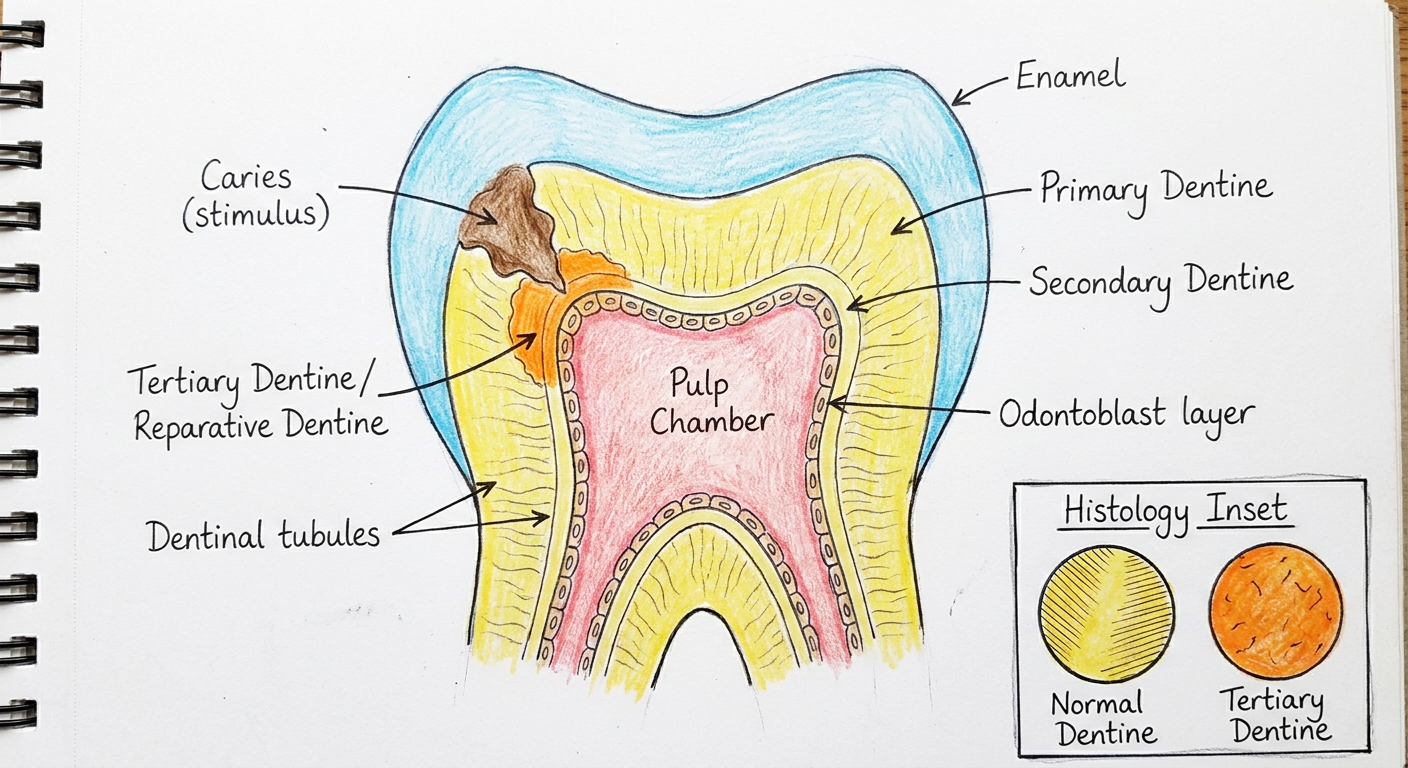
- Brown patch = Caries (the irritant/stimulus)
- Light blue = Enamel
- Yellow = Primary Dentine with dentinal tubules
- Orange patch = Tertiary/Reparative Dentine - localized only beneath the caries
- Pink/Red = Pulp chamber with odontoblast layer
- Inset = Histology comparison showing regular tubules (normal dentine) vs. few/absent tubules (tertiary dentine)
Give a short note on dentinal hypersensitivity. Give point-wise answer. Don't give too much long answer. Don't give too much short answer. Give appropriate, proper answer so that teacher should give me 3 on 3 marks.
Dentinal Hypersensitivity
- Gingival recession exposing root surface
- Attrition, abrasion (improper tooth brushing), erosion
- Periodontal treatment / scaling
- Loss of enamel due to caries or cavity preparation
- Dentinal tubules contain fluid.
- Any stimulus (cold, heat, air, touch) causes rapid movement of this fluid within the tubules.
- This fluid movement activates A-delta nerve fibers at the pulp-dentine junction.
- Result: sharp, short-duration pain.
- This is the most accepted theory of dentinal hypersensitivity.
- Sharp, short, well-localized pain
- Triggered by cold (most common), hot, sweet, sour, or tactile stimuli
- Pain disappears on removal of stimulus (unlike pulpitis)
- Tubule occluding agents - potassium oxalate, fluoride varnish, GIC
- Desensitizing toothpastes - containing potassium nitrate (reduces nerve excitability)
- Bonding agents / resin sealers - seal exposed dentinal tubules
- Treatment of cause - correcting brushing technique, treating erosion
Can I write the key point, instead of key point, can I write conclusion?
Can I write a key point instead of conclusion topic?