
Can you tell about pustular melanosis in neonates
Reading File
Now let me search the medical library and PubMed in parallel for pustular melanosis in neonates.
Finding Sources
Finding Sources
Searching PubMed
transient neonatal pustular melanosis
Excellent - multiple textbook sources found. Let me read them all in parallel.
Reading File
Reading File
Reading File
Reading File
Reading File
Let me now get the rest of the Dermatology 5e content and fetch the clinical images.
Reading File
Loading Image
I now have comprehensive information from multiple authoritative textbooks. Let me compile the full answer.
Transient Neonatal Pustular Melanosis (TNPM)
Also called transient pustular melanosis (TPM) or historically lentigines neonatorum (when first described in 1961), TNPM is a benign, self-limited, idiopathic pustular eruption unique to the newborn period.
Epidemiology
- Occurs in approximately 5% of newborns with darkly pigmented skin (skin types III-VI), versus less than 1% in lighter-skinned infants
- Most commonly affects full-term, Black neonates
- No sex predilection
- May be slightly more common after vaginal delivery than cesarean delivery
Pathogenesis
The pathogenesis is unknown. The eruption is considered idiopathic. There is speculation that TNPM may represent a variant of erythema toxicum neonatorum (ETN), given overlapping clinical and histologic features and reports of coexistence in the same patient - some authors use the umbrella term "sterile transient neonatal pustulosis" - but most experts regard TNPM and ETN as separate entities.
Clinical Features - The Three Morphologies
TNPM is distinctive because it presents with three different morphologies that can coexist or occur sequentially:
| Phase | Lesion | Timing |
|---|---|---|
| 1st | Superficial, 2-10 mm flaccid vesiculopustules on a non-erythematous base | Present at birth (or in utero) |
| 2nd | Slightly hyperpigmented macules with a fine collarette of scale at sites of ruptured pustules | Hours to days after birth |
| 3rd | Residual brown hyperpigmented macules (post-inflammatory) | Persist weeks to months |
Key points:
- Lesions are virtually always present at birth; the pustular phase may occasionally occur in utero, so only brown macules are visible at delivery
- Pustules resolve within 5-7 days; residual pigmented macules fade over several weeks to months
- Site predilection: forehead, chin, mandibular area, nape of neck, lower back, buttocks, shins - and less commonly the remainder of the face, trunk, palms, and soles
- The pustules are very fragile and may be wiped away during the first bath, going unnoticed
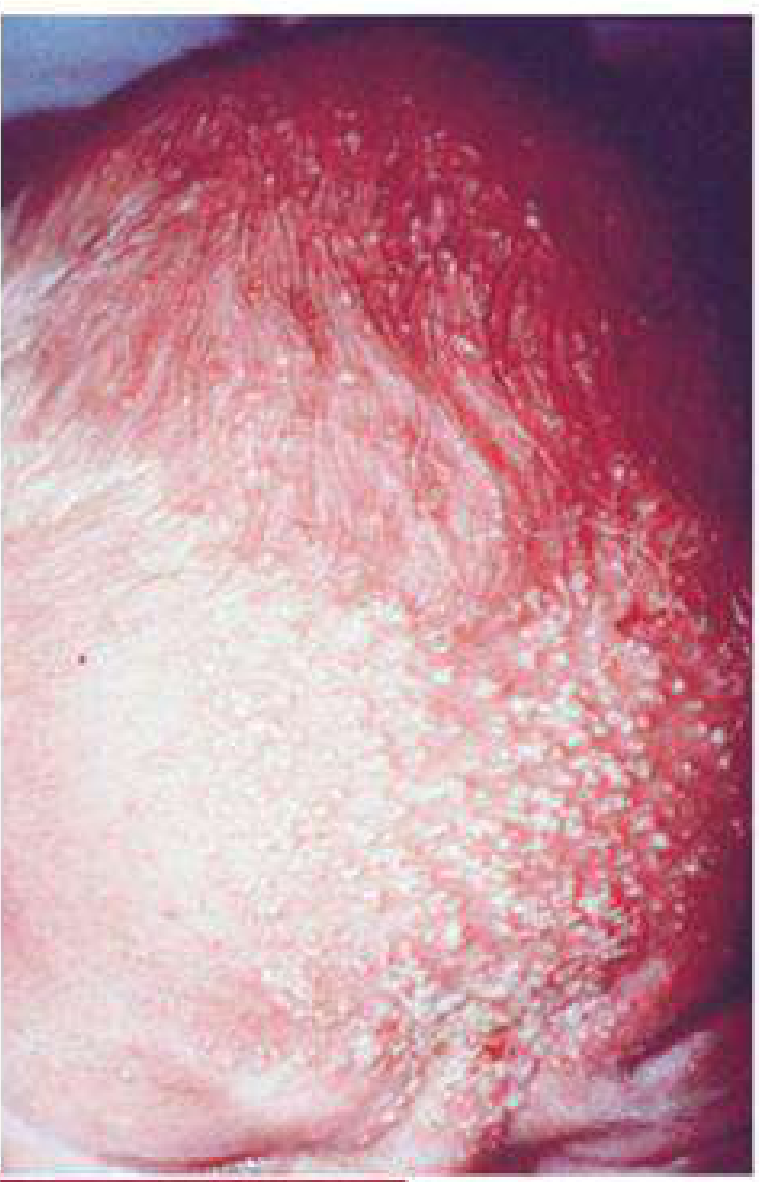
Clinical image: TNPM in a neonate showing the characteristic superficial pustules
Histology
- Intra- or subcorneal pustules containing predominantly neutrophils with occasional eosinophils
- The underlying dermis shows a mixed neutrophil/eosinophil infiltrate
- Residual pigmented macules show increased melanin within basal keratinocytes (post-inflammatory hyperpigmentation, not true lentigines - hence "lentigines" is a misnomer)
Diagnosis
The diagnosis is clinical in most cases. When in doubt:
- Wright-stained smear of pustule contents shows predominantly neutrophils with rare eosinophils
- This distinguishes TNPM from ETN, which shows mostly eosinophils
- Histologic biopsy is rarely needed
Any new pustules forming after birth should raise suspicion for another condition (see differential below).
Differential Diagnosis
| Condition | Key Distinguishing Feature |
|---|---|
| Erythema toxicum neonatorum | Erythematous base, eosinophils on smear, appears days 1-3 |
| Neonatal acne | Appears week 3, face-predominant, comedones |
| Miliaria crystallina | Clear vesicles, associated with heat/overswaddling |
| Staphylococcal pustulosis | Positive bacterial culture, may have systemic signs |
| Herpes simplex infection | Grouped vesicles, Tzanck smear positive, maternal history |
| Impetigo neonatorum | Culture-positive, honey-crusted, systemic involvement possible |
Treatment
No treatment is required. The condition is entirely benign and self-limited. Management is:
- Supportive care
- Parental reassurance - explain the 3-phase course and the fact that brown macules will fade spontaneously over weeks to months
- No topical or systemic therapy needed
Summary at a Glance
- Who: Full-term neonates, predominantly darker-skinned (Black infants most commonly)
- When: Present at birth; pustular phase resolves in 5-7 days
- What: 3 stages - pustules (non-erythematous base) → scaling macules → hyperpigmented macules
- Smear: Neutrophils (vs. ETN = eosinophils)
- Outcome: Fully self-limited; pigmentation fades over weeks-months
- Treatment: None; reassurance only
Sources: Andrews' Diseases of the Skin (12e), Dermatology 2-Volume Set (5e), Fitzpatrick's Dermatology, Tintinalli's Emergency Medicine, Harriet Lane Handbook (23e)
This is a shared conversation. Sign in to Orris to start your own chat.